Showing posts with label Animal cruelty. Show all posts

Thursday, April 22, 2010

Bits and Pieces

Mirriam Seddiq, at Not Guilty (a terrific blog I'll be adding to the list as soon as I update and which has the wonderful tag line "We are all not guilty of something. . .") has a great post about criminal defense lawyers being grizzlies whatever they look like on the surface.
Look at me, I'm so cute. Look, the panda is pregnant. Look, the panda is having twins! Look, the panda is staying home to raise her twins! She joined a playgroup! A multiples group! Look! Panda is um. . . what the. . what the fuck is happening to the Panda? Holy shit. That's no panda! That's a grizzly. RUN!! RUN!!!

I am scaring my new friends.
Damn right. But see, and here's the important thing. She's scary for a reason.
There are these people that prosecutors and some lay people (read: non-lawyers) call "True Believers" And true believers, dear 9 readers, are scary. Because they believe, truly, that everyone deserves not just a defense, but a kick ass defense. They believe that even when people do really bad things, someone needs to stand between them and the government. They believe in the Constitution and the Rule of Law.

Back in the olden days, when I was a baby lawyer and prosecutor, I didn't understand this phenomenon. I thought defense lawyers just did this cause it was their job, you know, like brick laying or working at Wendy's. They didn't really BELIEVE the stuff they said. They only said it cause they have to.

I will admit, sometimes you do an internal eye roll at some of the stuff your clients tell you, but the stuff I say, the stuff I write - I BELIEVE. Because if I don't, no one else will. And if I do, others will too.
Got that? We mean it. And we believe it. All of it. Not just that noble stuff about the Constitution and the Rule of Law and how sometimes are clients really didn't do it. But we believe it all.

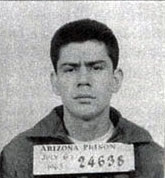
Consider this guy.


About 37 years ago, he was on trial for rape and kidnapping and armed robbery. He was represented by a lawyer named Alvin Moore. Moore stood up that Maricopa County courtroom (same Maricopa County, but before the era of Joe 'n' Andy) before the aptly name Judge McFate and said something like,
Your Honor. My client here may have confessed, but the local police didn't tell him that he didn't have to. They didn't say he had a right to remain silent. They didn't say he had a right to speak to a lawyer. And so, your honor, even though it says on his written confession that it was voluntary, it wasn't. His rights were violated. And you should throw out the confession of my client, Ernesto Miranda.
McFate, to what I expect was nobody's surprise, overruled Moore's motion. I don't know what the judge said, exactly, but I've always imagined the ruling was accompanied by suppressed giggles or eye-rolling or anger.

Here's the thing, and it's what Mirriam says so well. We believe this shit. Even when we're just starting it. Even when nobody's ever said it before or sold it before. Even when it seems frankly outrageous. We believe it because, as she says, if we don't believe it, we can't sell it. But we believe it, too, because dammit, we're right. It should be the law. And if we keep at it . . . .

*********

On Tuesday, as you know, in United States v. Stevens, SCOTUS declined to carve an exception out of the First Amendment so that visual depictions of animal cruelty could be criminalized. The animal rights folks are deeply disappointed, of course, when they're not apoplectic.*

Still, when Kent Scheidegger and I both agree that a law is unconstitutional, there's some likelihood that we're right. Of course, Kent would like to see a constitutional version of the law, but hey, this is closer than we've ever been. (Far less surprisingly, Bill Otis thinks Alito was right.)

*********

A couple of weeks ago, Brian Tannebaum began a campaign to convince Obama that Scott Greenfield was the man to replace Stevens (not the dog-fighting video Stevens, the Supreme Court Justice Stevens) on the Supreme Court.

I thought there wasn't a chance, but lent my endorsement in a comment. Greenfield wrongly thought the endorsement reluctant. Rather I was recognizing it as futile. (A judge once asked me to serve on his re-election campaign committee. I suggested it might hurt his chances. He said that he'd debated it with others on the committee and they'd concluded that on balance I'd get them 2 or 3 more votes than I'd cost them.) In any event, turns out Scott didn't get the call.

The short straw went, instead, to the darkest of dark horses: Gerry Darrow. We can all be proud. Truly, this is Change We Can Believe In. A lawyer of the people, from the people.

Well played, Barak. Well played.

Oh, you mean it isn't true? Damn.

Back to Greenfield for the court.


-------------------
Here's one commenter from the Cleveland Plain Dealer:
The Supreme Court is a joke. I cannot believe this. They think that torturing animals, videotaping it for bragging rights, and distributing the immoral activity all over the internet is FREE SPEECH!!!! OMG. Our country is just doomed. We are doomed. I cannot believe this. They are certainly no longer a high authority. They are immoral non-humans in black robes.


Tuesday, April 20, 2010

One Right - One Wrong

SCOTUS taketh away and it giveth.

I talked about the taketh away part earlier today, a couple of hours before they killed Darryl Durr. The Supremes denied three petitions for writ of certiorari and three motions for stay. I won't go there again - at least not today.

But this morning at 10, just as Ohio started to murder my client - having been given permission by the Supremes (OK, I won't go there much more today), the Supremes issued their long-awaited opinion in United States v. Stevens, the case that's been decisional before them longest, having been argued back on October 6.

Here's what I said about the case back in September.
As Adam Liptak puts it in the Times, the question is
whether the court should for the first time in a generation designate a category of expression as so vile that it deserves no protection under the First Amendment.
The category is depictions of violence against animals. Specifically, Stevens was charged with and convicted of three counts of violating a federal law criminalizing depictions of animal cruelty by selling videotapes containing footage of dog fighting. You know, what Michael Vick was convicted of actually participating in.

The law itself has a curious pedigree. It was originally intended to address what are known as "crush" videos, films designed to satisfy the sexual fetish of liking to see small animals crushed to death - particularly by women wearing stiletto heels. By the time congress got done tinkering with it, it was a lot bigger than that.
Oral argument was fractious with discussion of such things as an execution channel on television.

Now we have the decision. By a vote of 8 to Alito, the Court did the right thing. It refused to carve out a new exception to the First Amendment. And it refused to trust the government. Wisely, of course. As I noted back in September,
When Clinton signed [the law], he explained that it would only be enforced against crush videos. The problem with such Presidential assurances, of course, and even if they're honest assurances, is that Presidents come and go. And with the change in administration, there came the change in enforcement. Hence, the police to Mr. Stevens' door.
Roberts wrote the
opinion. Here's the money quote:
Not to worry, the Government says: The ExecutiveBranch construes §48 to reach only “extreme” cruelty, Brief for United States 8, and it “neither has brought nor will bring a prosecution for anything less,” Reply Brief 6–7. The Government hits this theme hard, invoking its prosecutorial discretion several times. See id., at 6–7, 10, and n. 6, 19, 22. But the First Amendment protects against the Government; it does not leave us at the mercy of noblesse oblige. We would not uphold an unconstitutional statute merely because the Government promised to use it responsibly. Cf. Whitman v. American Trucking Assns., Inc., 531 U. S. 457, 473 (2001).
It's that line about noblesse oblige that should be put on placards.

Saturday, September 19, 2009

"No law" means no law.

Now that Romell Broom has a stay, I can talk about something else for a day.

The First Amendment says,
Congress shall make no law respecting an establishment of religion, or prohibiting the free exercise thereof; or abridging the freedom of speech, or of the press; or the right of the people peaceably to assemble, and to petition the Government for a redress of grievances.
Justice Black understood the free speech and press part of that literally. "No law," he famously and repeatedly said, "means no law."

But even he didn't really mean it, and nobody else much does, either. Justice Holmes' comment in Schenck v. United States gets at the heart of the problem.
The most stringent protection of free speech would not protect a man falsely shouting fire in a theater and causing a panic.
Holmes didn't add intent into the formulation (i.e., "falsely shouting fire in a theater with the intention of causing a fire") which is a serious mistake, but he was getting, accurately, at something fundamental about how the First Amendment works. It extends just to the point where we get to nervous to extend it any further.

So in 1798, just seven years after the First Amendment was adopted, Congress enacted and President Adams both signed and used against members of Jefferson's party the Sedition Act criminalizing much criticism of the government. We think of that as a relic of the past, but it's not that long ago that the Supreme Court first decided, in New York Times v. Sullivan, that criticizing a government official does not, ordinarily, subject the critic to liability for defamation.

In fact, there are whole categories of speech that, according to the Supreme Court, have no protection under the First Amendment. As the Court explained in Chaplinsky v. New Hampshire,
There are certain well-defined and narrowly limited classes of speech, the prevention and punishment of which has never been thought to raise any Constitutional problem. These include the lewd and obscene, the profane, the libelous, and the insulting or 'fighting' words-those which by their very utterance inflict injury or tend to incite an immediate breach of the peace.
The list of categories is subject to expansion. In 1982, the Court added child pornography in New York v. Ferber. And now, in United States v. Stevens to be argued on October 6, the Court will hear argument over another category. As Adam Liptak puts it in the Times, the question is
whether the court should for the first time in a generation designate a category of expression as so vile that it deserves no protection under the First Amendment.
The category is depictions of violence against animals. Specifically, Stevens was charged with and convicted of three counts of violating a federal law criminalizing depictions of animal cruelty by selling videotapes containing footage of dog fighting. You know, what Michael Vick was convicted of actually participating in.

The law itself has a curious pedigree. It was originally intended to address what are known as "crush" videos, films designed to satisfy the sexual fetish of liking to see small animals crushed to death - particularly by women wearing stiletto heels. By the time congress got done tinkering with it, it was a lot bigger than that.

When Clinton signed it, he explained that it would only be enforced against crush videos. The problem with such Presidential assurances, of course, and even if they're honest assurances, is that Presidents come and go. And with the change in administration, there came the change in enforcement. Hence, the police to Mr. Stevens' door.

Now, dog fighting is illegal in all 50 states, but nobody's accused Stevens of engaging in or organizing any dog fights, just of selling videos - including some scenes shot in Japan where the, er, sport is legal. Still, and maybe this will seem relevant to you and maybe not, Vick got 23 months, Stevens was sentenced to serve 37.

In any event the Third Circuit threw out the law, and Stevens' conviction with it.

Regardless of how noble Congress's motives, the court said, it simply would not carve out from protected speech a new category for depictions of animal cruelty.

An Ohio judge once told me that the legislature (he was referring to the Ohio General Assembly, but could as easily have been speaking of Congress) should never get involved in criminal law. "They just fuck it up," he said.

Case closed.