Showing posts with label Constitutional interpretation. Show all posts

Friday, September 29, 2017

Selling a Cramped Originalism

I make my living in the courts.  My job (and yes, I'm oversimplifying like crazy; live with it) is convincing judges* that they should do what I want them to do, decide the way I want them to decide.  Doesn't matter if I'm right.  What matters is that I win.

The best, most logical argument in the world ain't worth shit if the judge doesn't buy it.  Arrant nonsense that the judge accepts?  BINGO! 

It's a real world business this lawyering thing.  And so, and I know this will make some lawprofs cry, day-to-day and case-by-case I don't really care how we should understand/interpret/analyze/whatever the Constitution.  

In the scheme of things, though, it matters.  A constitutional republic (and pretty much everyone agrees that's what we have) can take many forms, even framed by the broad outline of our Constitution.  The republic Clarence Thomas thinks we have (or ought to have if we understood and applied the Constitution properly - i.e., as he does) is a very different place than the one that, say, Stephen Breyer imagines.  And neither looks all that much like . . . well, maybe like yours.

Which brings me to Ilan Wurman's mistitled A Debt Against the Living: An Introduction to Originalism.**  Mistitled because it's not an introduction at all it's an argument.  

Wurman isn't interested in explaining how originalism actually operates.  He doesn't say what it looks like in practice.  There's no particular vision of the republic here beyond the claim that an originalist republic would have a lot smaller federal government than ours.  

Instead of an introduction to originalism, Wurman's is an argument for originalism.  The book, he says, 
aims to arm the reader with basic arguments about the legitimacy of Constitution and our Founding, and to explain the relevance of these arguments to modern debates over constitutional interpretation.  It argues that the Constitution does form a debt against us - against the living generation - that compels us to continue to obey and abide by it today. It then argues that originalism, the idea that the Constitution should be interpreted as it was originally understood by the Framers who wrote it and the public that ratified it, is the only method of constitutional interpretation that faithfully discharges this debt.
Maybe.  But before I get to the carping, let me lay it out.  It works, roughly, like this.

First, there's what's virtually a given for Wurman:  Of course we should understand the Constitution as it was understood by those who wrote and ratified it.  Any other approach is understanding a lie. After all, when the Constitution says that the President must be at least 35 years old, if we think 40 is better and treat 40 as the rule . . . .  (That's not his example; his example involves fried chicken seasoned with "pepper to taste" but a preference for rosemary.)  

Well, sure.  But that's not a different way of reading or applying the Constitution.  That's rejecting the Constitution.  It's not the originalist's bogeyman of the "living Constitution."  It's just a new rule with no pretense to being an understanding or interpretation or even application of the Constitution.  And while there are certainly those who'd chuck out the Constitution we have in favor of whatever, they aren't the plausible opposition.

Everyone who matters in this debate believes in the Constitution.  The disagreement is in how to apply it.  Wurman's claim is that we should apply the "original public meaning," how it was understood at the time.  Not particularly by the folks who wrote it.  And not by the folks who adopted it.  But by . . . well, by the public (whoever they are).  And we can know how the public understood it by studying what Madison said in the Federalist Papers (not so much what Hamilton said, perhaps because he understood the Constitution differently than Madison).  And also by looking at what prominent folks thought it meant.  

All of which strikes me as . . . .  Well, Brennan spoke of the hubris of imagining that we can tell how the Framers would have viewed issues arising today that were beyond possibility in 1781.  And others have pointed out that Judges and Justices (and lawyers for godssake) are not historians.  But of course that doesn't mean they shouldn't try or that they can't come close.

So sure, Wurman says, we apply the Constitution as it was understood from the get go because that's what we do.  Not particularly satisfying, but there it is.

And now that we know how to interpret the Constitution, the question is whether we should bother. And of course we should.  Because "We the people" (or at least the white male property owners) adopted it.  And because it's a good thing - despite all the ways it's a bad thing.  And because, well, sure.  Which is about as non-controversial as it gets except for those folks who'd just toss it aside - and really, that's not who Wurman's talking to - or even who I am.

OK, so originalism is good and the Constitution is good.  And other approaches, hey they're malleable.  This week's flavor may not be next weeks.  They're just preferences and politics.  Which isn't nonsense, but Wurman blows the other folks off pretty quickly.

In any event, having now convinced you (Wurman seems to think), the only real question is whether originalism supports Brown v. Board of Education.  If originalism would accept separate but equal schools, then even if it's the only proper way to read the Constitution, it should be abandoned.  Shockingly, Wurman think originalism and Brown are a match made in heaven.  And he explains why.  Maybe you buy it, maybe you don't.  Most originalists do, he says, though he acknowledges that some don't. And, although he doesn't say it, I take it that the folks who don't, since they're originalists, also don't think the Brown test is all that significant.

The problem with Wurman's originalism is that it's cramped.***  Because it was to be a government of limited powers, if it isn't explicitly allowed, it must be forbidden.  (Except, of course, when he wants to stretch a point to get a result he wants - which he is mostly how he gets to originalism endorsing Brown.)  

But there's another way that, if the term weren't taken, you could also call originalism.  Ask what's the Constitution trying to achieve.  How, within its scope and framework, understanding it's lexical terms broadly rather than narrowly, do we get there?

Consider the Fourth Amendment: 
The right of the people to be secure in their persons, houses, papers, and effects, against unreasonable searches and seizures, shall not be violated, and no Warrants shall issue, but upon probable cause, supported by Oath or affirmation, and particularly describing the place to be searched, and the persons or things to be seized.
And I get it that the Constitution doesn't say anything about an exclusionary rule for violations.  Wurman says that, therefore, originalist understanding would abolish the exclusionary rule.  But the exclusionary rule exists because without it the Fourth Amendment is no more than aspirational (we're remarkably close to that these days, but that's a different post).  If the Amendment is to be effected, the rule is a necessity.  So it's not part of the document and pretty clearly it wasn't part of the "original public understanding."  But effecting the Fourth Amendment requires it.  Which seems to me, but not to Wurman, the right test.

A Debt Against the Living is short.  It's mostly lucid.  You don't have to be a scholar, not even a lawyer I don't think, to get his argument.  But it's glib.  Too often trimming a bush  and declaring the forest cleared.  

On the other hand, based on the blurbs from some respectable and prominent originalists who seem to think the book brilliant, maybe the problem is that I'm not sufficiently of the choir to which he's preaching.
 
-----------------
*Juries, too, but less often and in any case they aren't relevant to where I'm going with this.
**The title is taken from a letter James Madison wrote to Thomas Jefferson.
***Wurman acknowledges that there's a strain of originalism that reads the Constitution more broadly than he does.  Having acknowledged the fact, he then pretty much ignores it.
------------
My thanks to Cambridge University Press for sending me a copy to review.

Tuesday, December 9, 2014

The Rule of Nine in a Supreme Year

No doubt it seemed a clever idea.  Focus on a single term of the Supreme Court to illuminate how it operates, what its individual and collective constitutional understanding currently indicates about some of the more controversial issues of the day, and how each of the nine justices interprets and applies the Constitution.

Or perhaps the seemingly clever idea was to focus on each of the nine justices interprets and applies the Constitution in order to illuminate what their individual an collective views indicate about some of the more important issues of the day and how the Court operates.

Or perhaps the seemingly clever idea was to focus on one opinion by each of the nine justices, some majority opinions, some dissents to illuminate . . . .

You begin, perhaps, to understand both the virtues and the problems of American Justice 2014: Nine Clashing Visions on the Supreme Court, the new book by Garrett Epps.

Epps is a lawprof with a focus on constitutional law.  He's also a credentialed reporter at the Court who writes regularly for The Atlantic.  It's not a bad combination for a book like this that "tries to give [his] sense one year in the life of the Supreme Court."  That year is the October Term 2013, the term that technically ended at the end of September this year but as a practical matter ended in June with the decision holding that Hobby Lobby would not have to provide birth control in the insurance packages it offered its employees no matter what the Affordable Care Act says.  (And if you come to this blog for my take on Hobby Lobby, you're going to be seriously disappointed.)

As a project, the one Epps set himself isn't bad.  Even though it's no more than a fragment, a moment in time necessarily limited in scope, you can learn a lot from a snapshot taken by a good photographer.  The snapshot provides focus, an opportunity to see and study one thing with care. When it's also well curated, you get context.  

There are, of course, many ways to take that picture of the 2013 Term.  You could look at the data.  How many cases?  What were the votes and who voted with whom most (or least) often?.  Who wrote concurrences and dissents and who just signed on to what someone else did?  You could ask what kinds of cases the Court chose to decide.  Business?  Criminal?  Were the successful petitioners individuals or businesses or government agencies or non-profits?  You could look into which courts got affirmed and which got reversed?  (Hint:  If the case comes from the 6th or 9th Circuit, it's almost certainly going to get reversed.)

Or you could pick, seemingly at random, a single opinion written by each justice and use it to try and reveal something about the justice and the Court as a whole.  Which is what Epps does.  And therein . . . .

Well, like I said, you can sort of see where this is going to go.

Consider the Clarence Thomas chapter.  Thomas is an interesting character.  A conservative African-American, he's deeply hostile to the affirmative action that worked to his advantage and, frankly, secured him a seat on the Court.  His confirmation hearings at the Senate Judiciary Committee were riveting television as he was accused by Anita Hill of graphic sexual harassment.  Epps summarizes.
Hill told the panel that her boss had harassed her in the rawest possible terms, pressured her to view pornography, discussed his own genitalia and sexual prowess, and asked her repeatedly for sex. Supporters of Thomas fought back with a furious attack on Hill's truthfulness and sanity, while Thomas branded the committee's hearing "a high-tech lynching for uppity blacks."
Yowzah.

There's much of interest in Thomas, including his backstory.  And there's the curious fact that he simply doesn't speak at the Court.  It's been, quite literally, years since he's asked a question at oral argument.  Some say that indicates that he's just blowing it off.  Epps says he's deeply engaged, which you can tell because he sometimes whispers comments to Stephen Breyer while "grinning broadly."  Hmmm.

Mainly, though, there's his jurisprudence.  He views the law in rigid, cramped terms.  And he's "notoriously unwilling to compromise his own views in order to win over his colleagues."  So he frequently concurs or dissents by himself.  Moreover, he's often not particularly "interested in the narrow issue actually presented by facts of cases," looking instead to find a broader rule he can write or a precedent he can overrule.  Which is interesting.  And raises the question of why Epps chose to have the Thomas chapter nominally be about his narrow opinion for a unanimous Court in Susan B. Anthony List v. Driehaus.

Or take Chief Justice Roberts.  Epps explains that it's obvious to anyone who pays attention that "he was quite sincere in his wish for greater unanimity, greater judicial modesty, and a widely repected Supreme Court quietly calling 'balls and strikes.'"  That quote is from page 19.  On page 22, just three pages later, Epps notes that Roberts' encomia "to Rehnquist and Reagan cut against the promise of humility."  

The case Epps chooses for Roberts?  It's McCutcheon v. Federal Election Commission, in which he "brushes aside" precedent and offers, at "the heart of the opinion," a "view of democracy" that is, at least as far as its logic goes, "demonstrably false."

Here's the thing.  Epps likes the so-called liberals on the Court, none more than Ruth Bader Ginsburg, and he has no particular affection for the conservatives.  While disavowing any prediction for the future, he brands this (not quite with disdain) the "Alito Court" and identifies it as one that adores and supports the rich and powerful while eagerly repressing the poor and powerless.  That's fine (and not altogether wrong). And really, there's much to be said for a book with a point of view.

American Justice 2014 is published by the University of Pennsylvania Press, but don't let that fool you.  It's not an academic book, nor is it for specialists.  But the generalist, the gal who's got an interest in how the Court operates, the guy who wants to know the players? This is for them.
  

--------------
My thanks to the Penn Press for sending me a review copy of the book.

Monday, September 15, 2014

Of Course, It's More Complicated Than That

Judge Kopf began with Digby.  Digby'd staked out the remarkably stupid position that since Nino didn't think the Constitution prohibited the execution of the factually innocent, and didn't think that it was immoral to hold that position, he therefore thought it was just fine that they should be killed.  As the tagline to her piece says,
He doesn't think executing an innocent man matters.
Of course, he never said any such thing.  He has said that the likelihood of it is vanishingly small (the phrasing is mine, not his).  And he has acknowledged that, at least as a theoretical matter it's at least a possibility if we have a death penalty, which he thinks we should have.  But that he thinks it's OK? No, he's never said that.  And it doesn't follow.

Nor, when explaining that lethal injection is a kinder death than Sabrina Buie suffered at the hands of Henry Lee McCollum and Leon Brown and that their execution would not, therefore, offend his sensibility, did he add, as Digby seems to think he meant, that he favored their execution even though they were innocent which would be revealed with their exoneration 20 years in the future.

So Judge Kopf rightly took Digby to task. 

But because he's a thoughtful guy, the Judge wrote another post exploring his own views about judging and about factual innocence.  
Except as noted in the following three paragraphs, I do not know what I would do if I were confronted with a case where the petitioner was factually innocent of murder and I knew that the petitioner was factually innocent of murder but there was no federal legal remedy available to stop the execution. However, I do know this: I would move heaven and earth to stop the execution, but I would not play games with the law to do so.
There followed, of course, those paragraphs.  Which carried within them, as does the introduction to them I just quoted, their own caveats and qualifiers, but at bottom said that there are circumstances under which he, as a judge, would not act to prevent the execution of a person he "knew" was factually innocent.  The law, he said.  Justice, he said, making clear that justice was different from morality.   Mine were among the so-far 95 comments.  Then I did a blog post.  In my typical discursive and round-about way, I talked about guilt and innocence and democracy and juries and Watergate and . . . . Hell, read it yourself it you're so inclined.  Or don't.

This morning, Scott Greenfield weighed in with a pair of posts:  If There Was No Other Way, Part 1 and If There Was No Other Way, Part 2.  Part 1 was an attempt to explain Judge Kopf's position. Part 2 was a response.  Pared of its explanatory framework, Scott's basic point is that whatever we might like to believe, our systems are far too fucked up to allow any executions - let alone the execution of the innocent.
We work in terrible trenches, even if the stench is removed with the perfume of an appellate decision. Nothing we do happens well enough to satisfy due process, law or the thoughtful concerns of a knowledgeable electorate. The law doesn’t happen well enough to make it just to execute anyone, no less a person known to be innocent.
All of us who labor in the trenches are unworthy of that level of respect, that the product of our labors is sufficiently sound that it justifies the taking of a human life. To believe otherwise is unbounded hubris. We may do so by relying on the platitudes of the law, but we are only fooling ourselves. There is nothing we do so well in the name of justice that the killing of an innocent person can be excused.
Which history is the immediate background to this. There is, though, a longer background.  One that reaches back to 1791 when the 5th and 8th Amendments became part of the Constitution.  First the 5th.
No person shall be held to answer for a capital, or otherwise infamous crime, unless on a presentment or indictment of a grand jury, except in cases arising in the land or naval forces, or in the militia, when in actual service in time of war or public danger; nor shall any person be subject for the same offense to be twice put in jeopardy of life or limb; nor shall be compelled in any criminal case to be a witness against himself, nor be deprived of life, liberty, or property, without due process of law; nor shall private property be taken for public use, without just compensation.
It's clear that the 5th Amendment accepts the prospect of executions. It says that with certain exceptions prosecution for capital crimes requires indictment by a grand jury.  The fact that a procedure for beginning capital prosecutions is set out makes clear that the Constitution in its own terms does not prohibit them.  Moreover, the amendment says that nobody can be "deprived of life . . . without due process of law."  Spin that however you like.  It says that before they can kill you, they have to give you due process.  If they do . . . .

That was Scalia's point.  The Constitution says that there can be no execution without due process. It must be, therefore, that the Constitution allows executions with due process.  Not that it mandates executions.  Not that it says executions are moral or right or even desirable.  Just that as long as there's due process, the Constitution doesn't prohibit them.

But there's also the 8th Amendment.
Excessive bail shall not be required, nor excessive fines imposed, nor cruel and unusual punishments inflicted.
On its face, that says nothing about the death penalty.  Nothing about executions.  Yet for the last 42 years, since Furman in 1972 when the Supremes said every death penalty law in the country violated the 8th Amendment (even if the death penalty as such did not), it's been 8th Amendment jurisprudence that defines it.  When it's arbitrary, when it's applied to the insane, when it's applied to the intellectually disabled, when it's applied to kids, when it's applied without full individualized consideration, when . . . . Why then it's cruel and unusual.  

But otherwise?  During his confirmation hearings, Stephen Breyer was asked about the death penalty. It is, he said correctly, settled that at least in the abstract it does not violate the 8th Amendment.  And then he went on to something else.

The 5th Amendment?  Meh.

Now, you might argue that killing the factually innocent is cruel and unusual, too.  But we've yet to find 5 Justices at one time who've said that.  Might we?  Today?  If the absolute question was called?

I suspect the answer is yes.  5-4 with Kennedy joining the moderate statists who commentators and the media have come to call liberals.  I also suspect the 9 of them will go through gyrations to avoid ever having to answer that question explicitly.

But there's another way of getting there.  That business of taking life only when there's due process begs the underlying question of all procedural due process cases.  The Court laid it out in Morrissey v. Brewer, a 1972 case involving parole revocation.
Once it is determined that due process applies, the question remains what process is due. It has been said so often by this Court and others as not to require citation of authority that due process is flexible and calls for such procedural protections as the particular situation demands. "[C]onsideration of what procedures due process may require under any given set of circumstances must begin with a determination of the precise nature of the government function involved as well as of the private interest that has been affected by governmental action."
To say that the concept of due process is flexible does not mean that judges are at large to apply it to any and all relationships. Its flexibility is in its scope once it has been determined that some process is due; it is a recognition that not all situations calling for procedural safeguards call for the same kind of procedure.
(Citation omitted, paragraph break added.)

The Court has suggested from time to time, and some think they mean it, that in death penalty cases, precisely because of the "private interest that has been affected by governmental action," the Constitution requires some sort of "super due process."  And if the person is factually innocent? 

Well, can there ever be enough process to justify the execution?

One more time.  I'm unalterably opposed to the death penalty in all circumstances.  It's bad policy, bad politics, unavoidably arbitrary and capricious.  Given the realities of our world, it's necessarily racist and classist.  It doesn't achieve it's purported ends.  And we're not capable of properly choosing its victims nor, it seems, of killing them as we insist we must:  Kindly, gently, lovingly, and in ways that disguise the fact of cold-blooded murder.  It makes us all worse.  And it's immoral.

And yet there it is.  Just waiting for some judge to answer the question of "What process is due" with an honest, 
More than we have available to give.

Friday, August 29, 2014

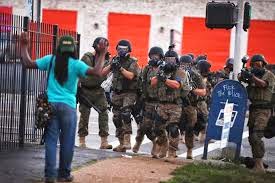
Ferguson and Spokeo

Rejecting the notion, floated by some so-called "progressives" and members of the Congressional Black Caucus that we need a Police Czar to prevent what happened to Michael Brown.  Or maybe what happened afterwards.  You know, to make the police friendly (just as the [war on] Drug Czar did such a fine job making the drug war genial and the Homeland Security Czar made TSA screenings warm and fuzzy and the Russian Czar made A FUCKING REVOLUTION), Scott Greenfield suggests that we already have the tools in place to reign in the police war on the citizenry.
But there is nothing sought for which there isn’t someone already responsible. The DoJ has an office of civil rights. The DoD doles out surplus military equipment under its 1033 program. You’ve got people paid to lead the police, oversee the police, fix the police, stop the police, then you can shake a stick at. And it’s amounted to a group of overarmed, undercaring, people with the power to subjugate upon command. So the answer is let’s add another layer with a cool Russian title?
Is there something progressive about the men and women we elected to national office, sometimes referred to as members of Congress, getting a free pass on their responsibilities? Or perhaps a Chief Executive who might use the fiat of his office to satisfy the needs of the citizenry. If only he had an Attorney General (which, If it makes people feel better, could be renamed to Attorney Czar) who was charged with seeing that the Constitution was honored by all who hoped to receive a government pension some day?
There is nothing here, nothing called for, that can’t be accomplished by the people already in place. They have the power and authority to control law enforcement. 
Don't hold your breath.

It is, after all, those elected officials (and the ones appointed by them and confirmed by them) who enthusiastically created this mess.  it is they who enthusiastically promoted the movement from 
 to

Oops.  Sorry.  Meant this

Of course, there are also the courts.  They, as Scott added, are the backup.
And to the extent some slimy bastards sneak through, we then have judges to fix their wagon.
Well, not so much.  As Erwin Chemerinsky pointed out in a Times Op Ed the other day, various sorts of Court-created immunity protect government and cops from being sued.  You have to make them pay, but the courts insist that we can't allow that.  Oh, sure we have the right not to have our rights violated. But nobody gives a rat's ass about that.

What some people do care about is a broader effort to shut the courthouse doors to people who've been wronged.  What makes it easy, and what purportedly justifies it, is how the Supremes have dealt with the provision of Article III of the Constitution (specifically, the first paragraph of Section 2 of Article III) that sets out the jurisdiction of the federal courts.
The judicial Power shall extend to all Cases, in Law and Equity, arising under this Constitution, the Laws of the United States, and Treaties made, or which shall be made, under their Authority;—to all Cases affecting Ambassadors, other public Ministers and Consuls;—to all Cases of admiralty and maritime Jurisdiction;—to Controversies to which the United States shall be a Party;—to Controversies between two or more States;— between a State and Citizens of another State,—between Citizens of different States,—between Citizens of the same State claiming Lands under Grants of different States, and between a State, or the Citizens thereof, and foreign States, Citizens or Subjects.
Which brings me to Spokeo.  That's Spokeo v. Robins, a case that the Supremes have been asked to hear this year.  

Spokeo asks the question of whether Congress has the authority to give people the right to go into federal courts and sue because their rights have been violated.  Technically the issue is much narrower than that, but the broad brush is suitable here.

This is the problem.  The Court has long held that those "Cases, in Law and Equity" coming from the Constitution, laws, and treaties, are only ones where somebody has suffered a specific and personal concrete injury.  Out some money, you can sue.  Be physically harmed, you can sue.  Just be pissed because your constitutional rights are being violated but not in any personal, concrete way - you haven't lost anything except a bit of your guaranteed freedom?  Nope.  Sorry.  The courts won't fix that.

As the Supremes said, back in 1979 (citation omitted, Rehnquist and Stewart dissented from the Court's decision, but pretty clearly not from what I'm quoting), explaining what that limitation to cases meant
In no event, however, may Congress abrogate the Art. III minima: A plaintiff must always have suffered "a distinct and palpable injury to himself" that is likely to be redressed if the requested relief is granted.
Why, if we actually said the courts were there to protect rights generally, to hold the government accountable for violating the Constitution?  It would surely be the end of the Republic.

Or not.

So Congress passed the Fair Credit Reporting Act and said that credit reporting agencies could be sued for willfully getting the information they reported wrong even if the person whose info was misreported hadn't suffered any actual harm from it.  (I'm oversimplifying like crazy.  Live with it.)  Spokeo said that Robins was better educated than he was, had more experience than he does, is married though he is not, and was better off financially than he is.  Robins sued for what he called a willful violation of the Act's requirements.  (Spokeo denies that it violated the Act, but that's irrelevant here.)  Ultimately, the 9th District said Robins could sue because he had an "injury in law" even if not an "injury in fact," and Congress said in the Fair Credit Reporting Act that an injury in law was enough.

Sorry for the arcana, but there was no other way.

So the question the Court can now answer if it's so inclined (the Court is set to consider whether actually to hear Spokeo at it's "long conference" on September 29) is whether there are circumstances when you can sue even if you haven't been hurt except that some right has been violated.  If the Court says yes (and I'm not putting good money on that), it's not only a victory for Robins and many other litigants, it's also a crack in the machinery that keeps the courthouse doors locked.

And once the doors are open even a little bit, then we can try to drive the trucks through.

The rules for closing the courthouse to people like Robins are supposedly based on the actual language of the Constitution.  The rules that say that cops are mostly immune to suit, that prosecutors are absolutely immune, that government is mostly immune, those rules have no grounding in the Constitution at all.  They were made up because the Divine Right of Kings and besides, if prosecutors and cops can be sued for riding roughshod over the innocent and guilty alike, they might exercise restraint - and then where would we be.

None of that would do much to hold Ferguson or Officer Wilson liable for what happened to Michael Brown.  And it doesn't directly address
But it'd be a start.


Sunday, July 20, 2014

It's Complicated. And the Law of Rule

Like Judge Kopf, I was sent a copy of Uncertain Justice: The Roberts Court and the Constitution by a publicist at Henry Holt & Company in the hope that I would review it.  And like Judge Kopf, but without the initial internal debate about whether I should accept the book and consider reviewing it (I
had no hesitation at all), I did.  

Here's the basic idea:  The 9 folks who sit on the Supreme Court are all individuals.  While it's easy to say that Ginsburg, Kagan, Sotomayor, and Breyer are generally on the liberal side of things while the others are generally conservative, that's misleading.  They all shift sides at least occasionally, have their own perspectives, interpret the Constitution in their own distinct (yet overlapping ways).  Tribe and Matz lay it out in their Prologue (footnotes omitted).
Of course, an effort to understand the Roberts Court—much like an effort to understand the Court at any point in history—must reckon with more than just its results. The Court issues opinions in which the justices grapple with fundamental principles, argue over what the Constitution means and what role they should play in giving it life, and offer signals of where they are heading. These opinions open a window into the justices’ hearts and minds, giving us a glimpse of how they view the world. In many cases, the justices’ decisions, as well as their concurrences and dissents, also exert a magnetic pull on American life, both in their practical effects and through their bold interventions in our discourse. When Justice Sandra Day O’Connor warned that “a state of war is not a blank check for the President,” and when Roberts condemned the “sordid business” of “divvying us up by race,” they spoke to the public about constitutional values in ways that can’t simply be reduced to how they voted in those cases.
. . .
To that end, we do not adopt a standard convention in books about the Court: the “deep explanation.” We do not point to a strong left/right split, a partisan realignment, or a dispute over legal method and then argue that the life of the Court really boils down to that story. We do not claim that the Roberts Court is ultimately about a fight between “activism” and “judicial restraint,” both of which are largely useless terms (all justices are “activists” in certain areas of constitutional law). We do not pick one or two justices and insist that their agendas or struggles fundamentally define the Court. Nor do we distill the Court down to “liberals” and “conservatives,” explaining cases as the result of ideological blocs and agonizing over one or more inscrutable “swing voters.”
There is, of course, much to be said for these approaches to the Court. Executed well, each can reveal important patterns, draw out the underappreciated influence of a particular justice or idea, and identify overall coherence or contradiction in the Court’s undertakings. Yet writing about the Court is not like examining the physical universe. Whereas scientists can at least strive for perfection in their models, only a madman or a fool would ever claim to have fully explained the Court. At times, this realization can inspire an intense frustration: scholars of the Court inevitably feel as if they are trying to nail jelly to the wall, to borrow an apt phrase from Teddy Roosevelt. In the end, though, accepting this limitation is liberating. It points the way toward a more ecumenical mind-set that can shed valuable light on the Court by approaching it from many angles at once.
Focusing their attention on 9 subjects (Equality, health care, campaign finance, free speech, gun rights, presidential power, privacy, trading rights, access to the courts), Tribe and Matz parse Court opinions, concurrences, and dissents.  They explain how each of the justices applies his or her approach to the Constitution in this or that case.  They explain how all these are "hard" cases because there are competing interests involved.  That's so, and the cases are hard, even on the rare occasions when the cases - I'm talking here about the ones they discuss - result in complete agreement and no recognition that there are interests at stake other than those the Court honors.

There's much to be said for this. Tribe and Matz are lucid explainers of what really can be horribly convoluted and confused.  They're good at clarifying nuance, at making plain.  And they really don't oversimplify.  The Court isn't just a bunch of right wingers who occasionally break ranks and vote for some liberal idea. They understand that and convey it. Judge Kopf calls Uncertain Justice a "mature book for mature people."  Which isn't wrong.

If you don't follow the Court regularly, this is a fine introduction.  Would be law students might fruitfully read it.

And yet.

Tribe teaches law at Harvard.  He's been doing it for a long time.  He wrote the major general treatise on constitutional law.  Matz was his student.  They taught a course together.  Matz is, I read somewhere, going to be clerking for Anthony Kennedy next term.  Tribe himself clerked at the Court decades ago, and he's argued something like 35 cases there.

All that helps explain how it is that they understand the Court so well.  But it's also, I think, the genesis (or at least part of the genesis) of the problem.  Like the justices themselves, Tribe and Matz are insulated and isolated from the real world.  Where they live and teach and do their work, the Rule of Law rules.  

They see 9 brilliant men and women, striving every day to understand and apply the constitution, always acting in good faith and with utmost sincerity.  It's surely true, as they write, that none of the 9 ever says,
"I’m a [liberal/conservative], so what does that mean for my vote here?”
But that's so obviously true that it's trivia.  What does happen is that their character, their politics, their cultural preferences, their backgrounds, have enormous influence on their votes and their opinions. \ They decide the hard cases in exactly the opposite of the way law faculty mostly understand and law students are mostly taught.  

Here's the law school model.
  • These are the facts.
  • The Constitution says ___ and is best understood as requiring outcome ____ to these facts.
  • Therefore ____.
Judges, lawyers, presidents, you dear readers, may disagree about just which thing the Constitution says is most relevant and (or) about what outcome best follows from whatever that provision is.  But the model holds true.  Or so they say in the law schools.

 There are, no doubt, times when that's just what happens.  In fact, it happens often.  Because most cases are easy and there's really no question how they'll turn out.  Those cases rarely end up in the Supreme Court.  Up there, and in the tougher cases down in the trenches where nearly all the real action is, it works like this.

  • These are the facts.
  • _____ is the outcome I'm going to reach because it's the only right outcome on this facts.
  • Fortunately, there's some provision of the Constitution that can be crammed together with those facts to lead to that outcome.

I'm not saying it's conscious.  I doubt that it generally is.  But it's real. 

To fully understand the Court, you need to grasp that.  Unless you're a law professor (or law student). It's the difference, ultimately, between the Rule of Law and the Law of Rule.  And its the one thing about the Court that Tribe and Matz don't quite get.

As I say, it's a good book, an important one.  As Judge Kopf says, it's a mature one.  

Just with that caveat.  Uncertain Justice that way, too.

Friday, January 25, 2013

Another Date, Another Voice

Let's start with the question before we get to the really important stuff.

My guess would be that you don't know just where you'll be on May 14.  At school? The office? On Vacation? Home with a cold?  Digging out from a blizzard or a hurricane?  And if by chance you know where you'll be that day, you surely don't know where you'll be at 10 that morning.  Sitting on the toilet reading the newspaper? Standing in the kitchen pouring a cup of coffee or doing the breakfast dishes?  Hanging around the water cooler shooting the shit with some co-workers and talking about the latest James Bond flick? 

What's that?  You actually think you know?  Wow.  Oh, wait.  You thought I meant May 14 this year?

No, May 14, 2015.  Almost 28 months from now. 

Don't feel bad. I don't know where I'll be, either.  Jeff Wogenstahl knows though.  At least, he knows where he's supposed to be: Strapped down to a gurney, needles in his arms, being killed.

This morning the Ohio Supreme Court set the date.  Wogenstahl is now joins Fred Treesh, Steven Smith, Billy Slagle, Harry Mitts, Jr., Ronald Phillips, Dennis McGuire, Gregory Lott, Arthut Tyler, William Montgomery, Raymond Tibbetts, and Warren Henness - the other 11 men in Ohio with very real execution dates.  He's at the end of that list, of course.  Treesh is due to be killed on March 6 of this year, less than two months from now.  Wogenstahl is, once again, looking at 28 months.

Albert Camus said, as I've noted before in this space
What then is capital punishment but the most premeditated of murders, to which no criminal's deed, however calculated it may be, can be compared? For there to be an equivalence, the death penalty would have to punish a criminal, who had warned his victim of the date at which he would inflict a horrible death on him, and who from that moment onward had confined him at his mercy for months. Such a monster is not encountered in private life.
And as I've said after quoting that, I'm not sure he's right about what you can't find in private life.  I am certain, though, that it shouldn't be a competition.  The test of how we should act isn't to see if there's not someone worse somewhere.  Yeah, Hitler oversaw vastly more executions than any governor of any state.  But "Hitler was a whole lot worse" isn't exactly a ringing endorsement.

So Wogenstahl will sit.  And wait.  For 28 months.  While his lawyers will scramble and argue.  And try to save a life.  And while the state of Ohio will try to stop them.

Just another in the line of 12 cases now lined up.

* * * * *

That's the stuff that's just the day-to-day reality of what happens in the courts of the Buckeye State. But there's also this.

When the Justices of the Supreme Court of Ohio raised their hands or said "Aye" or checked a box or whatever it was precisely that they did in selecting and approving May 14, 2015 as the day to kill Jeff Wogenstahl, only six of them did it.
  • Chief Justice O'Connor
  • Justice Pfeifer
  • Justice O'Donnell
  • Justice Lanzinger
  • Justice Kennedy
  • Justice French
The seventh Justice, Justice O'Neill, dissented.

It's not that he thought there was a problem with that date.  It's not that there was some issue that would take longer to resolve.  It's not that maybe Wogenstahl's crime wasn't that bad or that he didn't do it.  None of that.
If there exists a case that is appropriate for the imposition of the death sentence, this case clearly qualifies. 
Well then?
Without expressing an opinion as to appellant’s guilt or innocence, however, I would hold that capital punishment violates the Eighth Amendment to the Constitution of the United States and Article I, Section 9 of the Ohio Constitution.  The death penalty is inherently both cruel and unusual and therefore is unconstitutional. 
Oh.  That.
The time to end this outdated form of punishment in Ohio has arrived.  While I recognize that capital punishment is the law of the land, I cannot participate in what I consider to be a violation of the Constitution I have sworn to uphold.
Which takes some balls.

One vote's not enough, of course.  But it's a start.  A voice.  Another.  Add 'em together, and you've really got something.  (The complete text of Justice O'Neill's dissent is just below the YouTube.  It's pretty short.  You should read it all.


O’NEILL, J., dissenting.
 {¶ 1} I would deny the state’s motion to set an execution date, and I therefore dissent from the order issued by this court.  If there exists a case that is appropriate for the imposition of the death sentence, this case clearly qualifies.  Appellant was convicted of kidnapping a ten-yearold girl from her home, taking her to a secluded area, and stabbing her to death.  75 Ohio St.3d 344, 662 N.E.2d 311 (1996).  There can be no disputing that this was a horrific act that is deserving of the strongest penalty possible.
 {¶ 2} Without expressing an opinion as to appellant’s guilt or innocence, however, I would hold that capital punishment violates the Eighth Amendment to the Constitution of the United States and Article I, Section 9 of the Ohio Constitution.  The death penalty is inherently both cruel and unusual and therefore is unconstitutional.
 {¶ 3} Capital punishment dates back to the  days when decapitations, hangings, and brandings were also the norm.  Surely, our society has evolved since those barbaric days.  The United States is one of just a few civilized countries that still permit state executions.
 {¶ 4} To date, 17 states and the District of Columbia have eliminated the death penalty altogether.  It is clear that the death penalty is becoming increasingly rare both around the world and in America.  By definition it is unusual.
 {¶ 5} As Justice William J. Brennan of the United States Supreme Court stated in Furman v. Georgia, 408 U.S. 238, 92 S.Ct. 2726, 33 L.Ed.2d 346 (1972):
Death is truly an awesome punishment.  The calculated killing of a human being by the State involves, by its very nature, a denial of the executed person’s humanity.  The contrast with the plight of a person punished by imprisonment is evident.  An individual in prison does not lose “the right to have rights.”
 Id. at 290 (Brennan, J., concurring).
 {¶ 6} Additionally, death, even by lethal injection, is a cruel punishment.  One need
only look at the recent Ohio case of Romell Broom for a demonstration of that proposition.  Cooey v. Kasich, 801 F.Supp.2d 623 (S.D.Ohio 2011).  Although the executioners spent over two hours attempting to find a vein through which to administer the lethal injection, they ultimately failed.  Subsequently, the governor granted a one-week reprieve.  State v. Broom, case No. 1987-1674, available at http://www.sconet.state.oh.us/pdf_viewer/pdf_viewer.aspx?pdf= 651254.pdf.
 {¶ 7} Broom remains on death row today.  A more chilling definition of cruel is hard to imagine.
 {¶ 8} As stated by Justice Brennan in his dissent in Gregg v. Georgia, 428 U.S. 153, 96
 S.Ct. 2909, 49 L.Ed.2d 859 (1976):
This Court inescapably has the duty, as the ultimate arbiter of the meaning of our Constitution, to say whether, when individuals condemned to death stand before our Bar, “moral concepts” require us to hold that the law has progressed to the point where we should declare that the punishment of death, like punishment on the rack, the screw, and the wheel, is no longer tolerable in our civilized society.
 Id. at 229 (Brennan, J., dissenting).
 {¶ 9} The time to end this outdated form of punishment in Ohio has arrived.  While I recognize that capital punishment is the law of the land, I cannot participate in what I consider to be a violation of the Constitution I have sworn to uphold.  I must respectfully dissent.

Tuesday, October 9, 2012

I Rant, Too, But I Don't Get Royalties


There's a terrific short story by Lionel Trilling called "Of this Time, Of That Place."  It's about a young English professor (Howe) who, at one point, is speaking with a student (Blackburn) to whom he's given a richly deserved F on an examination.  They begin with a review on his comments about Coleridge's Rime of the Ancient Mariner.
Blackburn's eyebrows went up. From the height of a great and firm-based idea he looked at his teacher. He clasped the crags for a moment and then pounced, craftily, suavely. "Do you mean, Doctor Howe, that there aren't two opinions possible?"
It was superbly done in its air of putting all of Howe's intellectual life in the balance. Howe remained patient and simple. "Yes, many opinion are possible, but not this one. Whatever anyone believes of The Ancient Mariner, no one can in reason believe that it represents a -- a honey-sweet world in which we can relax."
"But that is what I feel, sir."
Kahlil Gibran, that misty and vacuous prose-poet whose works seem profound to generations of 15-year-olds pining for kumbaya-truths (love, peace, harmony) that ease the pain of actually confronting the complexities of the world, wrote in Sand and Foam
We shall never understand one another until we reduce the language to seven words.
Which, if you think about it, is pretty stupid.

I mean, it sounds good.  Simplify. Clarify. Let's all get on the same page.

The problem isn't agreeing about which words.  Pick any seven you like.

Either we couldn't say anything at all because there's no vocabulary for it - which wouldn't increase understanding a bit. Or we could say anything we'd like but nobody could understand it because each of us would be our own Humpty Dumpty.*those words would have so many possible connotations it would be impossible to do more than guess wildly at meaning.

When I was in law school, I had a professor whose response to every question from a student was to fling both hands up in the air in a gesture of uncertainty and say,
How the hell should I know?
Drove most of the class crazy, but of course, he was right. The correct answer to every legal question is, as I've said before,
It depends.
Unless, of course, you're a true believer. Perhaps Blackburn, say, who finds in Wordsworth
a rebel, a bringer of light to suffering mankind. I see him as a kind of Prothemeus [sic].
Or Gibran or Humpty Dumpty.

So you should immediately be suspicious when Nino (that's Associate Justice of the United States Supreme Court Antonin Scalia) carries on.
U.S. Supreme Court Justice Antonin “Nino” Scalia says it is “easy” to rule on cases involving the death penalty and legalization of abortion, issues which have been cause for soul-searching among other judges at all levels of the court system.
Scalia was recently discoursing before an American Enterprise Institute audience on being a self-described “textualist” who believes the U.S. Constitution should be interpreted exactly as written and intended by the Founders more than 200 years ago.
“The death penalty?  It’s easy.  Give me a break.  It’s easy.  Abortion? Absolutely easy,” Scalia told the AEI faithful.
Scalia, of course, has a putative framework for discovering the simplicity in those issues.  It's his version of originalism. He's referred to it, on occasion, as "faint-hearted."
Scalia, after all, has acknowledged more than once that if originalism leads to a result that offends too deeply, he'll blow it off.  And he admits that he believes in stare decisis (except when he doesn't) so that he'll vote against his originalist views if the alternative has been the law for a long time and he doesn't find it particularly offensive even if it is unconstitutional which he's really really serious about except when he isn't.

I've written about these things before, of course.  Most recently, I did it here. A couple of weeks before that, I wrote this about Scalia.
In other words (and again, Scalia admits this from time to time, though in language less stinging and admitting of less hypocrisy than what I'm about to write), his approach is to rigorously adhere to the original text and meaning of a constitutional provision or statute so that his personal and political preferences will have no effect on his decision.  Except that when his personal and political preferences conflict strongly with his understanding of the original text and meaning, he goes with preferences.
To do otherwise, actually to judge with integrity, he has not quite said, is to be Clarence Thomas.  And unlike Thomas (and this he has said), he's not nuts.
By those standards, Adam Freedman is nuts.
Freedman is the author of a new screed, The Naked Constitution: What the Founders Said and Why It Still MattersThe distributor offered me a copy to review and I foolishly accepted because I'm a sucker for this sort of thing.  But frankly a book that just preaches to its choir, when the memboers of that choir aren't likely my readers, well . . . .

Anyway, here's the thing.  Freedman says what Scalia and all the originalists and textualists, and ballsandstrikesists and justapplythefuckinglawists all say.  The Constitution means only one thing.  What it meant before or what the words mean or what the authors of the Federalist Papers said it means (except when they disagree) or what Ronald Reagan said it means except that we have to rewrite what he said because he was a secret closet radical socialist which we absolutely deny by refusing actually to consider what he said and did but only what his iconography looks like or what your uncle Jake thinks it meant or your local Kleagle or . . . .

And that thing, what they all think it means, is some single, readily identifiable thing.  It's absolutely unambiguous.

The Constitution says that the federal government can do A, B, C, and D.  It can't do anything else because it can't do anything that isn't explicitly authorized.  Or it can do whole shitloads of stuff because it can do anything that isn't explicitly prohibited.  And the people have exactly the rights identified in the Constitution and Bill of Rights and no others.  Except for all those rights which they have regardless of what the Constitution and the Bill of Rights says because the Ninth Amendment says so.  But because it doesn't identify them, they don't exist unless someone identifies them.  And that someone must be the Supreme Court or it cannot be the Supreme Court, depending on just what you believe.

Freedman's version is the cramped one.  The one favored by Scalia (except when he abandons it or blows it off).  The one that says the federal government has those powers specifically given to it by the Constitution.  That those powers are to be read very narrowly, so that if it's possible to understand the Constitution as not having specifically authorized something, you should understand it that way.
The Bill of Rights is absolute, but only prohibits the things it specifically prohibits.  People understood that they had lots more rights, which is why they insisted on the Ninth Amendment, which guarantees all of them.  But since the Ninth doesn't enumerate those rights, they don't exist unless some state chooses to offer them. (I'm only being a little unfair.)
Consider, for instance, the Free Exercise Clause of the First Amendment. It's the second part of the amendment's opening clause.
Congress shall make no law respecting an establishment of religion, or prohibiting the free exercise thereof.
Congress can't stop you from practicing your religion, even if it involves something we don't approve of, like taking peyote, say, or engaging in plural marriage.  Except the Supremes said that it can.  First they said that Congress can interfere away as long as it had a compelling reason.  Then they said it can as long as the reason wasn't to single out the religious practice.  The latter was the holding in the peyote case (Employment Division v. Smith).  See, Freedman says, these things are just wrong.  Because "no law" means "no law."  Cannot do it.  No way, no how.  Absolute prohibition.
Had the Smith Court consulted original meaning - as Justice Scalia normally does - it could never have invented a neutrality exemption for infringements of free exercise. Granted,there must be some limits to religious ritual - human sacrifice is probably out of bounds - but the Founders had a strong bias against government-imposed limits.
There are several things to say here.  First, Freedman is right about a claim he almost but doesn't quite make: Smith was wrongly decided.  The neutrality principle is nonsense since it allows Congress to basically prohibit any religious practice as long as it doesn't claim to be doing that.
Second, Freedman wants to have it both ways.  The prohibition on interfering with free exercise is absolute, except that it's OK to interfere with free exercise if the religious exercise is sufficiently problematic because, well, gee, if it's really absolute then people can do anything if their religion tells them to. 
Third, it's not at all clear that the original understanding of the text of the First Amendment (which is what Freedman says you have to look at) would support the view that Congress couldn't prohibit a Native American religious ceremony that included the taking of prohibited anything.  Why?  Because while the original understanding was that Congress couldn't interfere with the exercise of any Christian religion, there was no such understanding about non-Christian ones.  Certainly not about Pagan ones.
The point isn't that Freedman's being hypocritical.  (Though he often is.)  It's not even that his historic understanding is built on finding someone who agrees with the result he wants and quoting and relying.  (Though his history is too often built on the approach too often seen in second-rate high school debate teams. "I have a quotation from an expert, so I've proved it."  You know, there's always an expert. And a quote.)
The problem is that parsing doesn't work the simple-minded way that Freedman insists it does.  Yes, the original understanding of the Free Exercise Clause was that the feds couldn't interfere with the free exercise of religion.  But no, the original understanding of the Free Exercise Clause wasn't that the feds couldn't interfere with the free exercise of religions other than Christian ones.  Maybe.  Maybe not.
But which question are you going to ask?
It's true that the Constitution doesn't explicitly protect privacy, or the right of married couples to use contraception. But why should the Ninth Amendment's guarantee of other rights not include any unless some state decides to adopt it.  Sure, Justice Douglas's airy pronouncement about the "penumbras" of the Bill of Rights was silly.  But it was also exactly right.  When you look at the First, Third, and Fourth Amendments, it's clear that there's an area of private thought and action and place and property that government's supposed to respect.  If you understand the Bill of Rights to protect as little as possible, you probably don't care.  If you understand it to protect as much as is plausible, then there is in fact a zone of privacy and then the question isn't whether some state chooses to declare something within that zone but whether there's a compelling reason for keeping it out.
As I said when last I wrote about originalism,
[E]very exercise in interpretation is an exercise in making it up.
That's as true when interpretation is described as discovery of some sort of originalism as it is when interpretation is free wheeling.  Depending on how you ask the question, and exactly what question you ask, you get the answer you want.
Freedman, like Scalia (and Thomas and Robert Bork and, yes, Earl Warren and Thurgood Marshall and, to tell the truth, John Marshall) asks questions and pursue answers that mostly lead him to answers he likes.  That's generally how it works.  It's not hypocrisy.  But it's delusional to believe that they get there by altogether neutral application of altogether neutral principles and analyses.
There's another point, too. That second part of the subtitle
and Why It Still Matters
Here's why, according to Freedman (and no, he doesn't actually say this, but it's implicit): The interpretation of the constitution Freedman favors, he believes not only to be truer to the vision of the founders than the interpretation he sees liberals favoring (and my god, he has this incredibly expansive view of what "liberals" believe and insists that all liberals buy into all of it).  He also thinks it's better.
Here's the bottom line.  There's a lot to be said against free-floating interpretations of the Constitution.  Rigid insistence that there's a single, proper, originalist interpretation that any determined fool can (and does, by the way) discover isn't it.  There's nothing thoughtful or nuanced or careful about Freedman's book.  It's a rant.  Set up straw man.  Knock straw man down. Declare victory over straw man who's declared to be a liberal who favors socialism and thinks everyone should have abortions.  At government expense.  All the time.
Of course, if you agree with him to begin with, it'll sound very reasonable and logical.
It isn't.


-------------------
* From, of course, Through the Looking Glass.
`I don't know what you mean by "glory",' Alice said.
Humpty Dumpty smiled contemptuously. `Of course you don't -- till I tell you. I meant "there's a nice knock-down argument for you!"'
`But "glory" doesn't mean "a nice knock-down argument",' Alice objected.
`When I use a word,' Humpty Dumpty said, in rather a scornful tone, `it means just what I choose it to mean -- neither more nor less.'
`The question is,' said Alice, `whether you can make words mean so many different things.'
`The question is,' said Humpty Dumpty, `which is to be master -- that's all.'