Showing posts with label Free Speecch. Show all posts

Wednesday, November 3, 2010

Ohio Court Rules for Social Pervert

I've got considerably more to say about Marty Beeson who's been upping the ante since he first declared that public defenders don't work for the public and abuse the system by actually defending their clients rather than working with the prosecutor to ensure prompt convictions.
But not right now.
Because sometimes, as I note from time to time, the courts get it right.
Yesterday, Gideon pointed to a spectacular example from Connecticut.
There are others, some I've linked to and discussed, many I haven't.  Mostly, the ones you hear about in the blawgs and the ones I write about are the big cases, major felonies, death penalty cases, that sort of thing.  That's true, too, of most of the cases we blawgers write about that leave us outraged.
But you know, most cases aren't like that.  Most are the small things.  More people, many more people, get traffic tickets than get charged with murder after all.  (Which is as it should be.  Many more people violate the traffic laws than commit homicide.)
So maybe a note about a judge doing the right thing when dealing just with an annoyance is worth a bit of attention.
I direct your attention to Clinton County Municipal Court in Wilmington, Ohio.  And to the Honorable Robert Peelle, Magistrate.
Apparently there's no dispute from the trial record about what happened.  Chester Garen was parked in a strip mall selling Hawaiian Shaved Ice from his truck.  His ten-year-old son was with him.  A car came by.  The driver and passenger both gave Garen and his son the finger.  As the Magistrate accurately observed,
It is generally recognized that defendant's gesture is considered an insult, an annoyance, and is offensive.
In any event, the passenger, Joseph George, also said something though I don't know what.  Garen called a cop, because, well, hey, that's what people do when someone gives them the finger, don't they?
But you know, we have this First Amendment thing in the US of A.  And sometimes it counts.  (Though maybe not for the Phelps family; we'll see how that works out later.)
And so it is that Magistrate Peelle explained:
Although the defendant may have acted in a disgusting and immature manner, his right to behave like a social pervert is protected by the Constitution.
Oh, you wanted to read the whole opinion/decision.  Here it is.

Free speech                                                            

Sadly, it wasn't my case. 


Wednesday, September 15, 2010

The Killer, the Juror, and the Censor

Had I but world enough and time, I'd put out three full posts tonight. There's that much to discuss at length.  But I haven't the time, so I'm going to cram them all into this one.  Under the circumstances, I suppose a road map is in order.
  • From Texas, there's the arrogance of Sharon Keller making another appearance on this blawg as she explains that since the State Commission on Judicial Conduct imposed a punishment lighter than any it was authorized to impose (you'll recall that it just warned us all about her and warned her about . . . ?? Damned if I know) she must be adjudged noble and the charges against her dismissed.
  • From Connecticut, there's the absolutely extraordinary events in the capital trial of Steven Hayes where a juror was dismissed after telling the judge that he was confused and frustrated that the prosecution was so unfocused and another juror wanted more details than the prosecution provided.
  • And from Justice Stephen Breyer, there's the frightening misrepresentation of Holmes' warning about the limitations of speech in a crowded theater and how free speech should be limited by its potential consequences.
Fasten your seat belts.  It's going to be a bumpy night.
She really does have chutzpah
I never really know where to begin with Sharon Keller.  And at this point the arguments at least are counsel's rather than hers.  But good grief.
You know the story.  Charged with violations of judicial ethics for her behavior on September 25, 2007, the evening of the execution of Michael Richard.  Specifically, she was charged failure to follow court procedures which had the effect of denying Michael Richard access to the court and a hearing and of bringing disrepute on the court.
Sharon Keller
Her defense was, in essence, Richard was killed that night because his lawyers are dishonest and incompetent (a total red herring), the court had no rules, I didn't do anything wrong and I certainly wouldn't do anything differently if I had the chance to do it again.  So there.
The judge specially designated to hold a hearing determined that she didn't do too much that was wrong, that she lied when she said she hadn't learned her lesson, that Richard's lawyers were incompetent and dishonest so what's the big deal, and that since she learned her lesson, there was no reason to punish her.
Michael Richard
She declared vindication.  And demanded that the charges against her be dismissed.  The State Commission on Judicial Conduct instead concluded that she was arrogant and violated bunches of rules and brought disgrace and embarrassment on the court and that we and she should therefore be warned.
Outraged, she asked to have the Texas Supreme Court intervene and dismiss the charges.  The court refused.  So she appealed.  A Special Court of Review was convened to hear the appeal.  She filed a motion to dismiss the charges.  Her argument is simple:  The Commission on Judicial Conduct had no authority under the Texas Constitution to do what it did, and anyway, she didn't do anything wrong, so the charges should be dismissed.
She seems to be right about at least one of her procedural claims.  It seems pretty clear that the Commission had no authority to issue the warning she received.  It's choices were to dismiss the charges or impose a more serious sanction.  It's less clear that the Commission is unconstitutionally constituted.  And it's simply nonsense to say that the Commission did not find good cause to sanction her.  That argument rests, of course, on her ultimate claim that the hearing vindicated her.  But even Judge Berchelmann, who ruled in her favor on the merits, found that she acted improperly.
For those defendants whose cases she hears on the Court of Criminal Appeals, finality trumps fairness.  When it's her ox that's being gored, the standards shift dramatically.
Mike McKetta, the lawyer prosecuting the case for the Commission, is to file his reply on the 15th.  The Court of Review will listen to oral argument on Monday.
As I keep saying, stay tuned.
Meanwhile in Connecticut
It's an extraordinary case.  A horrific crime.  A survivor who becomes the voice of vengeance. 
Petit Family
The broad outline of the case seems clear enough to everyone.  Steven Hayes and Joshua Komisarjevsky broke into the home of Jennifer and Dr. William Petit, Jr., robbed and terrorized them, raped and strangled Jennifer, tied their children Hayley and Michaela to their beds,  beat William with a bat and tied him up in the basement, poured gasoline around and set the house on fire.
Somehow, miraculously, the doctor survived.
Hayes and Komisarjevsky both offered to plead guilty in exchange for life without the possibility of parole.   The state refused.  It wants them killed.
And so, after months of jury selection, the trial of Hayes (he's up first, began Monday.  First, three of the jurors bailed.  They were replaced by alternates and the testimony began.
Steven Hayes (left) & Joshua Komisarevsky
It continued Tuesday with Dr. Petit on the stand describing his family and telling his story.  It was, by all accounts, riveting and moving.  But that wasn't the real drama of the day.  For that, we turn to Norm Pattis.
But then the unprecedented occurred. Before the lunch break today, a juror sent a note out to the judge. He had concerns he wanted to discuss. The note was tendered apparently during the gripping testimony of Dr. William Petit, the sole survivor of the Cheshire home invasion. Judge John C. Blue decided to wait until after Dr. Petit finished testifying before addressing the juror's concerns.

When the juror was questioned, he offered the following: He did not think he'd be able to render a verdict in the case given the evidence. Is the case too gruesome, you might wonder? No. That was not the issue. The state's case was disorganized and made no sense, the juror said. It appeared as though the case was poorly prepared, he opined. During the most dramatic and sympathetic testimony of the case, that of Dr. Petit, a juror all but raised his hand and asked: "What the Hell is this all about?" The sucking sound you heard early this afternoon was that of the prosecution's gonads retreating to a safe, dark place.
Frankly, calling that "unprecedented" doesn't begin to capture how truly bizarre an event it was.  Jurors don't do that.  They may think it sometimes, of course.  (There was the case in Toledo where, after it was over, the jurors said that if they were ever charged with a crime, they wanted the prosecutors who tried that case to be the prosecutors in theirs.  Ouch.)  But they don't go public.  Not near the start.
Except this one did.  Here's the New York Times report.
The juror, John Lively, wrote that he was troubled by the “halting, desultory” approach of the prosecutors, Michael Dearington and Gary Nicholson.
The judge, Jon C. Blue of State Superior Court, read the note in court before questioning the juror. “As a juror in this case,” Mr. Lively wrote, “I am confused by the presentation of the state’s case and bewildered by what seems to be a lack of preparation of this case.”
And a juror who's dissatisfied with the prosecution's case?  Well, gee.  Tough nuggies.  Life's a bitch.  But them's the breaks.
Not this time, though.  This time the judge, the Honorable Blue, and over defense objections, dismissed the juror.  Because, you know, it's an important case.  The state wants to kill.  We can't have a juror who thinks they're screwing it up, who might vote for life - or god help us, might vote not guilty.
But we weren't done.  he Hartford Courant picks up the story right after Lively was excused.
Seconds after Blue excused the juror, another juror sent a note that the judge had to address, delaying the afternoon proceedings even further.
This time, an alternate juror wanted to know how Petit untied himself from the pole at his waist. With the jury seated, Blue told the panel notes about evidence at this stage of the trial are not permitted.
Norm imagines a mistrial by the beginning of next week when they no longer have twelve jurors.  It's not the sort of thing you'd bet on, but then nobody's ever seen anything quite like this.
Only if you say something nice
I've pointed out for years that while the First Amendment protects your right to stand on a street corner wearing a sandwich sign proclaiming "I support the status quo," you don't really need the First Amendment if that's what you want to say.  As a practical matter, the right of free speech is the right to say things that are disturbing or offensive.
Which brings us to the Reverand Lunatic.  You know, the guy in Florida who I won't dignify by naming, the one who wanted to burn the Quran to show we're better than people who'd do something rotten like, say, burn something others think sacred - like the Quran.
Like the idea or loathe it, what seems clear is that it's not a crime to use fire to make a point.  (Yes, the use of fire can be a crime - think arson, for instance - but if the fire's legal, the First Amendment allows you to toss on the Quran.)  See, making a point through fire, that's considered protected speech.  Doubt it?
In 1989, in Texas v. Johnson, the Supremes held that a public flag burning in protest at the Republican National Convention was protected expressive conduct and that the Texas flag desecration statute was unconstitutional.  The next year, in United States v. Eichman, the Court said that the federal flag desecration statute was, similarly, unconstitutional.
Those weren't unanimous decisions (in fact they were both 5-4), but they were clear.  It's deeply offensive to burn the flag as a political statement, but that's the whole point of doing it.  Better not to do it, but the Constitution permits it.
That would seem settled.
And if you can burn the flag, you can burn the Quran.  
Maybe.
Stephen Breyer
Because there's Justice Breyer.
I've made passing reference to this before, and said I'd discuss his peculiar constitutional vision in detail someday.  Frankly, this isn't the day.  So just briefly.
Breyer believe that the key to interpreting the Constitution is recognizing the values it represents - most particularly, the value of what he calls "active liberty."  To answer a close constitutional question, you look at active liberty (no, he never really explains what that means or how to recognize it in a dark alley) and adopt the interpretation that best comports with it.
And if a provision of the Constitution actually conflicts with active liberty?  Well, the provision gives way.  Because the Constitution's values are more important and more to be obeyed than the Constitution itself.  (Of course, he doesn't say that in those words, but it's the idea he sets forth in his interpretive manifesto, Active Liberty.) 
So maybe it's not all that surprising that he's unsettled.  As he told George Stehanopoulos the other day, the First Amendment has limits.
“Holmes said it doesn’t mean you can shout 'fire' in a crowded theater,” Breyer told me. “Well, what is it? Why? Because people will be trampled to death. And what is the crowded theater today? What is the being trampled to death?”
But, but, but (I'm sputtering here because that makes me so mad).
First, he's got Holmes wrong - and importantly wrong.  Here's the actual quote from Schenck v. United States.
The most stringent protection of free speech would not protect a man in falsely shouting fire in a theatre and causing a panic.
See the difference?
Holmes said that you can shout "fire" in a crowded theater.  In fact, if there is a fire, maybe you should.  But you can't (Holmes said), shout "fire" in that theater if it's not true and then cause "a panic."  There's no protection, that is, from causing great harm by a lie that should have known would cause great harm.  
But that's not what Breyer seems to see.  He sees no protection for speech which might result in harm.  And boy is that ever something different.
And damned scary.

Thursday, April 22, 2010

Bits and Pieces

Mirriam Seddiq, at Not Guilty (a terrific blog I'll be adding to the list as soon as I update and which has the wonderful tag line "We are all not guilty of something. . .") has a great post about criminal defense lawyers being grizzlies whatever they look like on the surface.
Look at me, I'm so cute. Look, the panda is pregnant. Look, the panda is having twins! Look, the panda is staying home to raise her twins! She joined a playgroup! A multiples group! Look! Panda is um. . . what the. . what the fuck is happening to the Panda? Holy shit. That's no panda! That's a grizzly. RUN!! RUN!!!

I am scaring my new friends.
Damn right. But see, and here's the important thing. She's scary for a reason.
There are these people that prosecutors and some lay people (read: non-lawyers) call "True Believers" And true believers, dear 9 readers, are scary. Because they believe, truly, that everyone deserves not just a defense, but a kick ass defense. They believe that even when people do really bad things, someone needs to stand between them and the government. They believe in the Constitution and the Rule of Law.

Back in the olden days, when I was a baby lawyer and prosecutor, I didn't understand this phenomenon. I thought defense lawyers just did this cause it was their job, you know, like brick laying or working at Wendy's. They didn't really BELIEVE the stuff they said. They only said it cause they have to.

I will admit, sometimes you do an internal eye roll at some of the stuff your clients tell you, but the stuff I say, the stuff I write - I BELIEVE. Because if I don't, no one else will. And if I do, others will too.
Got that? We mean it. And we believe it. All of it. Not just that noble stuff about the Constitution and the Rule of Law and how sometimes are clients really didn't do it. But we believe it all.

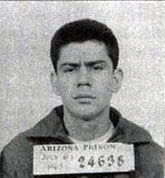
Consider this guy.


About 37 years ago, he was on trial for rape and kidnapping and armed robbery. He was represented by a lawyer named Alvin Moore. Moore stood up that Maricopa County courtroom (same Maricopa County, but before the era of Joe 'n' Andy) before the aptly name Judge McFate and said something like,
Your Honor. My client here may have confessed, but the local police didn't tell him that he didn't have to. They didn't say he had a right to remain silent. They didn't say he had a right to speak to a lawyer. And so, your honor, even though it says on his written confession that it was voluntary, it wasn't. His rights were violated. And you should throw out the confession of my client, Ernesto Miranda.
McFate, to what I expect was nobody's surprise, overruled Moore's motion. I don't know what the judge said, exactly, but I've always imagined the ruling was accompanied by suppressed giggles or eye-rolling or anger.

Here's the thing, and it's what Mirriam says so well. We believe this shit. Even when we're just starting it. Even when nobody's ever said it before or sold it before. Even when it seems frankly outrageous. We believe it because, as she says, if we don't believe it, we can't sell it. But we believe it, too, because dammit, we're right. It should be the law. And if we keep at it . . . .

*********

On Tuesday, as you know, in United States v. Stevens, SCOTUS declined to carve an exception out of the First Amendment so that visual depictions of animal cruelty could be criminalized. The animal rights folks are deeply disappointed, of course, when they're not apoplectic.*

Still, when Kent Scheidegger and I both agree that a law is unconstitutional, there's some likelihood that we're right. Of course, Kent would like to see a constitutional version of the law, but hey, this is closer than we've ever been. (Far less surprisingly, Bill Otis thinks Alito was right.)

*********

A couple of weeks ago, Brian Tannebaum began a campaign to convince Obama that Scott Greenfield was the man to replace Stevens (not the dog-fighting video Stevens, the Supreme Court Justice Stevens) on the Supreme Court.

I thought there wasn't a chance, but lent my endorsement in a comment. Greenfield wrongly thought the endorsement reluctant. Rather I was recognizing it as futile. (A judge once asked me to serve on his re-election campaign committee. I suggested it might hurt his chances. He said that he'd debated it with others on the committee and they'd concluded that on balance I'd get them 2 or 3 more votes than I'd cost them.) In any event, turns out Scott didn't get the call.

The short straw went, instead, to the darkest of dark horses: Gerry Darrow. We can all be proud. Truly, this is Change We Can Believe In. A lawyer of the people, from the people.

Well played, Barak. Well played.

Oh, you mean it isn't true? Damn.

Back to Greenfield for the court.


-------------------
Here's one commenter from the Cleveland Plain Dealer:
The Supreme Court is a joke. I cannot believe this. They think that torturing animals, videotaping it for bragging rights, and distributing the immoral activity all over the internet is FREE SPEECH!!!! OMG. Our country is just doomed. We are doomed. I cannot believe this. They are certainly no longer a high authority. They are immoral non-humans in black robes.


Tuesday, April 20, 2010

One Right - One Wrong

SCOTUS taketh away and it giveth.

I talked about the taketh away part earlier today, a couple of hours before they killed Darryl Durr. The Supremes denied three petitions for writ of certiorari and three motions for stay. I won't go there again - at least not today.

But this morning at 10, just as Ohio started to murder my client - having been given permission by the Supremes (OK, I won't go there much more today), the Supremes issued their long-awaited opinion in United States v. Stevens, the case that's been decisional before them longest, having been argued back on October 6.

Here's what I said about the case back in September.
As Adam Liptak puts it in the Times, the question is
whether the court should for the first time in a generation designate a category of expression as so vile that it deserves no protection under the First Amendment.
The category is depictions of violence against animals. Specifically, Stevens was charged with and convicted of three counts of violating a federal law criminalizing depictions of animal cruelty by selling videotapes containing footage of dog fighting. You know, what Michael Vick was convicted of actually participating in.

The law itself has a curious pedigree. It was originally intended to address what are known as "crush" videos, films designed to satisfy the sexual fetish of liking to see small animals crushed to death - particularly by women wearing stiletto heels. By the time congress got done tinkering with it, it was a lot bigger than that.
Oral argument was fractious with discussion of such things as an execution channel on television.

Now we have the decision. By a vote of 8 to Alito, the Court did the right thing. It refused to carve out a new exception to the First Amendment. And it refused to trust the government. Wisely, of course. As I noted back in September,
When Clinton signed [the law], he explained that it would only be enforced against crush videos. The problem with such Presidential assurances, of course, and even if they're honest assurances, is that Presidents come and go. And with the change in administration, there came the change in enforcement. Hence, the police to Mr. Stevens' door.
Roberts wrote the
opinion. Here's the money quote:
Not to worry, the Government says: The ExecutiveBranch construes §48 to reach only “extreme” cruelty, Brief for United States 8, and it “neither has brought nor will bring a prosecution for anything less,” Reply Brief 6–7. The Government hits this theme hard, invoking its prosecutorial discretion several times. See id., at 6–7, 10, and n. 6, 19, 22. But the First Amendment protects against the Government; it does not leave us at the mercy of noblesse oblige. We would not uphold an unconstitutional statute merely because the Government promised to use it responsibly. Cf. Whitman v. American Trucking Assns., Inc., 531 U. S. 457, 473 (2001).
It's that line about noblesse oblige that should be put on placards.

Sunday, January 31, 2010

Dissing the First Amendment

I was going to write about Tennessee State Senator Tim Burchett (R. Knoxville) and his plan to make it a felony for a criminal defense lawyer to dis a crime victim.* As reported by Cara Kumari of WSM-TV in Nashville,
While lawyers have called this bill unconstitutional, Burchett said it is the right thing to do.

"If I was member of the legal community, I would quit wrapping myself up in the Constitution and start thinking about what's right," said Burchett.
There goes that pesky Constitution thing again. Always getting in the way. Fortunately, Kumari explains to the people of the Volunteer State that Burchett's proposal really might be a problem.
The reason it may be unconstitutional is because the burden of proof in a criminal trial is with the prosecution.
In fact, while she's right about the burden of proof, she's wrong about why such a law would be unconstitutional. It would be unconstitutional because it would violate the most fundamental of all rights afforded to criminal defendants: The right to present a defense. Oh, and it would be a hell of an infringement on free speech, too unless it was mighty carefully circumscribed.

As Gideon says, "The Constitution is a wet blanket."

But you know, it doesn't manage to smother all fires. Especially those that burn up books. (How's that for a segue?)

Consider the Texas Department of Criminal Justice and the books it's banned during the last five years. We know about this, and about the details, because Scott Henson over at Grits for Breakfast noticed that the Austin American-Statesman's Eric Dexheimer actually went through the lists.

The Statesman reviewed 5,000 banned books. That's 1,000 a year, which is whole lot of banning, but it's probably just a small percentage because, you see, unless someone appeals, the book is just put on the forbidden list and there's no ready way to get the skinny on it. But if there's an appeal, well, then, there's a decision. That's what happens 1,000 times a year.

Grits focuses his attention on both important and popular works. He notes that Texas prisoners can't read books by some National Book Award winners and finalists, Pulitzer Prize winners, even Nobel Prize winners. Quoting the Statesman, he notes
Harold Robbins, Pat Conroy, Hunter S. Thompson, Dave Barry and James Patterson belong to the don't-read fraternity. Mystery writer Carl Hiaasen does, too, as do Kinky Friedman and Janet Fitch, whose "White Oleander" was an Oprah's Book Club selection.
And he mentions that books with paintings by da Vinci, Michaelangelo, and others are banned.

The Statesman digs deeper, exploring how it is that pictures of naked babies with angel wings are allowed, but if there are no wings? According to Tammy Shelby, "a program specialist for the prison agency's Mail System Coordinators Panel,"who denies many of the appeals,
If he is naked, the Baby Jesus would be denied.
After all, you don't want those child sex predators all riled up.

The real problem, of course, is that none of this is coherent. Books are, as Shelby readily admits, banned without the censors having read them.
When a book arrives at a Texas prison mailroom, an employee first checks the database to see if the book is already prohibited. If not, said Shelby, "he'll flip it over and read the back." If that provides insufficient information to make a decision, "they scan through it looking for key words" or pictures that would disqualify the publication.
Let's see. They examine the book in order to see if they can "disqualify" it. And they don't read it, just check for "key words." If this seems backwards, well, it is. But that's the nature of book banning. It's about fear and superstition. And the decisions reek, as these things tend to, of arbitrariness.

Many of the rejections — "Fun Under the Swastika" — seem reasonable: Race-related violence is a real concern in prisons. Yet the prohibition has been applied broadly: "Friday Night Lights," the best-selling book about Texas football, was prohibited because of its exploration of racial themes in Odessa.

In October 2007, censors rejected "Coming Through the Fire," which was reviewed on Amazon.com: "In this small but eloquent work, Duke University professor of religion and culture C. Eric Lincoln calls for a 'no-fault reconciliation' between the races." The following month, censors approved "The Hitler We Loved and Why," published by White Power Publications.

But that's the nature of censorship. It's the foolishness that goes with the territory. Random person notices something, and it's plucked from a shelf - or a cell.

The Texas prison report comes on the heels of a pair of school book bannings that have gotten some attention.

In Culpeper County, Virginia, they pulled the "definitive" edition of The Diary of Anne Frank (the version containing material that her father cut from the edition he released and that was the only one available for decades). As both Turley and Ken at Popehat noted, the book had been assigned to 8th graders but was pulled after a parent stumbled across and objected to Anne's vagina.

There are little folds of skin all over the place, you can hardly find it. The little hole underneath is so terribly small that I simply can't imagine how a man can get in there, let alone how a whole baby can get out!

Phew. Saved those 8th graders. The ones who have vaginas won't have to think such things about them and the ones who don't have vaginas now won't think anything at all. Surely banning the book will prevent teenage pregnancy. Certainly, the school district is apparently pleased that the dangerous passage was brought to its attention. Here, according to the Culpeper Star-Exponent, is what Jim Allen, "director of instruction for the school system" had to say.

“What we have asked is that this particular edition will not be taught,” Allen said from his office Wednesday morning. “I don’t want to make a big deal out of this. So we listened to the parent and we pulled it.”

There was no outpouring of community sentiment to get rid of the book. Focus on the Family didn't threaten a lawsuit. Pat Robertson didn't say anything about pacts with the devil or looming natural disasters. And, of course, the school didn't choose to defend educational standards or academic choice. A single parent complained and the school district was delighted to pull the book. It's the way things should be, Allen said.

“I’m happy when parents get involved with these things because it lets me know that they are really looking and have their kids’ best interest (in mind). And that’s where good parenting and good teaching comes in.”

Meanwhile, on the other coast, it's an elementary school. And a dictionary. This time it was Patrick at Popehat who caught the squeal.

You know, the problem with dictionaries is that they actually have, er, words. And definitions. The Menifee Union School District thought it would be a good idea for more advanced 4th and 5th graders to have access to a collegiate dictionary. Big mistake.

It seems a parent was volunteering in her son's classroom, and rather than working with the kids, was intrigued by this whole lexicon idea. One thing led to another and, wouldn't you know it, she found the entry for "oral sex." Of course, they pulled all the copies of that vile Webster's New Collegiate Dictionary off the shelves.

But wait. The Southwest Riverside News Network website posted an update.

Students at one Menifee elementary school will have the option of using an alternative dictionary rather than one that was temporarily removed from the classroom because of language a parent found objectionable.

Superintendent Linda Callaway announced Tuesday that a Menifee Union School District review committee met and determined that both the Merriam-Webster’s Collegiate Dictionary Tenth Edition and another dictionary will be available for use by fourth and fifth graders.

“We are aware that there may have been misinformation and/or misunderstanding with regard to this issue and it is important to clarify that at no time did the District state that the dictionaries were banned from the classroom,” Callaway said, reading from a prepared statement.

“We are confident that the Review Committee’s decision offers a reasonable resolution to this issue and there provides closure,” Callaway said during a school board meeting Tuesday in Menifee.

That's much better. Now there's a dictionary for kids who don't want to risk finding dirty words and one for those willing to take a chance.

Then there's Jason Rogers, who has three children in the school district. According to the original story on swrnn.com, he doesn't think the dictionary is a problem.

“You have to draw the line somewhere. What are they going to do next, pull encyclopedias because they list parts of the human anatomy like the penis and vagina?”

Well, yeah.

That's what they do at TDCJ.

And in Culpeper, Virginia.

But don't let them hear any complaining about it in Knoxville, Tennessee.

------------------
* That's not 100% fair. The news report actually says that the felony would be for "unproven insinuations" about crime victims, not for dissing them. Wait. There's really no difference, is there?