Showing posts with label Equality. Show all posts

Wednesday, November 11, 2009

Driving While Mormon

Despite what some members of the judiciary may profess to believe (and some, at least, probably do believe), law enforcement officers engage (sometimes consciously and obviously, sometimes in unconscious and subtle ways) in racial and ethnic profiling on a fairly regular basis. This is not news to any African-American or Latino or Middle-Easterner or Muslim over the age of 8 or 9. (Even Clarence Thomas knows it.)

Despite what many of those law enforcement officers, and large percentages of the civilian public, believe, that profiling is not just offensive, it's ineffective. (Don't just take my word for it. Go read David Harris's brilliant book Profiles in Injustice: Why Racial Profiling Cannot Work.) The problem is that policing by profiling is both overinclusive and underinclusive.

It's overinclusive because it sweeps in too many people. When you're looking for the bad guys, you want to narrow the pool of people you look at so that it's easier to find them. It's the metaphor of looking for a needle in a haystack. Profiling makes the haystack bigger.

It's underinclusive because it misses too many of the bad guys. Remember that right after Tim McVeigh, the very white guy from upstate New York blew up the Murrah Federal Building in Oklahoma City, the cops began by focusing their attention on middle eastern men. They were looking in the wrong haystack.

This is all fairly simple in theory but tough in practice. We all profile, all the time. Mostly it's a function of stereotyping. Members of this or that group are this or that. You can tell a book by its cover. It's not altogether wrong. Any sociologist will tell you that groups matter, and that group membership is indicative of some things. Not all people who listen to Rush Limbaugh agree with him about everything, but most regular listeners probably think he's generally right about stuff. And most of the folks who'll watch Michael Moore's Capitalism: A Love Story probably share some of his attitudes.

Which brings me to the great state of Utah, Salt Lake City, and the Mormon Church.

Let me be very clear. I'm no expert on religion. Certainly I'm no expert on Mormonism. Nor am I a social scientist. I have no particular expertise in anything relevant to what I'm reporting and discussing here. What I have is surprise, embarassment, and maybe a bit of shame.

So what we (I) know (believe) about most (not all, but most) Mormons is that they're deeply conservative (rigid, unfeeling, repressive) on social issues. We know that because they they are seriously right wing Republicans who support the death penalty and oppose abortion and gay rights.

Did I mention that we (I) are wrong. At least in part. Maybe.

Because here's the news out of the Great Salt Lake. As of Tuesday night, AP reports, Salt Lake City is gay friendly. The city counsel voted to
prohibit bias based on sexual orientation or gender identity. Under the two new ordinances, it is illegal to fire someone from their job or evict someone from their residence because they are lesbian, bisexual, gay or transgender.
Did I mention that council's vote was unanimous. That's astounding folks. And how did it happen? It happened because the Mormon Church said it was the right thing to do.

"The church supports these ordinances because they are fair and reasonable and do not do violence to the institution of marriage," Michael Otterson, the director of public affairs for The Church of Jesus Christ of Latter-day Saints said.

OK, there's still that equal marriage rights thing. But, as the Virginia Slims ads used to say, "You've come a long way, baby."

See, it's as risky to stereotype from my side of the aisle as from yours.

Friday, October 16, 2009

This Is Still America - Sometimes

It was riveting television.

Richard Nixon, President of the United States, shaking his jowels and intoning the famous words one should never actually say, even if they're true, because the mocking will know no bounds:
I'm not a crook.
Now, with special thanks to Jonathan Turley and Paul Kennedy, we have the words of the estimable Keith Bardwell, justice of the peace for the 8th Ward in Louisiana's Tangipahoa Parish:
I am not a racist.
Of course, backing up these sorts of claims is different than making them. For Nixon, there was that whole messy obstruction of justice thing. And the authorization of illegal spying. And the illegal bombing of Campbodia. And, aw, you get the point. For Bardwell, there's that pesky refusal to give marriage licenses to interracial couples.

But there's always the defense. For Nixon:
When the president does it, that means that it is not illegal.
For Bardwell:
"I'm not a racist. I just don't believe in mixing the races that way," Bardwell told the Associated Press on Thursday. "I have piles and piles of black friends. They come to my home, I marry them, they use my bathroom. I treat them just like everyone else."
You fill your home, you give people the key to your bathroom (I'm assuming maybe a special one for the "coloreds"), piles of them, piles and piles. And look at the grief you get just because you violate the rights of a few interracial couples. But for the best of motives: It will be hard on the kids.
Bardwell said he has discussed the topic with blacks and whites, along with witnessing some interracial marriages. He came to the conclusion that most of black society does not readily accept offspring of such relationships, and neither does white society, he said.

"There is a problem with both groups accepting a child from such a marriage," Bardwell said. "I think those children suffer and I won't help put them through it."

What a softy. The children must not be conceived (at least not in wedlock) because life will be hard for them - at least among his circle of friends.

Justice of the Morals Bardwell may believe he's doing God's work when he tries to stop those mixed race children from being born. He probably does believe he's not a racist and that all those black folks he has over to use the bathroom prove it. It doesn't matter. The rules count, and one of those rules is the Equal Protection Clause of the Constitution, right there in the 14th Amendment. Another of those rules, premised on the Equal Protection Clause, was set forth in the aptly named Supreme Court case Loving v. Virginia.

Mildred and Richard Loving (she African American, he white) were married in D.C., then moved to Virginia. They were charged and convicted of violating the state's ban on interracial marriage. When their case made it to the Supreme Court, Chief Justice Warren writing for the Court explained the simple rule:
There can be no doubt that restricting the freedom to marry solely because of racial classifications violates the central meaning of the Equal Protection Clause.
That was 1967.

Of course, Bardwell and the morals police aren't alone in thinking the rules don't apply. So it's a pleasure to find that sometimes they do.

From Russ Bensing at The Briefcase comes the news that Ohio's 8th District Court of Appeals affirmed a suppression motion in State v. Johnson last week. That happens a lot in the 8th where the combination of a bench that believes in the Fourth Amendment and police departments that don't result in a lot of bad searches and seizures getting thrown out. In Johnson, the court explained that
merely because appellee was in a car parked in an area where several people were loitering on a sidewalk does not give the state justification to search appellee or the car he was occupying.
Yep. Good call. Better, Russ tells us, is what the trial judge had said. His entire written opinion explaining why the motion to suppress would be granted, and from which I took the title of this post, reads:
This is still America. Motion granted.
Amen.

Sunday, October 4, 2009

Celebrity Justice. Or not.

Think about it another way.

Roman Polanski has spent the last 31 years or so living in France and Switzerland, making movies, winning an Oscar, and oh yeah, being a fugitive from justice. On his most recent trip to Switzerland - to attend a festival and pick up a prestigious award - he was arrested by Swiss authorities who have been, at last, asked to extradite him to the United States so that he can face whatever he might face for his crimes.

Perhaps we should be specific. He was charged with the drugging and multiple raping of a 13-year-old girl. He entered an agreed plea to something like unlawful sexual intercourse with a child under 14. He fled the country when word reached him that despite expectations when he entered the plea, the judge would impose some period of incarceration as part of the sentence. As is the case in all agreed pleas, the truth is murky.

In a plea bargain such as this one, the defendant (Polanski, here) admits to something less than the charges in return for the certainty that the sentence will be less than the potential sentence if found guilty at trial. The state obtains a guilty verdict and some sentence avoiding the risk that the defendant will prevail at trial and go free. Both the defendant and the state save the cost and stress of a trial. And when the alleged crime is a child rape, everyone avoids the public ugliness. The details of the allegation needn't come out. The child needn't suffer the stress of getting on the witness stand but also won't have to answer to cross examination.

The problem is that when everyone is willing to live with the bargain, nobody knows what actually happened. The reduction in risk and burden is also a reduction in accountability for the defendant and for the system.

[A brief aside here to note that the Duke lacrosse team did not rape Crystal Gail Mangum, and the Hofstra five did not rape Danmell Ndonye. Those cases never went to trial because the evidence that the allegations were false was clear and overwhelming and revealed and presented before things got that far. (And what is it about college students, anyway, that brings forth these false charges of gang rape?) There's no way of knowing how many false rape charges are prosecuted (but see here for an interesting discussion of the question). It's a certainty that it happens, though, and that some people are convicted of them - some even plead guilty.]

Polanski is now in his mid-70s. The girl now in her forties. He has been angling to get the prosecution dismissed. She has supported him in that effort, though she insists that he is guilty. The press, the arts communities (there's more than one) and the blogosphere are all in high dudgeon over Polanski's arrest and possible extradition.

It is, depending on who you listen to, an outrage or about time. Those who disagree are blinded by celebrity worship, wholly immoral, 21st Century Javerts chasing the noble Jean Valjean out of sheer vengence, Ashcroftian moral crusaders, or . . . . Enough. It's getting ugly out there.

Which brings us to that other celebrity rogue who's treatment has gotten attention lately, Andrew Sullivan. You remember, he's the friend of President Obama who got busted by the feds for blowing a bit of weed on federal property at Cape Cod. Unlike what happens to everyone else facing that charge, the local U.S. Attorney decided that the case against Sullivan should be dismissed because he'd suffer collateral consequences from a prosecution. The thing is most of those people who do get prosecuted suffer those same consequences, and nobody cares.

Yes, the government has discretion about who and when to prosecute. And yes the collateral consequences of prosecution are appropriate considerations to weigh when determining whether to exercise that discretion. (See commentary here, unearthed by Doug Berman here.) But when that discretion is only exercised in favor of the wealthy pal of the Pres with one of the most important political blogs in the country, well, you gotta wonder about abuse.

Don't misunderstand. Child rape is a vile act for which there's no excuse. Possession of marijuana (and this is in small amounts for personal use) shouldn't be a crime at all.

But the truth is that it looks a lot like Polanski got preferential treatment 31 years ago, and is being targeted now because he's charged the LA prosecutors with misconduct back then. And all of that is based on who he is. The ordinary child rape defendant wouldn't have been able to flee the jurisdiction in 1978. If he did, they'd have brought him back and nobody would have blinked. And if they hadn't found him for 31 years, they'd probably have forgotten all about it. Just as the public posturing on all sides is a consequence of his celebrity, so is every event in the case.

Same for Sullivan. What they did for him they should do for everyone. But anyone who spends even a brief time in the trenches of criminal law knows they don't.

Paris Hilton spent more time in custody than the typical drunk driver because of who she was. Michael Vick. OJ. The list goes on. Some do better for the celebrity, some do worse. What it never seems to be is irrelevant.

Saturday, September 12, 2009

BECAUSE THEY LIKE THEIR FRIENDS: THE HE'S GOT CONNECTIONS EDITION

From Mike over at Crime and Federalism comes the two-part saga (here and here) of the almost-prosecution of Andrew Sullivan for possession of marijuana on federal property at Cape Cod.

On July 13, the ever-vigilant park ranger G. Felling, dressed in civvies and on daunting foot-patrol in the beach and dunes at the Cape Code National Seashore spied Sullivan smoking a joint. Felling approached Sullivan, learned that he had a second J in his wallet, and issued a
notice of violation. The notice required, in essence that Sullivan either pay a fine of $125 or show up in federal court on September 2.

You'd have paid the fine. I'd have paid the fine. Lots of people pay the fine. Others show up in court (mostly, I suspect, those who don't have $125) show up in court where they hope not to get hammered with the maximum penalty: a fine of $5,000, six months in the hoosegow, a $25 processing fee and a $10 special assessment.

In fact, on September 2, along with Sullivan, there were three other defendants in court on the same charge. But Sullivan wasn't there to contest the charge or hope to get the $125 reduced to something he could afford.
He was there (along with his attorney) because of this rather unlikely document filed August 26 by James F. Lang, Acting Deputy Chief of the Criminal Division of the office of the U.S. Attorney for the District of Massachusetts:
Pursuant to FRCP 48(a), the Acting United Slates Attorney for the District of Massachusetts, Michael K. Loucks. hereby dismisses the above-numbered violation, which was issued on July 13. 2009 and which charges the defendant Andrew M. Sullivan with possession of a controlled substance (marijuana) on federal property, in violation of 36 C.F.R. § 2.35(b)(2). In support of this dismissal, the government states that further prosecution of the violation would not be in the interests of justice.
Just how is it, you might wonder, that the interests of justice militate against prosecuting Sullivan for blowing a joint but not against fining or prosecuting those other people for doing the same thing? Magistrate Judge Robert Collings also wondered, and he was in a position to try and get some answers, so he ordered Sullivan and the Deputy Chief to appear before him. They told Collings that if Sullivan paid the $125, there would be some unspecified collateral consequence having to do with Sullivan's immigration status. (Sullivan is a British citizen.)

In response to further probing, neither the Deputy Chief nor Sullivan's counsel could offer any further explanation. The Deputy Chief said that the magistrate had no right even to ask.
Collings granted the dismissal. He really did have no choice. But he did it in this remarkable "Memorandum and Order on Government's Request for Leave to File a Dismissal of Violation Notice" which I'm quoting at some length (I'm omitting a footnote):
In the Court’s view, in seeking leave to dismiss the charge against Mr. Sullivan, the United States Attorney is not being faithful to a cardinal principle of our legal system, i.e., that all persons stand equal before the law and are to be treated equally in a Court of justice once judicial processes are invoked. It is quite apparent that Mr. Sullivan is being treated differently from others who have been charged with the same crime in similar circumstances.

If there were a legitimate reason for the disparate treatment, the Court would view the matter differently. But the United States Attorney refused to allow the Court to inquire into why, in the circumstances of this case where Mr. Sullivan had already been charged with the crime, either a forfeiture of collateral or an adjudication would make a difference in the immigration application.

But there is more. If, in fact, a determination that Mr. Sullivan had possessed marijuana is a factor which, under immigration law, the immigration authorities are legally charged with taking into account when deciding Mr. Sullivan’s application, why should the United States Attorney make a judgment that, despite the immigration law, the charge should be dismissed because it would “adversely affect” his application? If other applicants for a certain immigration status have had their applications “adversely affected” by a conviction or a forfeiture of collateral for possession of marijuana, then why should Mr. Sullivan, who is in the same position, not have to deal with the same consequences?

In short, the Court sees no legitimate reason why Mr. Sullivan should be treated differently, or why the Violation Notice issued to him should be dismissed. The only reasons given for the dismissal flout the bedrock principle of our legal system that all persons stand equal before the law.
And you know, he's exactly right.

On a bronze plaque inside the Statue of Liberty there's the text of "The New Colossus," the poem read at the monument's dedication. These are the famous words:
. . . . Give me your tired, your poor,
Your huddled masses yearning to breathe free,
The wretched refuse of your teeming shore.
Send these, the homeless, tempest-tost to me . . . .
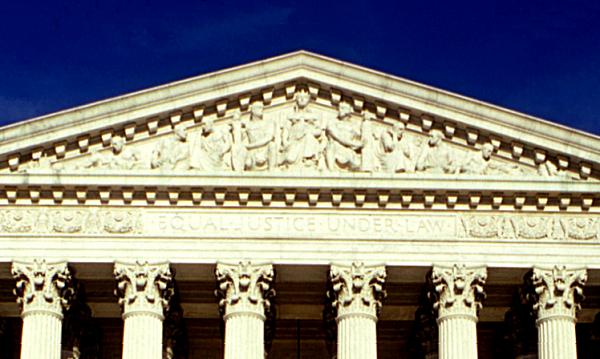
It says, in Washington, on the facade of the Supreme Court building.
EQUAL JUSTICE UNDER LAW
After the civil war, that principle was enshrined in the Fourteenth Amendment as a promise that we will not discriminate.
No State shall make or enforce any law which shall abridge the privileges or immunities of citizens of the United States; nor shall any State deprive any person of life, liberty, or property, without due process of law; nor deny to any person within its jurisdiction the equal protection of the laws.
It's about those folks Emma Lazarus invited to our shores. Those who don't get the breaks and desperately need them. Those we're supposed to welcome.

And yet, and yet.
So we protect the white guys, and the guys who can afford dream team counsel, and the Andrew Sullivans. Others we throw to the dogs because, after all,
[t]he law, in its majestic equality, forbids the rich as well as the poor, to sleep under bridges, to beg in the streets and to steal bread.
Except that, in the last analysis, the law is willing to forgive the rich who do those things.
The sign on Animal Farm was changed, you'll recall, to "All animals are equal, but some are more equal than others." Power corrupts, they say. They're right.

Monday, June 22, 2009

SECTION 5 STILL HANGING BY THAT THREAD

If you're the sort of person who reads transcripts of Supreme Court oral arguments, and if you have even a passing interest in civil rights law, then you probably figured that Section 5 of the Voting Rights Act was history.

The case was Northwest Austin Municipal Utility District No. 1 v. Holder and all you could want to know about is available at the scotuswiki here. Rather than making you slog through the briefs and argument and whatnot, here's the short version: The Voting Rights Act, a 1965 civil rights law designed to overturn decades of efforts to prevent African Americans from voting, is in part permanent and in part temporary. Among the temporary provisions is Section 5 which requires that certain states and localities which have a history of discriminatory practice in voting, cannot change anything about their voting procedures without getting preclearance from the Justice Department. There's a bailout provision whereby a covered entity can demonstrate it should no longer be subject to the VRA. The District tried to bail out but was told it was not an entity entitled even to seek bailout. So it went to the Supreme Court.

Back to the oral argument. The smart money, when it was over, was that there were 5 votes (which is enough, of course) to declare Section 5 unconstitutional as an infringement on state sovereignty. Everyone condemned the discriminatory past and praised the VRA, but the tea leaves seemed to permit little doubt that Scalia, Alito, and Roberts (along with the ever silent Thomas) would say that Section 5 had done its duty and was no longer necessary. Besides, it was irrational because, for instance, Massachusetts which has no preclearance requirement is at least as discriminatory as, say, Texas.

The key, naturally, would be Justice Kennedy, and the signs weren't good for Section 5:
But yet -- yet the Congress has made a finding that the sovereignty of Georgia is less than the sovereign dignity of Ohio. The sovereignty of Alabama, is less than the sovereign dignity of Michigan. And the governments in one are to be trusted less than the governments than the other.

One of the things we no about the Supreme Court (really, every court) is that it sometimes upends predictions. Today, the Court issued its decision. That 5-4 vote to hold Section 5 unconstitutional came out 8-1 to hold it . . .? Well, it's not terribly clear just how the 8 decided to hold it.

What the opinion by Roberts for the purportedly sane justices (Scalia has, on at least a couple of occasions, distinguished himself from Clarence Thomas by explaining, "I am not a nut") actually says is that the Utility District can seek a bailout from Section 5 preclearance. The lower court had simply read the provision too narrowly.

Whew! Section 5 survives. Preclearance survives. Voting rights survive.

But hold on. Roberts explains that the Court didn't reach the constitutional problems involved because it didn't need to. (Thomas disagreed and would have invalidated Section 5.) But Roberts made clear that Section 5 was surviving by the merest quirk of how the Utility District had argued its case.

The law may have been justified at its inception, but times change:
Some of the conditions that we relied upon in upholding this statutory scheme in Katzenbach and City of Rome have unquestionably improved. Things have changed inthe South. Voter turnout and registration rates now approach parity. Blatantly discriminatory evasions of federal decrees are rare. And minority candidates hold office at unprecedented levels. . . .
These improvements are no doubt due in significant part to the Voting Rights Act itself, and stand as a monument to its success. Past success alone, however, is not adequate justification to retain the preclearance requirements. See Issacharoff, Is Section 5 of the Voting Rights Act a Victim of Its Own Success? 104 Colum. L. Rev. 1710 (2004). It may be that these improvements are insufficient and that conditions continue to warrant preclearance under the Act. But the Act imposes current burdens and must be justified by current needs.
Besides Section 5 discriminates among the states.
The Act also differentiates between the States, despite our historic tradition that all the States enjoy “equal sovereignty.”. . . But a departure from the fundamental principle of equal sovereignty requires a showing that a statute’s disparate geographic coverage is sufficiently related to the problem that it targets.
And, again, things have changed.
The evil that §5 is meant to address may no longer be concentrated in the jurisdictions singled out for preclearance. The statute’s coverage formula is based on data that is now more than 35 years old, and there is considerable evidence that it fails to account for current political condi-tions.
This is all deeply troubling. But - punt.

The thing is, these narrow holdings don't do much. There will be another case. Section 5 just got a break on its shelf life, but there's an expiration date looming unless one of the 5 miraculously switches sides or leaves the court.

Judicial minimalism defers resolving broader questions. It doesn't obviate the need.