Showing posts with label proof. Show all posts

Wednesday, February 4, 2015

J'accuse!

It's a pesky thing this business of proof.  

I know, I know.  I'm a criminal defense lawyer.  I'm inclined to believe in the idea that someone saying so may not be enough.  Especially when there's like actual evidence pointing the other way.

Here in Ohio, the courts supposedly follow what's known as the Physical Facts Rule.  Here's how our Supreme Court put it in McDonald v. Ford Motor Company.
The testimony of witnesses which is positively contradicted by the established physical facts is of no probative value and a jury will not be permitted to rest a verdict thereon.
McDonald was a 1975 case of products liability.  But the rule didn't come with that limitation. People can't see through walls.  Dead bodies do not migrate, on their own, from one place to another.  If the victim was stabbed with the knife it should be her DNA in the blood, not just the DNA from the alligator the defendant skinned the week before.

The rule also didn't come with legs.  You'll search through Ohio case law and find a few mentions of it.  You won't find it followed.  Frankly, it's rarely even mentioned.

Which is part of why I explain to my clients, and their families, and the readers of this blawg, that proof has nothing much to with what actually happened.  Proof is about what juries believe.  And juries . . . .  
I don't think I've ever before quoted Hillary Clinton here, but she has a point.  
The science is clear: The earth is round, the sky is blue, and #vaccineswork.
But try convincing folks.

Strunk & White offered as advice 
If you don't know how to pronounce a word, say it loud.
Indeed.

Which brings me to Scott Greenfield who points out that when you look at the evidence, Emma Sulkowicz's case won't hold up.  Sulkowicz is Mattress Girl, the young woman who wanders around Columbia University carrying a mattress as proof evidence performance art.  It's intended to shame the University into expelling a young man for raping her - a charge supported by her well-after-the-fact claim that it happened but nothing else.  And rebutted by a mountain of evidence.

Of course, the evidence doesn't matter.  Because Sulkowicz says she was raped.  And those who accuse never lie.  If there's no evidence . . . . HAH! What more proof do you need of his perfidy.

A bit over a year ago, I started a blog post this way. (I'm deleting the footnotes now, but they're maybe worth your time to go back and look at, and because even after doing this for 5 1/2 years I can't get the formatting right, it's kind of fucked up.)
With cause, Gideon likes to quote this passage from Justice White's* opinion for a unanimous court in Coffin v. United States.
Ammianus Marcellinus relates an anecdote of the Emperor Julian which illustrates the enforcement of this principle in the Roman law. Numerius, the governor of Narbonensis, was on trial before the Emperor, and, contrary to the usage in criminal cases, the trial was public. Numerius contented himself with denying his guilt, and there was not sufficient proof against him. His adversary, Delphidius, "a passionate man," seeing that the failure of the accusation was inevitable, could not restrain himself, and exclaimed, "Oh, illustrious Cæsar! if it is sufficient to deny, what hereafter will become of the guilty?" to which Julian replied, "If it suffices to accuse, what will become of the innocent?" Rerum Gestarum, L. XVIII, c. 1.
White relates that story as he's tracing the genesis and history of the presumption of innocence.  He goes on to cite Fortescue. 
Indeed, one would much rather that twenty guilty persons should escape the punishment of death than that one innocent person should be condemned and suffer capitally." De Laudibus Legum Angliæ, Amos' translation, Cambridge, 1825.
Blackstone (1753-1765) maintains that "the law holds that it is better that ten guilty persons escape than that one innocent suffer." 2 Bl. Com. c. 27, margin page 358, ad finem.
These are bedrock principles of Anglo-American jurisprudence. Their heritage predates the republic, predates Blackstone, predates even the Emperor Julian.**
 OK, like I say, sorry about the formatting.  

Anyhow, the thing about bedrock principles is that they're fine in principle.  But if we follow them, the republic will crumble.

Oh, wait.  No, it won't.

The thing about bedrock principles is that we don't actually want to follow them. 

You know, Coffin was decided in 1895.  Blackstone is the 18th Century.  Fortescue the 15th.  And the Emperor Julian the 4th.

This is the 21st Century.  We know better than to apply bedrock principles now.  Hell, even the Physical Facts Rule rests on the shaky premise that facts matter.  

The world is more complicated than Sherlock Holmes thought.  He was wrong when he told Dr. Watson in The Sign of the Four,
When you have eliminated the impossible, whatever remains, however improbable, must be the truth.
There are, after all, many possible things that are not true.  On the other hand, whatever the White Queen managed to convince herself of before breakfast, no impossible things are true.

And j'accuse is not proof.

Sunday, July 14, 2013

Because There Really Is No Better Alternative

Eric Mayer, the Unwashed Advocate, clearly lays out "all you need to know."  Scott Greenfield explains why the crowd can't be trusted and hasn't a clue. And Brian Tannebaum gets to the nub of both points with well deserved slams at the media for making it worse.

So. One more time. Whatever you believe.  You need to start with this.
  • You don't know just what happened that night.
  • I don't know just what happened that night.
  • None of the reporters or analysts or commentators know just what happened that night.
  • The judge and the prosecutors and the defense lawyers don't know just what happened that night.
And, oh, yeah.  Which is how it happens that we're here.
  • The jury didn't know just what happened that night.
Oh, we all know that Trayvon Martin is dead and George Zimmerman killed him.*  That was never the issue.  The issue was whether George Zimmerman committed a crime.  And the answer to that, as I've told my clients repeatedly over the years, as I've written here from time to time, is that none of us (maybe not even George Zimmerman at this point, if he ever did) knows just what happened that night.

The other day, Scott Greenfield noted that despite what TV and the newspapers (and perhaps twitter and facebook but I'm not on those so can't say) may lead you to believe, there's a class of folks you might think spend their every waking moment - and perhaps a significant portion of their dream lives - contemplating the Zimmerman case but in fact don't.
Many criminal defense lawyers studiously ignore cases that catch the public's attention. They just aren't that legally interesting, even if the facts or issues give rise to popular passion. And so it's been for the trial of George Zimmerman for murder 2º in the killing of Trayvon Martin.
I confess to being part of that cadre.

After the knock, knock joke, I was done.  I mean, here's a lawyer who's carefully planned, worked out, scripted, practiced, beginning the trial by . . . . My head hurts just remembering it.**

So I quit. Enough of it.  The case had some sociological interest but legally it was just another show trial and they're just not interesting.  I have my own cases to worry about.  But then the jury came back.  

OK, I get it.  The people who think Zimmerman a hero for killing that drug-addled, dope-fiend street punk looking for a little white girl to rape are pleased that justice prevailed.  The people who think Zimmerman went trawling for the opportunity to kill someone and who better than an innocent black kid minding his own business while heading off to buy a candy bar are outraged.

But see, and here's back to what I tell my clients, this was a trial.  And trials aren't about what happened.  They aren't about truth (whatever that might be and regardless of whether it's knowable).

They're about proof. Which is something altogether different.  Proof isn't what happened.  Proof isn't whether it actually was Colonel Mustard in the den with the candlestick.  And god knows proof isn't what's in the human heart (or what was in George Zimmerman's head).  Proof is about what the jury believes based on the testimony and other evidence as it came in at the trial.  What it believes not more likely, but what it believes beyond a reasonable doubt (whatever that might be).  

Each crime has what lawyers call elements.  Those are the things that the duly enacted statute says the jury must believe the prosecution showed to be so beyond a reasonable doubt.  If the jury finds that the evidence (and only the evidence) as it came in at trial proves every one of those things beyond a reasonable doubt, then it's supposed to convict.  If not, if the prosecution didn't prove all of those things that thoroughly, then it's supposed to acquit.  To say
NOT GUILTY
Even if they believe in their heart of hearts that he did it.  And even if, maybe especially if, you believe it.

And even if it's factually wrong.

John Henry Wigmore who (quite literally) wrote the book on cross-examination said
Cross-examination is the greatest legal engine ever invented for the discovery of truth.
Which is just silly, even it's so.  The idea is the idea of trial.
Sparkling, brilliant, equally matched and resourced advocates lay out their evidence and point out the holes and gaps in the other side's evidence.  It's an adversary system, and like a Hegelian dialectic, the truth emerges from the clash and the 12 good men and true (it was pretty much always men when Wigmore was writing) will get it and reveal it in their verdict.  
It is to laugh.  It's not that cross-examination isn't valuable.  It can help lead to the discovery of truth (whatever that is) or more often it can show up lies and mistakes.  But if it's the best we can do, we're woefully incompetent.  And the lawyers?  Those masters of trustworthiness and integrity?  Please.

Look, I'm not saying that juries are usually wrong or that proof only occasionally overlaps perfectly with quotidian reality.  If the system were that fucked up it would have imploded decades, maybe centuries ago.  It probably comes pretty close to right a pretty large majority of the time.  And I surely don't have a better one to propose.

Nancy Grace? MSNBC? Your friendly neighborhood politician?  God help us Thane Rosenbaum?  

I think not.

But then?

The reality is that it isn't just me.  You really don't know what happened, not in absolute terms.  And really (epistemological moment here), it cannot be known.  And so we have - and in practice, by the way, in that Florida courtroom - The Rule of Law.

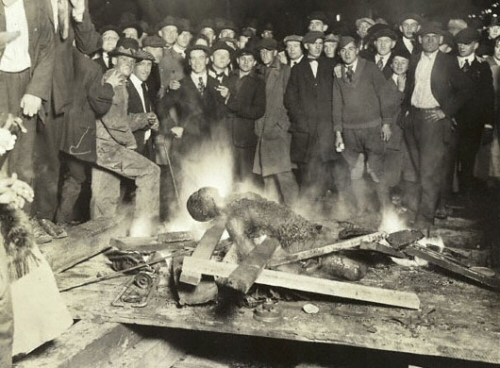
Because the alternative is the Law of Rule.  Which comes from vox populi as readily as from the government.  And which ultimately looks like this from Omaha, Nebraska in 1919.


Or like this


And it sucks.

---------------------
*Note to those of you who want to say, "Told you so" because I'm admitting to actually knowing something when they've accused me of lying when I say that we can never really know anything.  That's an epistemological claim and a quantum uncertainty claim, and I stand by it.  This is a quotidian world claim.  Context matters.  Keep reading.  (Or not.)

**Mark Bennett's commentary is all you need.

Sunday, December 16, 2012

The Problem of Evil - Part I(A)

In a post the other day addressing the problem of evil, I took off from a post by Bill Otis at Crime and Consequences.  Bill quoted Mike Moore, "a wonderfully fair-minded, bright and balanced man" who worked on the prosecution of the case describing Jeffrey MacDonald as "pure evil," and then wondered it people like me 
ever take the time to come to terms with what they are really defending. 
My post was the first part of an answer to that particular question.  My theme was uncertainty, that when you get right down to it, we can never really know, and some things necessarily follow.  I quoted the great lawyer Irving Younger from a short article he had in the first issue of the Georgetown Journal of Legal Ethics.
The best of all guides to thinking about anything is Oliver Cromwell's adjuration to the General Assembly of the Church of Scotland, "I beseech you, in the bowels of Christ, think it possible that you may be mistaken." Life and the affairs of the living are so tangled, the world not only stranger than we imagine but stranger than we can imagine, that all questions are conundrums, no answers "correct." Is it certain that parallel lines never meet? No. Does water freeze at thirty-two degrees Fahrenheit? Only probably. Shall I marry? Who can say. 
This morning, Bill (who apparently drops over here whenever I link to his stuff) put up a comment on that post.   
The premise that human beings are fallible is incontestable. The conclusion that we can't ever know if Defendant X did it is absurd. Every practicioner knows that, in the great majority of cases, factual guilt isn't in doubt and isn't even contested.
I started to reply with another comment, but decided to do it this way, instead.

There's no question we can be certain.  There's no question we often are.  Being certain isn't the same as being right.  As a matter of epistemology, there's a gap between our certainty and what may be, factually, true. That theoretical space sometimes even shows up in the real world of criminal law.

The DNA shows it was a mistake.  The confession was false.  The guilty plea was to avoid risk and was a straight plea because the jurisdiction or the court or the prosecutor wouldn't accept an Alford plea.  Overwhelming evidence was there but it wasn't him.  


All those things happen. Some think they happen a lot.  Some think it's incredibly rare.  But they happen.  And although we can argue about the frequency (and nobody will ever really know what the frequency is), one time makes the case.  To pretend it can't happen and doesn't happen is at best disingenuous.

The only real question is what should follow from the possibility of error even in those cases where it seems inconceivable.  


Here's the next paragraph from Younger.
And yet the world's work must be done. One Oblomov is enough. Thus we learn a conventional certitude, acting as though all were light by blinking the shadow. A simple proof demonstrates that parallel lines meet, but, on the assumption that they do not, the architect builds the skyscraper. Despite extensive knowledge of statistical mechanics, the engineer designs the refrigerator to maintain a constant temperature of thirty-one degrees. 'Le coeur a ses raisons que la raison ne connait point,' and families are raised.
We act, we must act, the only sensible way to act is as if some things were in fact true - even if we can't know (and even if we think we do).

Fair enough.  

So we can accept as factually true that Bill's Defendant X did it even if our absolute knowledge that he did is imperfect and might be wrong. There's no rational alternative to that.  And if what X did is criminal, and if some sanction is appropriate, and if it's really awful and the sanction might then fairly be severe, and if it's something that's likely to be repeated and makes the person who did it a danger to the community . . . .

Well, then, yeah.  And if you're one of those folks who believes that eradicating people who've done terrible things is ok.  Not merely separating them, not treating them, not isolating them, but eradicating them.  Not just from our awareness but from our world.  If you believe that execution is morally right and good public policy.  If you believe that killin' is OK when it's our killin' under some sort of legal justification in a system you trust.

But see, for me there's that nagging doubt, that Cromwellian uncertainty.
I beseech you, in the bowels of Christ, think it possible that you may be mistaken.
Maybe not  about the fact.  Maybe just about the response.  Perhaps your moral sense isn't as perfect as you imagine.  Perhaps the cost of breaking a few eggs is too great to justify the omelet.  Or maybe this is the odd case where the moral balance doesn't come out where you might imagine.

This isn't about the numbers, about whether it's better that some number of the guilty go free than that one innocent be convicted or punished.  (Or, in the alternative formulation, it's better that some number of innocents be convicted or punished than that one guilty person goes free.)  It's not about ratios and how sure you have to or ought to be and whether we can quantify reasonable doubt.

Ultimately, of course, Otis is speaking of the death penalty, about which he and I forcefully disagree.  He would inflict it far more than we do.  If would prohibit it in all cases.  He's sufficiently sure that he (we) can tell often enough who deserves killing.  I don't doubt that there are some people who might.  I just don't think we can ever know with sufficient certainty who they are.

And that doesn't begin to address either the underlying morality or policy or practicality of whether we should be doing it. Or what it says about those of us who would.

Friday, September 7, 2012

None Dare Call It Bullshit

But my guy's gonna say it ain't so.  That's reasonable doubt, so I can't be guilty.  Ain't taking no deal.
We've all heard that from our clients.  And then we've watched them hauled off to the pokey because, well, as I've said repeatedly, trials are about proof and proof is whatever the jury believes.  And the jury tends to believe the cops and the alleged victims rather than, say, the defendant's mother or best friend.
But there is this thing about reasonable doubt.  Not just any old doubt.  Reasonable doubt.  And the proof is supposed to be beyond it.
I've been reading (slogging, might be a better word) through the transcript of a capital trial, but really, it could be any trial, civil or criminal.  There are expert witnesses on both sides.  Each is highly credentialed.  And each is determined by the court to be an expert in the same field.*
Each looks at the same evidence.  Defense expert says A.  State expert looks at the same stuff and says not A.
The jury goes back to deliberate.
Guilty or not guilty?
The outcome rests on whether it's A or not A.
The jury has been told it can believe all, some, or none of what any witness has to say.  But it cannot find the defendant guilty unless the state proves guilt beyond a reasonable doubt.  That is, the jury must be convinced, beyond a reasonable doubt, that the state's witness expert is right, that not A.
Here are the three possibilities:
  1. One expert is incompetent.
  2. One expert is a liar.
  3. Experts disagree.
Let's consider those in turn.  
Incompetence
Both experts have credentials, as they say, up the wazoo.  Degrees, affiliations, experience.  Neither side disputed the expertise of the witness on the other side.  And the judge, the authority in the courtroom made specific findings, aloud and on the record in front of the jurors, that each is in fact an expert.
Have the jurors any basis on which to believe one incompetent?
No.  A juror who thought one or the other expert incompetent wouldn't be following her oath.
Lies
Sure, could be.  Witnesses lie under oath all the time.
Cops do it so much there's even a term for it.  It's called testilying.
Now, there are experts and experts.  Some really are whores who'll say whatever they're paid to say.  But there aren't many of them and they don't last long because, frankly, it's obvious.  They're charlatans and mountebanks and everyone can see it.  Competent lawyers don't use them because they won't help.
And serious experts, they don't want to damage their reputation by selling it to the highest bidder.
Disagreement
These two guy looked at the same stuff and just interpreted it differently.  They have specialized training the jury doesn't have.  Education, affiliations, experience.  One says it's flu the other says pneumonia.  One says the widget was badly manufactured, and here's why.  The other says the widget was just fine until the frazmut smashed into it, and here's how I can tell.
Maybe that mushroom is poisonous.  Maybe not.
Maybe global warming.  Then again, maybe it's just getting hotter.
Anecdote
Some years ago, I sat on a jury in a civil case.  The issue, the only issue, was whether the fact that the plaintiff was in more pain after the accident than before was a function of the accident or a coincidentally timed consequence of an earlier injury. 
There were opposing experts.  One we concluded was a whore.  The other admitted cheating the defendant.  One might have been right.  I suppose one has to have been right, in the same way that a stopped clock is right twice a day.  I mean, their positions were X and not X.  So sure, however dishonestly they came to their conclusions, one was right.  It's just that there was no way to tell which one.
Except, she was in more pain after the accident than before.  With no reason to believe the expert who said coincidence, the likelihood was that the accident caused the pain.  Accidents, after all, will do that.
Here's the thing, though.  Civil cases are decided by a preponderance of the evidence.  More probable than not.  She didn't have to prove beyond a reasonable doubt that the accident did it.  If she'd had to prove that, we'd have voted against her. 
End of Anecdote
OK, here's the point.
We look to experts because jurors aren't competent to answer the question.  Is it cancer or a calcium deposit?  Damned if I know.  The jurors really can't tell, either.
Yet they have the job of deciding whether it's proved beyond a reasonable doubt.  When the oncologists disagree.
In an honest system, we'd acknowledge that the state simply hasn't proved it unless one of the experts is believed, beyond a reasonable doubt, to be flat out lying.
Not wrong.
Crooked.
And we'd ask the jury to make a special finding.  If they didn't say 
Fucking asshole lying sack of shit,
then it would have to be Not guilty.  No matter what they decided.
Our legal system doesn't live in that world.  We ask jurors to decide whether the skull fracture was caused by a bat or an auto accident, whether the accused has mental retardation, whether the guy will be dangerous in the future, whether the baby was dropped or thrown. Whether the DNA was his or not.
And, and here's the bottom line.
They can't.  
And yet we send men to death row because of what they say.
In their ignorance.

-----------------
*For any non-lawyers reading this, that's a standard thing.  The lawyers put forth the purported expert's credentials in order to show that the person is, in fact, an expert and asks the judge to make that finding which allows the witness to offer opinions within her field of expertise.

Friday, May 18, 2012

Believe It . . . Or Don't

Three years now, I've been doing this.
896 posts.
God only knows how many half written and abandoned posts.
And so little changes.
Carlos DeLuna was executed in Texas in 1989.  He said he was innocent.  It was Carlos Hernandez  who did it. A team from Columbia University has now proved that to be true.  Unless you don't believe it.  Because proof, as I've said more than once, is what's found convincing to whoever. 
Cameron Todd Willingham was innocent, too. Except to those folks who don't believe it.
There are, of course, lots of others.
This morning, the Ohio Parole Board said that Abdul Awkal should be killed on June 6. Eight of them found the proof that he's a monster sufficiently convincing.
One of them, Ellen Venters, wasn't convinced.
Venters reviewed the same evidence, heard the witnesses speak, was present for the same arguments. 
It's that thing about proof. And believing.  
Of course, there's also that deep desire to kill.
What Awkal did is inexcusable.  That's the easy part.
But it's not all.
Except for 8 of them, the rest didn't prove anything.
For one it did.
Governor Kasich?

Tuesday, February 7, 2012

Believe It - Or Don't

I haven't posted anything for a few days because I've been (1) working, (2) dealing with stuff that isn't working but still has to be taken care of, and (3) trying to put together a coherent post that will serve as a follow-up to last months "The Rule of Law of Rule - Part the First: Freedom's Just Another Word for Nothin' Left To Lose."
Really, I'd wanted to have finished that post tonight and gotten it up.  There are many things I want, of course.  But as the Stones made clear, you can't always get what you want.  And neither can I.
Anyway, I really did want to be finishing that Rule of Law of Rule thing, but there's this actual work I have to do and then, anyway, my friend Kathy G sent along the news that this guy
was actually elected to office by the people of the Louisiana's 4th Congressional District.
That's not actually the news she sent.  The news she sent is that John Fleming (that's him in the picture), who happens now to be serving his second term as Congressman from Louisiana's 4th, is deeply concerned about the "Abortionplex" Planned Parenthood just opened in central Kansas.
The 900,000-square-foot facility has more than 2,000 rooms dedicated to the abortion procedure. The abundance of surgical space, Richards said, will ensure that women visiting the facility can be quickly fitted into stirrups without pausing to second-guess their decision or consider alternatives such as adoption. Hundreds of on-site counselors are also available to meet with clients free of charge and go over the many ways that carrying a child to term will burden them and very likely ruin their lives.
Here's a picture of the facility.
Here's a picture of Barak Obama's birth certificate.
Which of these is fake?
I don't know what Rep. Fleming would say about the birth certificate.  But we know what he thinks about the Abortionplex because he alerted his facebook faithful (another reason I'm not on facebook) to the horror.
So let's be clear.  If you, like Rep. Fleming, believe in an abortion facility complete with
coffee shops, bars, dozens of restaurants and retail outlets, a three-story nightclub, and a 10-screen multiplex theater—features intended not only to help clients relax, but to foster a sense of community and make abortion more of a social event,
you believe in fantasy.
The Abortionplex story (and therefore the photo of the facility) came from The Onion, a satirical paper.  You know, it makes shit up.  As in, it's not true.  It's a joke.
OK, maybe it wasn't Fleming himself.  Maybe he's got some junior (or senior) staffer keeping up his facebook pages.  So maybe he's not the gullible fool.  Maybe he just hires gullible fools.
Which is perhaps good for the dimwitted (they need work, too), but probably not great for the rest of us.
The real problem isn't Fleming (except to his constituents and to the people of the United States and the world).  The real problem is a willingness to believe stuff that has no relationship to reality and a refusal to accept evidence to the contrary (though the story about Fleming believing the abortionplex story says that he's "obviously deleted" his facebook post).
Which is, of course, why I chose the Obama birth certificate as the counterpart.  Because to birthers, any evidence that Obama was born in the USA is obviously as fake as an Onion story.  But I could have chosen, instead, this picture.
Which kind of makes the same point.
And did I mention, these folks are eligible to serve on juries?

Saturday, October 29, 2011

Fear Itself

As the Chronicle's Lisa Falkenberg observed in her column, "If Lykos and her prosecutors have done nothing wrong, there's no reason why a runaway grand jury should have them running scared."
That's from near the end of an editorial in yesterday's Houston Chronicle about the runaway grand jury in Harris County that's busy investigating the local DA's office.  I've kept in the link to Lisa Falkenberg because it doesn't actually link to the column the Chronicle's editorial board is quoting.  In fact, as best I can tell, the Chronicle's quote isn't a quote at all.  What Falkenberg wrote, in what I think must be the column to which they refer, is this.
If she trusts this grand jury to judge the facts in other cases, why not trust them to judge her, and HPD?
Or perhaps there's a reason this runaway jury has Lykos and her prosecutors running scared.
Which is much the same theme, but not the same words (or at least not all of them, and not in the same order) as the ones the editorial board put in quotes.
Despite appearances in the early going, this isn't really going to be a post about language or sloppy reportage or messy copy editing/cite checking or even why it is that if you can't trust the newspaper to quote itself accurately you might plausibly wonder why you should trust anything else it puts out.  (Mark Bennett made a similar point about Pat Lykos's office a few days ago, but that's not my point, either.)  No, this is a post about trust and fear and grand juries and prosecutors and why Lisa Falkenberg (and the Chronicle editorial, for that matter) are naively wrong.  And so was the second President Roosevelt.
You know, the one who said
We have nothing to fear but fear itself.
Because, in fact, there's a whole lot to fear.  And I'm not talking about terrorists or nuclear proliferation or overpopulation or an economic meltdown or the lack of health insurance or the drunk driver in the next lane on the interstate.  I'm talking about fear of cops and prosecutors and grand juries (and courts and all legal process, for that matter) even if you've done nothing wrong.
Because they're ready to bite you on the ass.
Just ask some of the factually innocent folks who've been convicted of crimes.  (Forget legal exoneration here.  I'm talking about the people who didn't do it - even sometimes when the "it" they didn't do didn't happen.)  The ones who were once on death row or just serving long terms in prison.  The ones who pay the traffic ticket they didn't deserve because it's easier and cheaper than finding a lawyer and fighting it.  The ones who entered a plea in exchange for time served regardless of guilt because they couldn't afford bond and needed to get out of jail.  The ones who got fucked by bad lawyers or dishonest prosecutors or cops or just by really bad luck.
And then there are the ones who got caught up in what nobody could have expected to be a crime but damned if some overzealous prosecutor didn't find a way.  (See Harvey Silverglate's Three Felonies a Day: How the Feds Target the Innocent, which isn't as good as it should be and doesn't make the point quite as clearly as the title suggests but certainly points to the problem.)
Yes, you can be charged with crimes, even convicted of them, if you're innocent.  Hell you can be shot by the cops (and no, those aren't the only examples) just because. 
And yet we maintain this fantasy that somehow, someway, innocence is enough.  It isn't.  Not even close.
It's not enough to prevent criminal charges.  It's not enough to prevent criminal convictions.  It's not enough to prevent time in prison.  It's not enough to prevent executions (just ask Cameron Todd Willingham).  And, sadly, it's not enough to prevent being shot and killed by a rogue cop.
And yet there's this myth embraced by Ms. Falkenberg and by the Chronicle.  If you have nothing to hide, you're secure.  There's nothing to fear but fear itself.
And so:
  • Of course I'll come down to the station and answer your questions.  I have nothing to hide.
  • Of course you can search my car.  I have nothing to hide.
  • Of course I don't need a lawyer.  I have nothing to hide.
Which as any half-smart criminal defense lawyer can tell you is simply (and I'm putting this in boldface for a reason) wrong.
It may be true that you have really have nothing to hide.  
It's still not true that you should go to the station (or sit at your kitchen table, for that matter) and answer questions.  It's still not true that you should consent to the search of your car.  It's still not true that you don't need a lawyer.
What's true is that once they start looking at you, you're in trouble.  Maybe you get out of it unscathed.  Maybe not.
And the "not" happens more often than we like to think.
Let me put this as simply as possible.
You don't trust the government to do much of anything right, but you trust it not to pursue criminal charges against innocent people?  You're living in a fool's paradise.
I don't know whether Pat Lykos and her office have violated any laws.  I don't know whether the grand jury in Harris County will end up bringing indictments against anyone.  I do know that to say she and her minions have no reason to be scared if they didn't do anything wrong is to be grossly naive.
Lykos and her minions know that, of course.  The Chronicle should know it, too.  So should you.

Wednesday, October 19, 2011

Who Smoked That Butt?

Maybe.
Here's what we know.
  • In 1990 Bernhardt and Cora Hartig were murdered in their home.  Shot to death in their kitchen.
  • There were no fingerprints pointing to the killer.
  • Police found a single cigarette butt in the driveway.
  • Three co-defendants testified that Tyrone Noling was the killer.
  • All three have recanted.
  • Noling had a gun he'd used in some robberies.
  • It wasn't the gun used in the killing.
  • The gun actually used in the killing has never been found.
  • Police found a single cigarette butt in the driveway.
  • DNA from saliva on the butt was not from Noling or any of the three co-defendants.
  • Tyrone Noling is on death row in Ohio for the murders of Bernhardt and Cora Hartig.
  • There is reason to believe that Daniel Wilson, executed for a different killing in 2009, is the one who murdered the Hartigs.
  • Nathan Chesley, Wilson's foster brother, says that Wilson confessed to him.
  • DNA databases include Wilson's DNA.
  • DNA from the cigarette butt has never been compared to Wilson's.
  • The state refuses to allow the butt to be tested.
That's a lot of stuff.  Unfortunately, it leaves a whole lot unanswered.  In particular, it leaves open the question I keep asking here:
Why not test the fucking DNA?
I mean, what's the harm?
We know it won't come back as Noling's or any of the co-defendants.  That's interesting, but it doesn't mean they're innocent.  It just means the butt was smoked by someone else.
But if it was smoked by Wilson - then you've probably got the actual killer.  And Noling is probably innocent.
OK, so the state won't voluntarily test the DNA.  But we have a statutory procedure.  In 2008, Noling went to court.  Denied since the old test definitively excluded him.  The statute was modified.  He applied again.  Denied, because he'd been turned down before.  (Yes, that's why.)  So he appealed to the Ohio Supreme Court.
The state's position was simple.  He isn't entitled.  He still doesn't get to ask again.  And since the butt isn't his, it can't prove definitively that he's innocent.
To which I say (in broken-record mode), 
So what?  Test it anyway.
Look the state wants to kill Noling.  If the butt is as meaningless as they say, they can get on with it.  Instead, it's an impediment.  And it makes them look cheap and stupid.  I mean, why kick up a fuss?  Why give him a forum
Oh, yeah.  They don't wanna. I get that.
So what?  Test it anyway.
Because why the fuck not?  Because it won't prove anything?
Then where's the harm?
Which is, once again, the point.
Because if they're so sure, sure enough to kill, you'd think they'd be confident enough to just humor the guy and get it over with.
And they fact that they won't?
Doesn't that really tell you just how sure they are?
Of course, it might be nothing.  And Noling might be the killer.  
Then again.
Today, the Ohio Supreme Court agreed, unanimously, to decide whether to order the testing.
Because why the hell not?
It's maybe worth a reminder here that the Chief Justice is setting up a task force on the death penalty.  The question:
Is the system we have the best we can do?
We're still waiting to see just how that shakes out and just how serious she is.  One sign may come in the Court's decision about whether to test that cigarette butt.  It'll be a while before we know.  Stay tuned.

Sunday, November 7, 2010

On Throwing One's Hands Up In Despair

Back around 2005, I was a juror.  Workers compensation case.  There was no question the plaintiff was injured due to an accident on the job.  And there was no question that after the accident, she experienced severe pain.  The sole question for us as jurors was whether the accident & injury caused the pain or whether the pain was a result of a pre-existing condition which just happened to get worse shortly after the accident.
The company's expert, a physician certified in workplace injury or some such thing, assured us that it was the pre-existing condition.  He knew that, he said, because he was a physician certified in whatever it was, and so we could be sure he was right.  You know, because he was a physician and certified.  A certified physician.  Trust him.  He just knew.
Her expert was a chiropractor chosen by her lawyer who allowed as how he treated her (and got paid for it) 44 times after he knew he could do her no good whatsoever.  The pain, he assured us with the same fervor as the certified doc, was caused by the accident.  He knew that because he treated her for it, after all.  Up to the point where he knew his treatments were worthless.  And then 44 more times.
And so we retired to the jury room.  Forty minutes later, we had a verdict.  Twenty-five or so of those forty minutes were spent picking a foreperson and observing that the MD was a whore and the chiropractor a charalatan. (I don't think those particular descriptive terms were used, but at this remove I wouldn't swear to it.)  The verdict itself was a snap once we decided to discuss the evidence and vote.  It was a civil case, so it didn't have to be unanimous.  But unanimous it was.
My fellow jurors took very seriously their job.  The deliberation was easy and quick, but their attentiveness and thoughtfulness (and their serious concern about the ethics of both experts), and the care with which they tried to get it right, was something to behold.
Of course, the whole thing was a breeze.  We were called to the courtroom for jury selection at 9 a.m.  We had a verdict by noon.
I repeat, it was unanimous.  I have no idea, of course, if our verdict comported with biomedical fact.  We know what we believed by a preponderance of the evidence (our burden of proof).  Objective truth wasn't in our charge.
And so we turn to The Land of Steady Habits.
Consider, if you will, the twelve jurors who are trying to figure out what to do with Steven Hayes.  Compare them to the eight of us.
We worked hard for 15 minutes of deliberations.  They're now going into the weekend, which, as Norm Pattis explained and the Hartford Courant agreed, is essentially unprecedented in the Provisions State.
I assume they're working hard during their deliberations, discussing, evaluating, considering, arguing, weighing the evidence, all that stuff.  We did too.  Of course, their task is different than ours was.  We just had to decide whether her claim was proved by a preponderance of the evidence.  Not whether it was true, not whether she was actually right.  And certainly not whether she had a moral claim on the workers comp fund.
The jurors in the Nutmeg State, on the other hand, have to make (or may have to make) what Justice O'Connor (that's Sandra Day of SCOTUS, not Chief Justice-elect Maureen of the Columbus 7) called a
reasoned moral response to the defendant's background, character, and crime.
How even to begin.
Connecticut's system, laid out in a chart you can find in the Courant but that I can't reproduce without some serious copyright violation, works roughly like this.  The jury found Hayes guilty of bunches of stuff.  Now it has to decide what to do with him.  It does it by answering a series of questions.
First, did Hayes prove one of three statutory mitigating factors:  Was he mentally impaired?  Was his ability to obey the law impaired?  Was it unreasonable to imagine that what he did would pose a "grave risk of causing death"?*  How one proves such things is, well, less than clear.  On the other hand, as I've noted before (here, for instance), proof is what a jury believes, however it gets there.
In any event, assuming the jury doesn't believe that Hayes proved one of those three things, it has to decide if the state proved any of the aggravating factors it charged.
And assuming they do (and you can trust me, they will), the jury has to decide whether Hayes has proved some non-statutory mitigating factor.  That is, did Hayes offer, in a moderately convincing way, some reason why the jury should spare his life?  
If so (and probably so), they come to the money question.
Do the aggravating factors outweigh the mitigating factors?
If they do, it's murder.  If they don't, it's death in prison.
But see, there's no way to answer that.  Consider the aggravators.  They're about the crimes, and although this isn't the language or even properly the test, they come down to whether this was a particularly horrible set of murders.  Answer:  Of course.
Now consider the mitigators.  They're about Hayes.  He's damaged.  He's hopeless.  Look at his childhood.
Excuse me.  What do these things have to do with each other?  They're not in the same category.  We're not asking jurors to compare apples and oranges for taste.  We're asking them to compare apples and Pontiacs and try to figure out which is better.
The task is, plainly, impossible.
Yet we demand it of jurors.  Based on evidence.  From which the jury is to decide whether the government proved Pontiacs.  Or something.
I don't know what the jury will do.  Juries are, ultimately, unpredictable.  Will they be swayed by the horror of the crime?  One fine death penalty lawyer I know says that in any weighing test, the defendant loses because the body on that side of the scale always ways more than whatever goes on the this side.  Maybe.  
On the other hand, studies show that most juries begin with a least some votes for life.  No matter what.  I know a judge who, explaining why he voted against death in a case that was tried to a three-judge panel (you can do that in Ohio), said,
I just wasn't ready to say "Fuck you" to him.
Yeah.  It turns out that even for death qualified jurors, at least for some of them, that's hard to do.  Maybe not impossible, but hard.  Which is as it should be, I suppose.
The jury will return Sunday morning.  More weekend deliberations in the effort to come up with that reasoned moral response, objectively determined, based on evidence, and looking for proof.
If they're doing the job right (and for all we know they can be sitting in the jury room playing parcheesi), they have two choices.  They can find that he proved one of the statutory mitigators which means life.  Or they can admit that the task cannot be done.  They can't decide because it isn't decideable.  The questions don't admit of proof.  And the things to be weighed cannot be weighed.  A fair jury will return a verdict of "Sorry.  Can't be done."
Sorry, can't be done.  It's not that we disagree.  We all agree that there is no proper answer to whether the aggravators outweigh because none of it is susceptible to weighing.
And then . . . 
And then . . .
And then the system stops!
Except no.  They'll get another jury, one less prone to honesty and integrity.
Because once we let the truth genie out of the bag, well, you can't stuff that sort of truth back in.


--------------------
*A digression (which is why I've relegated it to this footnote).
In Romeo and Juliet, Romeo attempts to break up a sword fight between his friend Mercutio and Juliet's counsin, Tybalt.  But Tybalt reaches under Romeo's arm and mortally stabs Mercutio.  After which there is this.
 

Monday, June 21, 2010

Six Impossible Things

Consider this a follow-up if you like, though I don't think that's exactly right.
In my last post, I talked about proof and truth and belief.  And then I read the first part (the next four parts aren't out yet) of Errol Morris's article, "The Anosognosic’s Dilemma," in the on-line NY Times.  Morris takes off from a 1999 article by David Dunning and Justin Kruger.*
Dunning was intrigued by a bank robber he'd read about who thought his likeness couldn't be captured on film (the bank's cameras) because he'd washed his face in lemon juice.  He was sure that would work because he had conducted experiments with a polaroid camera which clearly proved his photographic invisibility.  Obviously (to Dunning and the cops, but not - at least in advance - to bank robber McArthur Wheeler), Wheeler is incompetent.  And what intrigued Dunning (and then his graduate student Kruger) was Wheeler's inability to recognize his own incompetence.
Here's Morris.
Dunning and Kruger argued in their paper, “When people are incompetent in the strategies they adopt to achieve success and satisfaction, they suffer a dual burden: Not only do they reach erroneous conclusions and make unfortunate choices, but their incompetence robs them of the ability to realize it.  Instead, like Mr. Wheeler, they are left with the erroneous impression they are doing just fine.”
It became known as the Dunning-Kruger Effect — our incompetence masks our ability to recognize our incompetence. 
Morris interviews Dunning, gives some examples, and then focuses on Donald Rumsfeld's famous koan about knowledge.**
As we know,
There are known knowns.
There are things we know we know.
We also know
There are known unknowns.
That is to say
We know there are some things
We do not know.
But there are also unknown unknowns,
The ones we don't know.
Dunning thought that was quite something.  He told Morris,
That’s the smartest and most modest thing I’ve heard in a year.
Morris riffs off that for a bit before raising the philosophical question that seems to intrigue him.
Is an “unknown unknown” beyond anything I can imagine?  Or am I confusing the “unknown unknowns” with the “unknowable unknowns?”  Are we constituted in such a way that there are things we cannot know?  Perhaps because we cannot even frame the questions we need to ask?
Interesting for a kind of speculation I enjoy but don't want to pursue here.
Instead, what I want to pursue about the unknown unkowns, and why this can be seen (though I don't think it properly is) as a follow-up to the earlier post, is the other part of it.
Rumsfeld recognizes that there are things we are aware we don't know.  (Morris uses, as an example, the melting point of beryllium.)  But the unknown unknown, that there's the stuff you just don't know you don't know.  You don't even know what it is.
Morris's question - is there a category of stuff that's beyond our lack of awareness so that we cannot know of our ignorance? - points beyond that.
But I want to take it in another direction, back to McArthur Wheeler, inept criminal.
Because you, er, know, his knowledge about the invisibility-producing effect of lemon juice is a different sort of unknown unknown.  He started with theory.  Then applied a rigorous testing procedure.  As a result, he knew.  But he was wrong.
Unknown (in the sense that he didn't know the answer) unknown (in the sense that he didn't know that he didn't know the answer).
It's the falsely known (not the unknown known, say the name of the 7th dwarf, which is something quite different).  And it takes us back to the birthers and the truthers and the folks who insist that no innocent person would ever confess no matter what and that cops don't lie, regardless of the video.
But it also takes us back to all of us.
We all believe things that are, demonstrably, not true, though presumably we don't know what they are.  To some extent, that's because we're lazy.  We believe the politician or Wikipedia or Nancy Grace or whoever.  To some extent, it's because we trust our memory and perception more than we should.  
There are also the things we believe, with great certitude, that might or might not be true but that are, for us at least, and at least now, beyond confirmation or disproof.
Richard Dawkins and Christopher Hitchens forcefully deny the existence of a deity.  Are they right?  They make compelling cases for the claim that a god defined as the omnipotent, omniscient, unique creator of the universe who oversees and perhaps reacts to or even intervenes in the day-to-day affairs of man and state is remarkably unlikely.  But they cannot falsify it.  The best they can do is say that there's no scientific evidence in support and that Occam's razor is (oddly, given that it's the eponymous Franciscan friar William of Ockham who developed the idea) points away from such a deity.  But that doesn't disprove god.  It just drops the odds.  
The theists have it no better.  Are there gaps in the understanding of the origin of the universe as grasped by the best thinking of particle physicists and cosmologists?  Yes.  Does that make them wrong when they (those that do) assert that there is no god? No.  The unexplained, even the currently inexplicable, is not proof of god as explanation.
Nor is error in calculus or error in explanation of biblical creationism evidence that the whole structure is a lie and, therefore, some other and identified structure is accurate.  But, and this is the point, we're all there.  We all believe things that are, at best, uncertain.
I started that earlier post by listing various evidentiary standards and suggesting that we mostly don't know what they mean.  Scott Greenfield pursued the idea with an explanation of how the very idea, so ingrained in our national and legal culture of "proof beyond a reasonable doubt" is ultimately meaningless.  But those measures (the list was incomplete, by the way) are the ones we have to deal with, and as Scott well knows, we can't just pretend they don't exist.
One key, at least, and this is why I'm carrying on about this now, is that we reach our audience where they are.  We engage them at their point of engagement, build belief, or skepticism from their base line rather than ours.  We lawyers pretty much all know that in theory.  It's the practice that's tricky.  And it's tricky precisely because we live in our own interpretive communities. 
Do this simply: The ghetto is different than the suburb.  Demography is telling.  It's not perfect as a belief measuring device, but it's a start.  So we want the jurors with the demographics we want (whatever they are).  And we want the ones who answer the questions the way we like.  And then we have to try and reach them not based on how we view the world, but on how they do.  As best we can.  Because what they believe is where we have to start.
Because proof, whatever the evidentiary measure, is about being convincing.  And that's about making people believe.
OK, maybe this is a follow-up.

Ballad of a Thin Man
Bob Dylan 
You walk into the room with your pencil in your hand
You see somebody naked and you say 'Who is that man?'
You try so hard but you don't understand
just what you will say when you get home
because something is happening here but you don't know what it is
do you, Mr. Jones?
You raise up your head and you ask 'Is this where it is?'
and somebody points to you and says 'It's his'
and you say 'what's mine?' and somebody else says 'well what is?'
and you say 'Oh my god am I here all alone?'
but something is happening and you don't know what it is
do you, Mr. Jones?
You hand in your ticket and you go watch the geek
who immediatly walks up to you when he hears you speak
and says 'How does it feel to be such a freak?'
and you say 'impossible' as he hands you a bone
and something is happening here but you don't know what it is
do you, Mr. Jones?
You have many contacts among the lumberjacks
to get you facts when someone attacks your imagination
but nobody has any respect, anyway they already expect
you to all give a check to tax-deductible charity organizations
Ah you've been with the professors and they've all liked your looks
With great lawyers you have discussed lepers and crooks
You've been through all of F. Scott Fitzgerald's books
You're very well read, it's well known
But something is happening here and you don't know what it is
do you, Mr. Jones?
Well the sword-swallower he comes up to you and then he kneels
He crosses himself and then he clicks his high heels
and without further notice he asks you how it feels
and he says 'Here is your throat back, thanks for the loan'
And you know something is happening but you don't know what it is
do you, Mr. Jones?
Now you see this one-eyed midget shouting the word 'now'
and you say 'for what reason?' and he says 'how'
And you say 'what does this mean?' and he screams back 'You're a cow'
'Give me some milk or else go home'
And you know something's happening but you don't know what it is
do you, Mr. Jones?
Well you walk into the room like a camel and then you frown
You put your eyes in your pocket and your nose on the ground
There ought to be a law against you coming around
You should be made to wear earphones
Cause something is happening and you don't know what it is
do you, Mr. Jones?

----------------
*Justin Kruger and David Dunning, “Unskilled and Unaware of It: How Difficulties of Recognizing One’s Own Incompetence Lead to Inflated Self-assessments,” Journal of Personality and Social Psychology, 1999, vol. 77, no. 6, pp. 1121-1134.
** Reproduced here from Hart Seely's "The Poetry of D.H. Rumsfeld" at Slate.com.  Watching it provides another dimension.