Showing posts with label truth. Show all posts

Wednesday, February 4, 2015

J'accuse!

It's a pesky thing this business of proof.  

I know, I know.  I'm a criminal defense lawyer.  I'm inclined to believe in the idea that someone saying so may not be enough.  Especially when there's like actual evidence pointing the other way.

Here in Ohio, the courts supposedly follow what's known as the Physical Facts Rule.  Here's how our Supreme Court put it in McDonald v. Ford Motor Company.
The testimony of witnesses which is positively contradicted by the established physical facts is of no probative value and a jury will not be permitted to rest a verdict thereon.
McDonald was a 1975 case of products liability.  But the rule didn't come with that limitation. People can't see through walls.  Dead bodies do not migrate, on their own, from one place to another.  If the victim was stabbed with the knife it should be her DNA in the blood, not just the DNA from the alligator the defendant skinned the week before.

The rule also didn't come with legs.  You'll search through Ohio case law and find a few mentions of it.  You won't find it followed.  Frankly, it's rarely even mentioned.

Which is part of why I explain to my clients, and their families, and the readers of this blawg, that proof has nothing much to with what actually happened.  Proof is about what juries believe.  And juries . . . .  
I don't think I've ever before quoted Hillary Clinton here, but she has a point.  
The science is clear: The earth is round, the sky is blue, and #vaccineswork.
But try convincing folks.

Strunk & White offered as advice 
If you don't know how to pronounce a word, say it loud.
Indeed.

Which brings me to Scott Greenfield who points out that when you look at the evidence, Emma Sulkowicz's case won't hold up.  Sulkowicz is Mattress Girl, the young woman who wanders around Columbia University carrying a mattress as proof evidence performance art.  It's intended to shame the University into expelling a young man for raping her - a charge supported by her well-after-the-fact claim that it happened but nothing else.  And rebutted by a mountain of evidence.

Of course, the evidence doesn't matter.  Because Sulkowicz says she was raped.  And those who accuse never lie.  If there's no evidence . . . . HAH! What more proof do you need of his perfidy.

A bit over a year ago, I started a blog post this way. (I'm deleting the footnotes now, but they're maybe worth your time to go back and look at, and because even after doing this for 5 1/2 years I can't get the formatting right, it's kind of fucked up.)
With cause, Gideon likes to quote this passage from Justice White's* opinion for a unanimous court in Coffin v. United States.
Ammianus Marcellinus relates an anecdote of the Emperor Julian which illustrates the enforcement of this principle in the Roman law. Numerius, the governor of Narbonensis, was on trial before the Emperor, and, contrary to the usage in criminal cases, the trial was public. Numerius contented himself with denying his guilt, and there was not sufficient proof against him. His adversary, Delphidius, "a passionate man," seeing that the failure of the accusation was inevitable, could not restrain himself, and exclaimed, "Oh, illustrious Cæsar! if it is sufficient to deny, what hereafter will become of the guilty?" to which Julian replied, "If it suffices to accuse, what will become of the innocent?" Rerum Gestarum, L. XVIII, c. 1.
White relates that story as he's tracing the genesis and history of the presumption of innocence.  He goes on to cite Fortescue. 
Indeed, one would much rather that twenty guilty persons should escape the punishment of death than that one innocent person should be condemned and suffer capitally." De Laudibus Legum Angliæ, Amos' translation, Cambridge, 1825.
Blackstone (1753-1765) maintains that "the law holds that it is better that ten guilty persons escape than that one innocent suffer." 2 Bl. Com. c. 27, margin page 358, ad finem.
These are bedrock principles of Anglo-American jurisprudence. Their heritage predates the republic, predates Blackstone, predates even the Emperor Julian.**
 OK, like I say, sorry about the formatting.  

Anyhow, the thing about bedrock principles is that they're fine in principle.  But if we follow them, the republic will crumble.

Oh, wait.  No, it won't.

The thing about bedrock principles is that we don't actually want to follow them. 

You know, Coffin was decided in 1895.  Blackstone is the 18th Century.  Fortescue the 15th.  And the Emperor Julian the 4th.

This is the 21st Century.  We know better than to apply bedrock principles now.  Hell, even the Physical Facts Rule rests on the shaky premise that facts matter.  

The world is more complicated than Sherlock Holmes thought.  He was wrong when he told Dr. Watson in The Sign of the Four,
When you have eliminated the impossible, whatever remains, however improbable, must be the truth.
There are, after all, many possible things that are not true.  On the other hand, whatever the White Queen managed to convince herself of before breakfast, no impossible things are true.

And j'accuse is not proof.

Friday, November 21, 2014

Print the Legend

Those of you of a certain age know that Davy Crockett was the last defender at the Alamo to be killed, swinging his empty rifle (ol' Betsy) like a baseball bat at the hoards of Santa Ana's men who've overrun the mission-turned-fort.  

Or so Walt Disney told us.  There is in fact some reason to believe not only that the detail is not true but that David (his preferred way of referencing himself) Crockett was actually captured by Santa Ana's troops and then executed.  What's the truth?  Does it matter?

Hold those questions for a moment while you consider the blog of Judge Richard Kopf, "Hercules and the Umpire."  Judge Kopf speaks his mind, which makes his blog interesting.  It also, sometimes, generates controversy.  After all, he speaks his mind.  And some folks think he ought not have one. 

Or at least keep the fact that he has one a secret.  I a post this morning, he addressed the subject directly.
If a federal trial judge writes bluntly in extrajudicial articles, does the judge expose too much of himself or herself such that the judge risks recusal and harms the federal judiciary by punching holes in the myth of complete but insular objectivity.
He quotes Alison Frankel from her blog at Reuters.com (I'm deleting her internal links).
I also believe there’s a cost to outside-the-courtroom commentary by judges. I still cling to the admittedly starry-eyed hope that judges aren’t just ordinary folk – that they’re wiser or fairer or at least better at rising above their inevitable biases than the rest of us. I know, there’s plenty of evidence to the contrary. But if I didn’t believe in the legal system I’d have wasted an awful lot of time writing about it. And believing in the system means believing, albeit with exceptions, in the impartiality of the judges who preside over cases. When judges give the public a reason to doubt their impartiality, whether it’s through their acceptance of campaign funding or their intemperate comments, faith in the system erodes.
Ms. Frankel calls herself a reporter in the first sentence of that blog post, and in the bioblurb that accompanies it we're offered supporting evidence.  
A founding editor of the Litigation Daily, she has covered big-ticket litigation for more than 20 years. Frankel’s work has appeared in The New York Times, Newsday, The American Lawyer and several other national publications. 
Which is pretty good.  Especially for someone who doesn't actually favor knowing what's true.  The emperor must have his new clothes.  How dare the child reveal the truth!  

Her jumping off point is an article written by Mark Bennett (federal judge Mark Bennett, not Houston criminal defense/first-amendment lawyer Mark Bennett) which mentions that the good work of trial lawyers has resulted, among other things, in “hundreds of thousands of lives have been spared from tobacco-related deaths and billions have been saved in health care costs.” And which, along with other comments in the article, led Phillip Morris to try to convince him to recuse himself from a case because he'd demonstrated his bias. (He declined.)

Frankel concedes that the law doesn't require Bennett's recusal.  But she'd like it better if the issue had never been able to be raised.
Would the system be better served, however, if judges didn’t say things that might cast doubt on their impartiality? I think it would.
After all, the point is to maintain illusion, to keep the secret, for judges to pretend to have no thoughts, no ideas, no beliefs.  To preserve the pretense of Olympian disinterest in the affairs of humans.  Majestic objectivity.

That's all nonsense, of course.  What we can hope from judges is that they will set their perceptions and perspectives aside and decide cases based on the law and the evidence.  We cannot expect, and really should not want, judicial automatons.  The question is whether we want the lie or the truth?

Which brings us to most famous line from The Man Who Shot Liberty Valence.
When the legend becomes fact, print the legend.
Because what Jack Nicholson said is true for Alison Frankel.
You can't handle the truth.
The thing is, we aren't in Oz anymore.  And really, we never were.  Hiding one's head in the sand really doesn't change anything.

Friday, November 22, 2013

The First Lie

It was around 1:30 in the afternoon.  Physics class in high school. Some student or other came in and announced that the President had been shot.  After physics was mechanical drawing, but we didn't do any schoolwork in that class.  Instead, and since we'd heard by then that he was dead, we tried to reconstruct the line of succession (just where did Carl Albert fit in?) and debated over how many more officials had to die before the line of succession would get us to a President we'd like.

And then it was the subway home and days of television and Jack Ruby and Lee Harvey Oswald and a bullet and from then on there would be nothing but uncertainty because --

Because it wasn't just Kennedy and Oswald who were killed and it wasn't just Jackie's suit that was spattered with blood.  We were, a generation and onward, spattered.  And if we'd ever had any trust, it was killed.

What we learned (really we learned many things, but the one I'm interested in here) was that when our parents and our teachers taught us that the authorities could be trusted, that Father didn't Know Best (no, the upper-case letters aren't typos), that policemen were our friends, and that . . . .

What we learned, though it took a while to fully learn it and some people never really did, was what Crime and Federalism uses for a tag line.
Because everything I was ever told was a lie.
Which is at least close to true.  And what is absolutely true is that the first lie is
Trust us.
I don't know whether Oswald acted alone and on his own.  I don't know whether Jack Ruby did. Whatever you think, however sure you may be, neither do you.  And you can study what passes for the evidence all you want.  You still won't know (though you might believe with certainty, and it's possible you'll be right).

The first in Francis Bacon's Essays is "Of Truth."  It begins this way. 
What is truth? said jesting Pilate, and would not stay for an answer.
Indeed.

The thing about innocence is that once you've lost it you can never get it back, though you may catch fleeting glimpses of it from time to time.

Two songs from the old days.


Sunday, July 14, 2013

Because There Really Is No Better Alternative

Eric Mayer, the Unwashed Advocate, clearly lays out "all you need to know."  Scott Greenfield explains why the crowd can't be trusted and hasn't a clue. And Brian Tannebaum gets to the nub of both points with well deserved slams at the media for making it worse.

So. One more time. Whatever you believe.  You need to start with this.
  • You don't know just what happened that night.
  • I don't know just what happened that night.
  • None of the reporters or analysts or commentators know just what happened that night.
  • The judge and the prosecutors and the defense lawyers don't know just what happened that night.
And, oh, yeah.  Which is how it happens that we're here.
  • The jury didn't know just what happened that night.
Oh, we all know that Trayvon Martin is dead and George Zimmerman killed him.*  That was never the issue.  The issue was whether George Zimmerman committed a crime.  And the answer to that, as I've told my clients repeatedly over the years, as I've written here from time to time, is that none of us (maybe not even George Zimmerman at this point, if he ever did) knows just what happened that night.

The other day, Scott Greenfield noted that despite what TV and the newspapers (and perhaps twitter and facebook but I'm not on those so can't say) may lead you to believe, there's a class of folks you might think spend their every waking moment - and perhaps a significant portion of their dream lives - contemplating the Zimmerman case but in fact don't.
Many criminal defense lawyers studiously ignore cases that catch the public's attention. They just aren't that legally interesting, even if the facts or issues give rise to popular passion. And so it's been for the trial of George Zimmerman for murder 2º in the killing of Trayvon Martin.
I confess to being part of that cadre.

After the knock, knock joke, I was done.  I mean, here's a lawyer who's carefully planned, worked out, scripted, practiced, beginning the trial by . . . . My head hurts just remembering it.**

So I quit. Enough of it.  The case had some sociological interest but legally it was just another show trial and they're just not interesting.  I have my own cases to worry about.  But then the jury came back.  

OK, I get it.  The people who think Zimmerman a hero for killing that drug-addled, dope-fiend street punk looking for a little white girl to rape are pleased that justice prevailed.  The people who think Zimmerman went trawling for the opportunity to kill someone and who better than an innocent black kid minding his own business while heading off to buy a candy bar are outraged.

But see, and here's back to what I tell my clients, this was a trial.  And trials aren't about what happened.  They aren't about truth (whatever that might be and regardless of whether it's knowable).

They're about proof. Which is something altogether different.  Proof isn't what happened.  Proof isn't whether it actually was Colonel Mustard in the den with the candlestick.  And god knows proof isn't what's in the human heart (or what was in George Zimmerman's head).  Proof is about what the jury believes based on the testimony and other evidence as it came in at the trial.  What it believes not more likely, but what it believes beyond a reasonable doubt (whatever that might be).  

Each crime has what lawyers call elements.  Those are the things that the duly enacted statute says the jury must believe the prosecution showed to be so beyond a reasonable doubt.  If the jury finds that the evidence (and only the evidence) as it came in at trial proves every one of those things beyond a reasonable doubt, then it's supposed to convict.  If not, if the prosecution didn't prove all of those things that thoroughly, then it's supposed to acquit.  To say
NOT GUILTY
Even if they believe in their heart of hearts that he did it.  And even if, maybe especially if, you believe it.

And even if it's factually wrong.

John Henry Wigmore who (quite literally) wrote the book on cross-examination said
Cross-examination is the greatest legal engine ever invented for the discovery of truth.
Which is just silly, even it's so.  The idea is the idea of trial.
Sparkling, brilliant, equally matched and resourced advocates lay out their evidence and point out the holes and gaps in the other side's evidence.  It's an adversary system, and like a Hegelian dialectic, the truth emerges from the clash and the 12 good men and true (it was pretty much always men when Wigmore was writing) will get it and reveal it in their verdict.  
It is to laugh.  It's not that cross-examination isn't valuable.  It can help lead to the discovery of truth (whatever that is) or more often it can show up lies and mistakes.  But if it's the best we can do, we're woefully incompetent.  And the lawyers?  Those masters of trustworthiness and integrity?  Please.

Look, I'm not saying that juries are usually wrong or that proof only occasionally overlaps perfectly with quotidian reality.  If the system were that fucked up it would have imploded decades, maybe centuries ago.  It probably comes pretty close to right a pretty large majority of the time.  And I surely don't have a better one to propose.

Nancy Grace? MSNBC? Your friendly neighborhood politician?  God help us Thane Rosenbaum?  

I think not.

But then?

The reality is that it isn't just me.  You really don't know what happened, not in absolute terms.  And really (epistemological moment here), it cannot be known.  And so we have - and in practice, by the way, in that Florida courtroom - The Rule of Law.

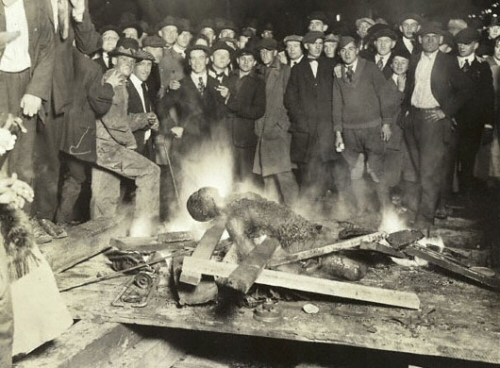
Because the alternative is the Law of Rule.  Which comes from vox populi as readily as from the government.  And which ultimately looks like this from Omaha, Nebraska in 1919.


Or like this


And it sucks.

---------------------
*Note to those of you who want to say, "Told you so" because I'm admitting to actually knowing something when they've accused me of lying when I say that we can never really know anything.  That's an epistemological claim and a quantum uncertainty claim, and I stand by it.  This is a quotidian world claim.  Context matters.  Keep reading.  (Or not.)

**Mark Bennett's commentary is all you need.

Sunday, December 16, 2012

The Problem of Evil - Part I(A)

In a post the other day addressing the problem of evil, I took off from a post by Bill Otis at Crime and Consequences.  Bill quoted Mike Moore, "a wonderfully fair-minded, bright and balanced man" who worked on the prosecution of the case describing Jeffrey MacDonald as "pure evil," and then wondered it people like me 
ever take the time to come to terms with what they are really defending. 
My post was the first part of an answer to that particular question.  My theme was uncertainty, that when you get right down to it, we can never really know, and some things necessarily follow.  I quoted the great lawyer Irving Younger from a short article he had in the first issue of the Georgetown Journal of Legal Ethics.
The best of all guides to thinking about anything is Oliver Cromwell's adjuration to the General Assembly of the Church of Scotland, "I beseech you, in the bowels of Christ, think it possible that you may be mistaken." Life and the affairs of the living are so tangled, the world not only stranger than we imagine but stranger than we can imagine, that all questions are conundrums, no answers "correct." Is it certain that parallel lines never meet? No. Does water freeze at thirty-two degrees Fahrenheit? Only probably. Shall I marry? Who can say. 
This morning, Bill (who apparently drops over here whenever I link to his stuff) put up a comment on that post.   
The premise that human beings are fallible is incontestable. The conclusion that we can't ever know if Defendant X did it is absurd. Every practicioner knows that, in the great majority of cases, factual guilt isn't in doubt and isn't even contested.
I started to reply with another comment, but decided to do it this way, instead.

There's no question we can be certain.  There's no question we often are.  Being certain isn't the same as being right.  As a matter of epistemology, there's a gap between our certainty and what may be, factually, true. That theoretical space sometimes even shows up in the real world of criminal law.

The DNA shows it was a mistake.  The confession was false.  The guilty plea was to avoid risk and was a straight plea because the jurisdiction or the court or the prosecutor wouldn't accept an Alford plea.  Overwhelming evidence was there but it wasn't him.  


All those things happen. Some think they happen a lot.  Some think it's incredibly rare.  But they happen.  And although we can argue about the frequency (and nobody will ever really know what the frequency is), one time makes the case.  To pretend it can't happen and doesn't happen is at best disingenuous.

The only real question is what should follow from the possibility of error even in those cases where it seems inconceivable.  


Here's the next paragraph from Younger.
And yet the world's work must be done. One Oblomov is enough. Thus we learn a conventional certitude, acting as though all were light by blinking the shadow. A simple proof demonstrates that parallel lines meet, but, on the assumption that they do not, the architect builds the skyscraper. Despite extensive knowledge of statistical mechanics, the engineer designs the refrigerator to maintain a constant temperature of thirty-one degrees. 'Le coeur a ses raisons que la raison ne connait point,' and families are raised.
We act, we must act, the only sensible way to act is as if some things were in fact true - even if we can't know (and even if we think we do).

Fair enough.  

So we can accept as factually true that Bill's Defendant X did it even if our absolute knowledge that he did is imperfect and might be wrong. There's no rational alternative to that.  And if what X did is criminal, and if some sanction is appropriate, and if it's really awful and the sanction might then fairly be severe, and if it's something that's likely to be repeated and makes the person who did it a danger to the community . . . .

Well, then, yeah.  And if you're one of those folks who believes that eradicating people who've done terrible things is ok.  Not merely separating them, not treating them, not isolating them, but eradicating them.  Not just from our awareness but from our world.  If you believe that execution is morally right and good public policy.  If you believe that killin' is OK when it's our killin' under some sort of legal justification in a system you trust.

But see, for me there's that nagging doubt, that Cromwellian uncertainty.
I beseech you, in the bowels of Christ, think it possible that you may be mistaken.
Maybe not  about the fact.  Maybe just about the response.  Perhaps your moral sense isn't as perfect as you imagine.  Perhaps the cost of breaking a few eggs is too great to justify the omelet.  Or maybe this is the odd case where the moral balance doesn't come out where you might imagine.

This isn't about the numbers, about whether it's better that some number of the guilty go free than that one innocent be convicted or punished.  (Or, in the alternative formulation, it's better that some number of innocents be convicted or punished than that one guilty person goes free.)  It's not about ratios and how sure you have to or ought to be and whether we can quantify reasonable doubt.

Ultimately, of course, Otis is speaking of the death penalty, about which he and I forcefully disagree.  He would inflict it far more than we do.  If would prohibit it in all cases.  He's sufficiently sure that he (we) can tell often enough who deserves killing.  I don't doubt that there are some people who might.  I just don't think we can ever know with sufficient certainty who they are.

And that doesn't begin to address either the underlying morality or policy or practicality of whether we should be doing it. Or what it says about those of us who would.

Wednesday, October 24, 2012

Praise the Lord and Pass the Condoms

Here are some of the things I haven't written about lately but would have if actually practicing law hadn't got in the way.
  • Steven Hayes wants Connecticut to kill him now.
  • Despite the best efforts of the good people in Florida, they didn't get to kill the Prince of God last night.
  • Executions at a comparative snail's pace this year, despite strides in Oklahoma (4), Arizona (5), and Mississippi (6).  Texas has only managed to commit 10 murders this year.  Nationally, we're sitting at 32.  Of course, Texas has one planned for tonight, and there are more around the country to come.
  • The Oregon Supreme Court has agreed to decide whether Governor Kitzhaber has the right to put off the execution of Gary Haugen even though Haugen doesn't want him to.  A lower court gave Haugen a grudging win on that issue a couple of months ago.
  • It's not just a shame that scientists don't know when and where the next major earthquake will strike.  it's a crime.
  • There may be fewer bayonets now than there were in 1917, but there's still a hell of a lot of them.
As I say, though, I've been busy practicing law.

But this is election season. The lies and half-lies, the misrepresentations. The I-stand-foresquare-and-permanently-for-whatever-position-today's-audience-favors The refusal of any major party candidate actually to address matters of civil liberties and criminal justice, of constitutional rights, of the Rule of Law or the Law of Rule.

So the death sentence and ensuing trial of Khalid Shaikh Mohammad.  (Yes, it is Wonderland:  ‘No, no!’ said the Queen. ‘Sentence first — verdict afterwards.')  It will be scrupulously fair, and we want the world to know it.  Which is why there are buttons in the courtroom that will turn off the microphones to prevent anyone from hearing evidence or argument the government wants to keep secret even if it's already been published in the press.  And why the defendant is prohibited from testifying about how he was tortured by the government.  And why the government will (I'm confident about this, though as with all prediction, it's at least theoretically possible I'll be proved wrong) absolutely reject the defense request to televise the trial live and worldwide.

And then there's rape and the Republican candidates for Senator.

First, Todd Akin who believes that legitimate rape victims have a secret something preventing pregnancy.  Even if he used the wrong word. Of course, maybe it's because doctors don't know about that secret legitimate-rape-contraceptive that they keep performing abortions on women who aren't pregnant.  (Which you might think wouldn't bother the anti-abortion crowd so much since, after all, what''s the harm in aborting a fetus that doesn't exist?)

Then there's Tom Smith who thinks getting pregnant without benefit of clergy is just like getting pregnant from a rape (although, of course, the latter may be gynecologically impossible).

Now, racing hard to catch up to his fellow senatorial the candidates from Missouri and Pennsylvania, comes Indiana's Richard Mourdock who explained last night that when a rape victim get's pregnant, it's a gift from God.  (He didn't say whether that's because only God can override the secret legitimate-rape-contraceptive.)  And, of course, since God's given her that pregnancy via rape, it follows that she should be grateful for the rape.  OK, Mourdock didn't say that last part.  And he says he opposes rape. But really, when it leads to the joy of being the mother of a rapist's baby - truly a special gift from God.  How could she not give thanks for being raped?

Bonus:
My friend Bob W. directed my attention to this (found at Turley)  from the Rev. Phil Snider of Brentwood Christian Church on providing protection for the LGBT community under Springfield, Missouri's anti-discrimination ordinance.  (Please, watch all the way to the end.)

Which gives me the excuse to reproduce Soggy Sweat's brilliant Whiskey Speech.  Soggy was serving his single term in the Mississippi legislature at the time (April 1952), and a hot topic was whether the Magnolia State should repeal prohibition.  Soggy took the question on at a banquet.
My friends,

I had not intended to discuss this controversial subject at this particular time. However, I want you to know that I do not shun controversy. On the contrary, I will take a stand on any issue at any time, regardless of how fraught with controversy it might be. You have asked me how I feel about whiskey. All right, here is how I feel about whiskey.

If when you say whiskey you mean the devil's brew, the poison scourge, the bloody monster, that defiles innocence, dethrones reason, destroys the home, creates misery and poverty, yea, literally takes the bread from the mouths of little children; if you mean the evil drink that topples the Christian man and woman from the pinnacle of righteous, gracious living into the bottomless pit of degradation, and despair, and shame and helplessness, and hopelessness, then certainly I am against it.

But;
 

If when you say whiskey you mean the oil of conversation, the philosophic wine, the ale that is consumed when good fellows get together, that puts a song in their hearts and laughter on their lips, and the warm glow of contentment in their eyes; if you mean Christmas cheer; if you mean the stimulating drink that puts the spring in the old gentleman's step on a frosty, crispy morning; if you mean the drink which enables a man to magnify his joy, and his happiness, and to forget, if only for a little while, life's great tragedies, and heartaches, and sorrows; if you mean that drink, the sale of which pours into our treasuries untold millions of dollars, which are used to provide tender care for our little crippled children, our blind, our deaf, our dumb, our pitiful aged and infirm; to build highways and hospitals and schools, then certainly I am for it.

This is my stand. I will not retreat from it. I will not compromise.

Wednesday, October 3, 2012

Todd Akin: The Gift That Keeps On Giving

What I really wanted to write about was tribal law.
Honest.
My friend Nick F. was a public defender on a reservation.  From him I learned that the Bill of Rights does not apply on the rez.  At least, not in the tribal courts.  Of course, there's an argument (and not a frivolous one) that the Bill of Rights doesn't apply in any of our courts, but that's in practice.  In the tribal courts, it doesn't even apply in theory.  (I gather there may be an exception here or there for parts of the 6th Amendment, but that's getting way beyond my expertise.)
Anyhow, that's what I really wanted to write about.
One of these days.
* * * * *
Then I wanted to write about the quest of 82 year old Bernice Mable Graham Telian.  Seems that her great-great-great-great-great-great-great-grandmother, Mary Barnes, was hanged by the Godfearing paranoids lunatics friends and neighbors who populated Hartford, Connecticut in 1663.  They having concluded that she was a witch, you see.  Bernice wants to clear her name.
Mary Barnes was just one of 11 purported witches hanged in Connecticut between 1647 and 1663, and Bernice is trying to clear them all.  Massachusetts, New Hampshire, Virginia, they've all admitted they screwed up and killing innocent folk.  Not so much in the Land of Steady Habits. 
Bernice is aided in her quest to get the Connecticut legislature to act by the ACLU, NRA, Communist Party, Taliban Connecticut Wiccan & Pagan Network.
Ann Marie Somma of Religion News Network, in the Washington Post.
Now members of the Connecticut Wiccan & Pagan Network are pushing Gov. Dannel Malloy to sign a proclamation to clear the names of the victims. Supporters are asked to send Malloy a postcard that reads: “I am a Pagan/Witch and I vote. Clear the names of Connecticut’s eleven accused and executed witches.”
Anthony Griego, who is heading the effort, said the proclamation is nonbinding and doesn’t open up the door for lawsuits.
“The witch hunts were about fear and intolerance,” said Griego. His group even wrote to Britain’s Queen Elizabeth II seeking a pardon for the accused. The queen’s office wrote back, denying the request.
Drat that Queen.
Look, I tend to be wary of innocence claims, but I think we have a good one here.  Just ask no les an authority than Frank Kirkpatrick (that's him on the right).  He's the Ellsworth Morton Tracy Lecturer and Professor of Religion at Trinity college in Hartford.  He told Somma that
the evidence presented during the trials was flimsy at best. 
You think?
But no, I don't really have anything to say about that.
* * * * *
And anyway, Todd Akin's back.
You remember Todd Akin?  He of the claim that women don't get pregnant when their rapes are legitimate because they have a legitimate-rape-detecting somethingorother that stops those legitimately raping little spermies from interacting with their virginal ova. 
It turns out that Todd's been medically misinformed for a while.  It was back in 2008, we now know (and would have known sooner if we'd paid more attention to C-Span) that he explained how doctors perform abortions on women who aren't pregnant.  Commonly.
Don't want to watch the whole thing?  Here's the money quote.
You find that along with the culture of death go all kinds of other lawbreaking. The not following good sanitary procedure, giving abortions to women who are not actually pregnant, cheating on taxes, all these kinds of things. The misuse of anesthetics so that people die or almost die. All of these things are common practice, and all that information is available for America.
Put aside Todd's medically improper language.  (If there's no pregnancy, there's nothing to abort.  If there's nothing to abort, it's not an abortion.)  I mean, it's possible to do a procedure that would cause an abortion if only the woman were pregnant.  Presumably, that's what he had in what passes for his mind. The man is, after all, a mere lawmaker, charged with writing laws with such precision that the court's cannot misinterpret them.  We can't expect him to use words properly.
Instead, consider the claim that it's "common practice."  You know, like it happens all the time.
  • You have the flu?  Get lots of rest and then come in for a D & C.
  • Broken arm?  Let me just get that splint on and then we'll do a D & C.
  • Heart palpitations?  Let's just do a D & C.
  • Hey, maybe a hysterectomy while we're at it?  Or would prefer a mastectomy?
  • Oh, and may I recommend a fatal dose of anesthesia?
  • By the way, if you pay in cash, I won't have to report it.
h/t Gideon (for Bernice Telian) & Turley (for the latest on Akin)

Wednesday, September 12, 2012

Worser and Worser

Criminal defense lawyer turned federal judge turned Harvard Law School professor Nancy Gertner has an important article/column/post/whateveritis at Cognoscenti, on the WBUR website.
We sentence more people to more time than we used to, she says, not because it serves any rational purpose but because we've largely abandoned the idea of sentencing based on rehabilitation and specific deterrence.  Instead, judges now sentence based on retribution.  The main goal of sentencing is no longer to keep us safe but to punish.
Three decades ago, we considered rehabilitation and specific deterrence to be more important than retribution. And while there were unquestionably problems with that approach, at the very least it enabled a discussion about what punishments made sense to ensure public safety, to minimize recidivism and to balance all of the purposes of sentencing. In addition, it permitted criminal justice experts in various fields – including judges – to participate in a meaningful discussion about crime.
But in the 1980s rehabilitation was discredited. On the eve of sentencing reform in the federal courts, one scholar wrote: “What works? Nothing!” – although he subsequently amended his views. The sentencing focus shifted for the most part to a single purpose: retribution. And for that purpose there were new “experts”: the public. If the most important question had become, “What punishment fits this crime?” Everyone could weigh in. 
And weigh in everyone did.
Now, if all you're concerned about is satisfying public anger or distaste or temper or disgust, if the desire to punish is what drives the system, well, there's no top.  
  • Gee, if that guy only got five years then surely this guy should get 10.
  • 15
  • 20
  • 30
  • life
  • death
  • life and the then death
  • death and then life
Sigh.
Gertner spreads the blame, putting much of it on the media for feeding the public a string of lies and misrepresentations convincing them that tougher, ever tougher sentences are necessary. 
By the late 1980s, crime issues were part and parcel of the political debate — think of the role of the Willie Horton ads in the 1988 presidential election. A decade later came the shock jocks and 24/7 pundits. What the public thinks about the crime, and thus what the criminal “deserves,” came to be shaped — indeed inflamed — by the press.
Meanwhile, criminal justice experts were sidelined. As Duke University law professor Sara Sun Beale argued in the aptly titled 1997 article “What’s Law Got to Do With It?” — criminal justice policy is largely driven by the media. The good news of falling crime rates over the past two decades was rarely reported; the nightly news famously reflected the principle, “if it bleeds, it leads.” The result? Popular punitiveness trumped everything, whether or not it bore any relationship to good public policy.

Gideon and Greenfield use Gertner's piece as a template, agreeing with and extending her anger.  Matt Brown shares their view, giving it the dynamic touch of moving from the abstract argument to the concrete reality with the story of a supposed honor killing of a young woman and its aftermath.  (I've edited slightly and removed links.)
Her father had apparently became enraged by her lifestyle, which by all accounts seemed to be typical of American girls her age. He ran her over with his SUV in a shopping mall parking lot, and the he fled. Based on the theory that it was a premeditated murder to preserve family honor, prosecutors charged him with first degree murder. He went to trial and was convicted not of the most serious charge, but of the lesser-included offense of second degree murder in addition to counts involving aggravated assault and leaving the scene of the accident.
This is where the case ties in with the posts mentioned above. You see, on April 15, 2011, the judge sentenced him to 16 years on the second degree murder count consecutive to 15 years on the aggravated assault count and 3.5 years on the two leaving the scene of an accident counts. The total sentence was 34.5 years, and he was 50 years old at the time of sentencing. Arizona isn’t like other states where a sentence ends up being a lot less than it might seem. Second degree murder requires flat time. The other counts likely require that he serve 85% at the very least. His exact release date, will be June 13, 2041. He will be over 80 years old. Given the typical impact imprisonment has on longevity, he is effectively serving a life sentence.
Which you'd think might be enough.  But no, Matt quotes Detective Chris Boughey.
I wasn't happy.  Still not. Never will be.
Why?
He got off easy, as far as I'm concerned.
Really? Because he could have gotten more time?
Because life isn't long enough?  I've discussed impossible sentences more than once.  (See here, for just one instance.) There are the folks sentenced to repeated executions, to death and then life (or perhaps the other way around), to sentences of multiple century's duration.
To what end?
Is there a lesson, a moral, even a meaning to a sentence that simply cannot be served?  Hard to see what it might be.  Those extra years are numbers for the sake of numbers.
But if we try for some sort of rational sentencing scheme, well then we have actually to figure out what makes sense.
Which requires thought.
And consideration.
And attention to actual evidence rather than spittle.
Sadly, that means we have to deal with the American public which, as Gertner and company point out, isn't really all that concerned with evidence.
After all, the world looks flat.
And the Bible says the world was created in 7 days, so there.
And women don't get pregnant from legitimate rapes, which are kind of like premarital sex.
And Custer died for all of us and Lubbock is ground zero for the UN invasion.
And then there's Osama.  You know, the dead guy.  The one the dems are crowing about having killed.  From Blade Slices, the politics blog Tom Troy writes for the Toledo Blade.
In its poll taken in Ohio Sept. 7-9, PPP says it asked the following question:
Q15 Who do you think deserves more credit for the
killing of Osama bin Laden: Barack Obama or
Mitt Romney?
The answers from Republicans were:
Barack Obama................................................ 38%
Mitt Romney.................................................... 15%
Not sure .......................................................... 47%
The answers from Democrats were:
Barack Obama................................................ 86%
Mitt Romney.................................................... 1%
Not sure .......................................................... 13%
Tom (and PPP) wonder about the numbers from among the Republicans and conclude that they just won't give Obama credit for anything.  That's probably a fair reading of the 38%.  More troubling, though, is the other 72%, and the 14% among Democrats.
Because even if you don't want to give Obama credit, how can you be confused or uncertain about whether Mitt had more to do with it unless you're either wholly ignorant or thoroughly gulled?
And, of course, some of those folks are going to be electing our judges, sitting on our juries, and telling the world that 25 years just isn't enough time for a guy who drove drunk and didn't hurt anyone. 


Friday, September 7, 2012

None Dare Call It Bullshit

But my guy's gonna say it ain't so.  That's reasonable doubt, so I can't be guilty.  Ain't taking no deal.
We've all heard that from our clients.  And then we've watched them hauled off to the pokey because, well, as I've said repeatedly, trials are about proof and proof is whatever the jury believes.  And the jury tends to believe the cops and the alleged victims rather than, say, the defendant's mother or best friend.
But there is this thing about reasonable doubt.  Not just any old doubt.  Reasonable doubt.  And the proof is supposed to be beyond it.
I've been reading (slogging, might be a better word) through the transcript of a capital trial, but really, it could be any trial, civil or criminal.  There are expert witnesses on both sides.  Each is highly credentialed.  And each is determined by the court to be an expert in the same field.*
Each looks at the same evidence.  Defense expert says A.  State expert looks at the same stuff and says not A.
The jury goes back to deliberate.
Guilty or not guilty?
The outcome rests on whether it's A or not A.
The jury has been told it can believe all, some, or none of what any witness has to say.  But it cannot find the defendant guilty unless the state proves guilt beyond a reasonable doubt.  That is, the jury must be convinced, beyond a reasonable doubt, that the state's witness expert is right, that not A.
Here are the three possibilities:
  1. One expert is incompetent.
  2. One expert is a liar.
  3. Experts disagree.
Let's consider those in turn.  
Incompetence
Both experts have credentials, as they say, up the wazoo.  Degrees, affiliations, experience.  Neither side disputed the expertise of the witness on the other side.  And the judge, the authority in the courtroom made specific findings, aloud and on the record in front of the jurors, that each is in fact an expert.
Have the jurors any basis on which to believe one incompetent?
No.  A juror who thought one or the other expert incompetent wouldn't be following her oath.
Lies
Sure, could be.  Witnesses lie under oath all the time.
Cops do it so much there's even a term for it.  It's called testilying.
Now, there are experts and experts.  Some really are whores who'll say whatever they're paid to say.  But there aren't many of them and they don't last long because, frankly, it's obvious.  They're charlatans and mountebanks and everyone can see it.  Competent lawyers don't use them because they won't help.
And serious experts, they don't want to damage their reputation by selling it to the highest bidder.
Disagreement
These two guy looked at the same stuff and just interpreted it differently.  They have specialized training the jury doesn't have.  Education, affiliations, experience.  One says it's flu the other says pneumonia.  One says the widget was badly manufactured, and here's why.  The other says the widget was just fine until the frazmut smashed into it, and here's how I can tell.
Maybe that mushroom is poisonous.  Maybe not.
Maybe global warming.  Then again, maybe it's just getting hotter.
Anecdote
Some years ago, I sat on a jury in a civil case.  The issue, the only issue, was whether the fact that the plaintiff was in more pain after the accident than before was a function of the accident or a coincidentally timed consequence of an earlier injury. 
There were opposing experts.  One we concluded was a whore.  The other admitted cheating the defendant.  One might have been right.  I suppose one has to have been right, in the same way that a stopped clock is right twice a day.  I mean, their positions were X and not X.  So sure, however dishonestly they came to their conclusions, one was right.  It's just that there was no way to tell which one.
Except, she was in more pain after the accident than before.  With no reason to believe the expert who said coincidence, the likelihood was that the accident caused the pain.  Accidents, after all, will do that.
Here's the thing, though.  Civil cases are decided by a preponderance of the evidence.  More probable than not.  She didn't have to prove beyond a reasonable doubt that the accident did it.  If she'd had to prove that, we'd have voted against her. 
End of Anecdote
OK, here's the point.
We look to experts because jurors aren't competent to answer the question.  Is it cancer or a calcium deposit?  Damned if I know.  The jurors really can't tell, either.
Yet they have the job of deciding whether it's proved beyond a reasonable doubt.  When the oncologists disagree.
In an honest system, we'd acknowledge that the state simply hasn't proved it unless one of the experts is believed, beyond a reasonable doubt, to be flat out lying.
Not wrong.
Crooked.
And we'd ask the jury to make a special finding.  If they didn't say 
Fucking asshole lying sack of shit,
then it would have to be Not guilty.  No matter what they decided.
Our legal system doesn't live in that world.  We ask jurors to decide whether the skull fracture was caused by a bat or an auto accident, whether the accused has mental retardation, whether the guy will be dangerous in the future, whether the baby was dropped or thrown. Whether the DNA was his or not.
And, and here's the bottom line.
They can't.  
And yet we send men to death row because of what they say.
In their ignorance.

-----------------
*For any non-lawyers reading this, that's a standard thing.  The lawyers put forth the purported expert's credentials in order to show that the person is, in fact, an expert and asks the judge to make that finding which allows the witness to offer opinions within her field of expertise.

Sunday, September 2, 2012

And Then He Said


`Really, now you ask me,' said Alice, very much confused, `I don't think--'
`Then you shouldn't talk,' said the Hatter.
Louis Carroll, Alice's Adventures in Wonderland
It's not the lies and misrepresentations (see Ryan, Paul).  We are, after all, in the middle of a presidential campaign where truth isn't merely a casualty, it's a no show.
It's not the self-promotion (see Christie, Chris) or the silliness (Eastwood, Clint).
Hell, it's not the conventions at all.
No, it's the stupidity.
Within the last two weeks, we've had Todd Akin's bizarre gynecological discovery of the magic, legitimate-rape-detecting, intra-uterine spermicide.
We've had Tom Smith, Republican Senate candidate in Pennsylvania who, when asked whether he agreed with Akin that abortion should be banned in all situations including cases of rape and incest said it should.  At which point he should probably have packed in his appearance at the Pennsylvania Press Club and gone home. Instead
Asked by a reporter how he would counsel a daughter or granddaughter who had been impregnated by rape, Smith said: "I lived something similar to that with my own family. She chose life, and I commend her for that. . . . Don't get me wrong; it wasn't rape."Smith responded: "Having a baby out of wedlock." After that, he seemed to struggle to articulate what he meant.
"That's similar to rape?" a reporter asked.

"No, no, no," said Smith, who was referring to a daughter's decision to have a child outside marriage. Then he added, "But, well, put yourself in a father's position. Yes, I mean, it is similar."
And we've had Lubbock County Judge Tom Head explaining that he needs tanks because if Obama should win re-election he'll turn the country over to the UN and then send UN troops into Lubbock to stop the civil war that will erupt there.
But I think we have a winner.
Lubbock sits just at the bottom (really, just below the bottom) of the Texas panhandle.  It's but a short trip west to New Mexico where Pat Rogers of the Republican National Committee was upset with Governor Susana Martinez.  See, she attended an annual summit with tribal and pueblo leaders, which, according to James Monteleone reporting for the Albuquerque Journal, the governor is required by New Mexico law to attend.
Rogers, a longtime Republican strategist, wrote in a June email to members of the governor’s staff in June that 2010 Republican gubernatorial candidate Allen Weh “would not have disrespected Col. Custer in this manner.” 
Really. 
The feral genius, Jennifer Abel, was dumbstruck.
Still, I naively thought "These rape comments are so stupid, so bigoted, so utterly clueless, it is not possible for any mainstream Republican to say anything stupider." Wrong! Over in New Mexico, GOP lobbyist and RNC leader Pat Rogers ignored issues of rape and sex altogether, in favor of something even worse: criticizing New Mexico's governor for meeting with Indian leaders, on the grounds that such a meeting dishonored the memory of General George Armstrong Custer.
In the wake of his comments, Rogers resigned from his law firm.  
He hasn't resigned from his elected leadership position in the Republican Party.
Now, I haven't been quite fair.  I said all this within the last two weeks.  Actually Rogers made his boneheaded statement back in June.  Then again, stupidity hath no season.  And the news only broke last week.
This is, by the way, non-partisan.  Joe Biden will be speaking at the Democratic convention in a few days.