Showing posts with label Exoneration. Show all posts

Wednesday, September 7, 2016

He Held Her. They Both Cried.

It was 1983.

She was 19.  He was 22.  She was white.  He was black.  She was raped.  He wasn't the guy who did it.

But she identified him.  In a photo array.  In a courtroom before a jury.  In another courtroom before another jury.  Guilty!

60 years,  Four times what he'd have gotten from the plea offer he turned down even though his lawyer urged him to take it.  After all, he was factually innocent and the truth would surely come out and set him free.  Because God or the American way or just blind faith.

But no.  The trial lasted one day.  The jury was out for one hour.  Guilty!  

And 60 fucking years.  Which might as well have been a lifetime.

He appealed.  You know how that went.
His appeals failed, and he grew to accept that he would die behind bars. He shut himself off to the outside world — an adjustment exacerbated by the fact that, other than a visit from a friend in the first year, no one, not even his family, came to see him. He began to doubt his own innocence. 
There are, of course, two stories here.  

While he was losing his life, the woman he didn't rape* was working on hers.  She was comforted because the guy who'd raped her wouldn't get to do it again.  To her or anyone.  60 damn years.  And he deserved every one of them.

This was Oklahoma, so it's maybe no surprise (it shouldn't be anyway, but hey, this is my storytelling) that a church choir came to the prison for a Christmas musical.  One of the women from the choir noticed him.  She was impressed.  She followed up.  She believed.  They got married.  

When they learned about DNA she cashed out her retirement and used the money to hire a lawyer who managed to get the samples and have them tested. (I keep saying they should test the fucking DNA - this time they did.) 

And of course, since he didn't rape anyone, including the woman who'd repeatedly said he was her rapist, well . . . .  Damn!  He was the first person in Oklahoma to be cleared by DNA.  And after only 13 years.
“There’s nothing I can do to correct the 13 years of injustice that he has endured in this case,” the district attorney at the time, Tim Kuykendall, said in court.
Kuykendall also stressed that blame did not lie with the victim. “I do not believe she lied,” he said. “I think she truly believed [he] was the perpetrator.”
And so he went home, with his wife.  And he found a job and was getting his life together.  Which is maybe a whole lot tougher than you'd think, because really, innocence isn't enough.

Oh, it looked like things were going well.  He had a job.  He had a home.  But it's not that easy.
“I went from 14 years in prison to the streets in less than eight months. No halfway house. No integration. No nothing,” he said.
He also had no opportunities to explore the trauma of having been locked up and treated as a criminal for nearly half his life.
He was maybe ready to howl a little.  His wife, the church lady, not so much.  Still.

They worked together and Oklahoma passed a law to compensate exonerees for their years in prison. 

Well, some exonerees.  They didn't make the law retroactive.  Fucked again.  And then there was the drinking and the drugs and he lost his job and his marriage.  He ended up homeless.
“I had expected that all I needed to do was just get out, and then I can pick up where I started off,” he said. “But what I didn’t understand was that I didn’t know how to live life. I had lost the ability to cope.”
Of course, there was still the woman he didn't rape.  She'd known about the DNA testing, 
but she’d thought little of it, because she was sure there’d been no mistake — she’d even traveled to prison to fight his parole. So the disclosure was hard to accept. It brought back terrifying memories of the attack — and the realization that [he] was not the one responsible. 
And that, of course, in another way, she was. The day he was exonerated and set free
She knocked on the door of a church, weeping, and asked to see a pastor. “I told him I just needed God’s mercy,” she said. “I needed forgiveness and mercy.”

About 6 years later, the woman he hadn't raped called the wife he no longer had.  They spoke for a while.  How is he?  How is he doing?  She wanted to know.  And the ex-wife, How did you do that to him?  How could you?

In the fall of 2012, some 30 years after he was accused and tried and convicted of the rape of the woman he didn't rape, some 7 years after he was exonerated, he bottomed out.  He started to reclaim his life.  He got housing.  He got disability payments.  He went into recovery in a 12-step program.  

Last year, he was to speak at high school with a bunch of other exonerees.  The woman he didn't rape was an alumna.  She saw reference to the program, saw his name as one of the panelists.  She screwed up her courage.  

She tapped him on the shoulder.  Some 33 years after the fact.  After they'd last seen each other - her glaring and him mystified - across a courtroom.
“Could I talk to you for a minute, please?” she asked.
He followed her into a hallway, where she told him her name. His gut skipped.
She stepped back, afraid of how he’d react.
“I’ve been waiting so long to say this: I’m so sorry,” she said. She crumpled into tears. “I’m so, so sorry.”
[He] listened in amazement. It was the first time anyone had apologized for what had happened to him. “It’s OK,” he told her. “I forgive you. I forgave you a long time ago.” He put his arms around her. He began to cry, too.
It is one of the myths lies they tell people who've been victimized.  You'll only feel better if the monster is destroyed.  Or at least kept away.  But they learned otherwise.  Her apology freed him. His forgiveness cleansed her.  They'd both been victims.

His name is Thomas Webb.  At her request, the NBC News team that put this story together refers to her, at  as K.  I don't know how she picked that.  I assume it's her initial.  Or maybe she'd been reading Kafka and sensed - if only subliminally - a connection to Joseph K.
Every so often, he and K meet on lunch breaks. They check up on each other. He calls her sis. She says she loves him like a brother.
Their friendship has brought each of them a level of peace that neither thought possible.
“She’s able to move on with her life now instead of being stuck in fear and guilt because of me, and I’m able to be free from the resentment, the anger, the disappointment,” Webb said.


---------------
* Don't be a smartass.  Yes, There are actually millions of women, billions of women he didn't rape.  But you know what I mean.

Saturday, April 18, 2015

You Think Maybe a Bit of Exploitation by the Media?

Then Marty Stroud went to meet Glenn Ford.

Stroud was the prosecutor who put Ford on death row 30 years ago.  Ford's the innocent guy Stroud put on death row 30 years ago.

Stroud's the guy who wrote an apology to the Shreveport Times.  Stroud's the guy who now says he was a kid, concerned with winning at all costs.  Stroud's the guy who says he cheated to get Ford convicted and sentenced to die.  Stroud's the guy who says Ford should get all the money Louisiana makes available to the wrongly convicted and the should get a lot more.

Ford's the guy who lost 30 years of his life because of what Stroud did.  Ford's the guy who got out of prison a month ago and then discovered he has stage 4 lung cancer and only a few more months to live.  Ford's the guy who, the courts said, won't get any of the money Louisiana theoretically makes available to the wrongfully convicted.

So Marty Stroud went to meet Glenn Ford.

Ford, who was released from prison with a manila envelope holding a $20 debit card ('cause they're so damned generous) and maybe the 24 cents he had in his account, lives on the kindness of volunteers and from donations.  While he dies of the disease they didn't bother telling him he had.

I'd like to think ABC News paid Ford for the privilege of ogling the meeting.  They certainly had the cameras there.  They picked Stroud up at the airport and drove him to the meeting.  They had the cameras in the car, too.

When Marty Stroud went to meet Glenn Ford.

And Marty Stroud said he was sorry.  He said he hopes he's a better man now.  He said he's learned.  

Ford said anger's not what drives him.  Trying to stay alive is what drives him.

Stroud said he's thought "for a long, long time," about this - whichever "this" exactly he meant.
I want you to know that I am very sorry. It's a stain on me that will be with me until I go to my grave, and I wasn't a very good person at all. I apologize for that.
But 30 years is a hell of long time.  Ford:
I'm sorry.  I can't forgive you.
They shook hands.  Wished each other well.  

Stroud left.  Ford, who really had nowhere to go and no means to get there, stayed.  The volunteers who care for him came and circled him.

ABC kept the cameras rolling for a bit.

When Marty Stroud went to meet Glenn Ford.

Videoshttp://abcnews.go.com/US/exonerated-death-row-inmate-meets-prosecutor-put/story?id=30399619

Thursday, September 18, 2014

So We Can Remember To Be Perfect From Now On

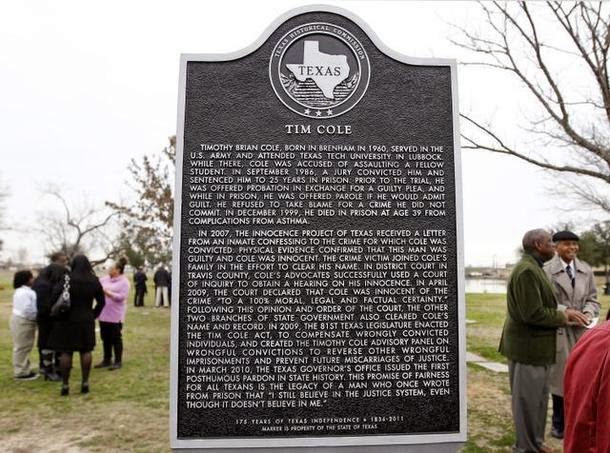
Tim Cole was 39 when he died from asthma-related heart issues in 1999.  He's buried at Mt. Olivet Cemetery in Fort Worth, which is where he's from.  But it's not where he died, and it's not where the story began. 

It began in 1985.  In Lubbock, hard by the campus of Texas Tech University.  That's where and when Michele Mallin, 20 years old, a student at Tech, was taken at knife point and raped.  

Tim was 25.  He'd served a hitch in the army.  Now, he was following his sister's footsteps, going to Tech as she had.  He was working on a degree.  His life ahead of him.

Michele Mallin picked Tim Cole out of a photo lineup, identified him.  That man, she said.  He's the one who raped me.  

No, no, no.  You're mistaken.  He said.

The jury sided with Michele.  On September 17, 1986, 28 years ago yesterday, Tim Cole was sentenced to serve 25 years in prison.  Several times he was offered parole.  All he had to do was admit that he'd raped Mallin.  He wouldn't do that, couldn't do that.  Because, he said, said again and again, he hadn't raped her.

For 13 years, Tim sat in Texas prisons.  Insisting on his innocence.  In December, 1999, at the age of 39, he died.

In 2007, after the statute of limitations on Mallin's rape had run, a guy named Jerry Johnson, who was doing life for rape, sent Tim a letter.  Sent it to his home in Forth Worth, because really, that's where you'd expect him to be, out on parole and all.  Except of course Tim was dead.  Had been for 8 years. Still, it was a hell of a letter.  I raped Michele Mallin, Johnson said.  I'll take a DNA test to prove it was me and not you. 

Too late for Tim, of course, but still.

Ruby Cole Session, Tim's mother, took that letter to prosecutors and legislators.  And as prosecutors and legislators typically do when someone gives them a letter like that, they blew her off.  But she was nothing if not persistent.  She kept at it.  The Texas Innocence project happened to be based at the Texas Tech law school.  It took on the case.  

In 2009, a decade after he died in prison where he'd spent 13 years for a crime he didn't commit, Tim was exonerated.  The legislature passed and the governor signed the Tim
Cole Act granting compensation to the wrongfully convicted.  The next year, Governor Rick Perry (yes, that Governor Rick Perry) granted Tim a full pardon.  They put up an historical marker about Tim in the Mt. Olivet Cemetary.  It's the first in the nation about a wrongful conviction.

And in Lubbock yesterday, 28 years to the day after he was convicted, on the corner of the Tech campus in what's now the Tim Cole Memorial Park (or something like that), they unveiled the Tim Cole Memorial.

Some 400 people attended the ceremony honoring Tim.  They got to listen to politicians and preachers.  They heard from Rick Perry and from Wendy Davis and Greg Abbott who are campaigning against each other to succeed him.  They heard from the candidates for Lt. Governor, Dan Patrick (who voted against the Tim Cole Act) and Letitia Van de Putte.  A number of exonerees were there and stood up to be applauded as if having been wrongly convicted was something for which they deserved praise. 

One might be forgiven for thinking there was more than a bit of posturing, of politicking going on while everyone got to deny that there was anything political about it.  Indeed, Perry said there was nothing political about the ceremony.  So did Jeff Blackburn who founded the Texas Innocence Project.

Of course, they were both lying.  

But here's the thing.  Tim Cole was, in fact, a quite extraordinary man.  From his prison cell he encouraged his siblings in their college classes, helped set them toward their careers.  He convinced his sister to stay the course at the Tech law school.  He gave thousands of dollars to charity, money he got from the GI Bill.  He wrote, in a letter from prison,
I still believe in the justice system, even if the justice system doesn't believe in me.
It was Constitution Day, and Tim's brother, Cory, reminded the crowd.
We the People of the United States, in Order to form a more perfect Union, establish Justice
Tim's mother wasn't there.  She died last year.  But Michele Mallin was.  She'd joined in the effort to clear Tim's name.  She'd developed a relationship with his family.  Tim's mother had told her
You're a victim, just like my son was.
Jim Bob Darnell was there, too.  Jim Bob (hey, it's Texas; that's how he's known) was acting DA when Tim was prosecuted.  He actually tried the case.  These days, he's a judge.

The memorial itself is a 13-foot bronze sculpture of Tim.  He's standing, facing toward the Tech law school several blocks away.  He's holding two books.  On the spine of one, it says, 
Lest We Forget.
At the base of the sculpture, in large bold lettering, it says
And Justice For All.
When it was over, news reports say that family and friends (and maybe the politicians, but the reports I've seen don't say) sang "We Shall Overcome."  As if all it takes is will to ensure that no innocent person is again convicted of a crim.

Tim Cole died in prison.  An innocent man.  Statues won't change that.  

He's not the only one.  He's just one we happen to know about.  Who lets a lot of people pat themselves on the back and vow that we'll do better in the future.  Because you know, we can prevent wrongful convictions if we're just more careful.  

It really is a fine sculpture.  

And a noble enough fantasy.  


--------------------
Disclosure: I was a student at Tech law school when Michele Mallin was raped, a student when Tim Cole was convicted and sent to prison for what turned out to be the rest of his life.   I'd like to say I remember something about the case, recall having questions about it.  I can't.  I have a vague recollection of there having been a vicious rape of a student near the campus.  I wouldn't swear it was that rape.  I wouldn't swear the memory is even true.

Friday, February 28, 2014

They Didn't Just Kill an Innocent Guy; They Also Lied about It

Let's recap.

Cameron Todd Willingham was sentenced to death and then executed by the good people of the Great State of Texas (as they sometimes call it) for setting his house on fire and burning up his kids.  

In fact, there's no credible evidence that the fire was arson.  Every competent investigator, everyone who's studied fire, every one of them agrees.  The fire team that said it was arson based their conclusion on tradition and guess work and what one of the scientists called "old wives tales."  Before he signed off on the execution, Rick Perry was given a report telling him just that.  Did he read it?  Damned if I know.  But Perry said Willingham was a "monster."  Enough reason, that, to kill him even if he was factually innocent.  I mean, really, a monster.

OK, so there's no real evidence that Willingham did it and lots of evidence indicating that he didn't, that the fire was an accident.  

And then there was the investigation by the Texas Forensic Science Commission which Perry managed to disrupt and that then said,
Yeah, problems, but we're not going there.
And, well, it kinda just sat.

Except that it's kinda like that loose thread that once you start pulling it the whole sweater unravels. 

See, along with the junk science arson evidence, the other thing that got Willingham convicted was a jailhouse snitch, a guy named Johnny Webb.  Webb told the jury that Willingham confessed to him. Well, sure.  Of course he did.  Criminals do that all the time.  And public spirited guys who are in the next cell run to the police and, because they are noble and decent and want to see bad guys pay rat the confessor out.  And then to the jury.  Which eats that shit up.  

And as the prosecutors said, even if the arson investigation was just completely fucked up, the guy freely confessed to Webb, who of the goodness of his heart . . . . Which is more than enough evidence to convict and kill. 

Oh, sure, Webb's tried to recant.  And there's the fact that it wasn't arson, so the confession's pretty clearly bogus.  But still.

John Schwartz reports in the Times.
In recent weeks, as part of an effort to obtain a posthumous exoneration from the Texas Board of Pardons and Paroles and Gov. Rick Perry, lawyers working on Mr. Willingham’s behalf say they have found evidence that Mr. Webb gave his testimony in return for a reduced prison sentence. 
Ooops.  What's that?  A deal?  You mean it wasn't just 'cause Webb's public spirited?  He was bought and paid for?  Damn.  Shit.
Evidence of an undisclosed deal could have proved exculpatory during Mr. Willingham’s trial or figured in subsequent appeals, but Mr. Webb and the prosecutor at trial, John Jackson — who would later become a judge — explicitly denied that any deal existed during Mr. Webb’s testimony.
. . .
[Because] recantations in criminal cases are relatively common, . . . the biggest open question has been whether Judge Jackson and Mr. Webb had made a deal. Judge Jackson, who has retired from the bench, continued to insist there was no deal, even in an interview last year.
Liar, liar, pants on fire.
What has changed is that investigators for the Innocence Project have discovered a curt handwritten note in Mr. Webb’s file in the district attorney’s office in Corsicana. The current district attorney, R. Lowell Thompson, made the files available to the Innocence Project lawyers, and in late November one of the lawyers, Bryce Benjet, received a box of photocopies.
As he worked through the stack of papers, he saw a note scrawled on the inside of the district attorney’s file folder stating that Mr. Webb’s charges were to be listed as robbery in the second degree, not the heavier first-degree robbery charge he had originally been convicted on, “based on coop in Willingham.”
Bingo.

In truth, there's nothing much surprising in this.  The snitches who testify that the bad guy in the next cell, a guy he's never met before, just opened up and described the horrific things he's done and that the government is trying to prove  - well, they're pretty much always bought and paid for.  They'll generally make up any bullshit the state wants to hear.  For a price.

And the prosecutors know that if they just lie about there having been a deal, the testimony is more credible.  So lie they will.  Not always, but often enough.  And we see through it.  And the jury, which hasn't spent much time in the trenches, thinks the emperor is wearing the finest raiments.

And then, one day, sometimes.  

Barry Scheck called it a "smoking pistol."

Or maybe it's the chickens coming home to roost.  And shitting all over former judge Jackson.  And his case.

The hope, of course, is that this will be the final piece leading to a formal exoneration and admission that they killed an innocent man.
Mr. Willingham’s stepmother, Eugenia Willingham, said: “I’m real thrilled that all this has come to light. We’ll see what happens. I can’t help but be hopeful.”
His cousin Patricia Cox said that if an exoneration does occur, the family has no plans to press for damages. “We’re not asking compensation,” she said. “We’re asking justice.”
I still don't know just what justice is, but I know what she's asking for.  And I'm on her side.

Sunday, June 16, 2013

Unitended Consequences and Unrecognized Victims

Guilty or innocent, being charged with a even a relatively minor crime fucks up your life.  And the lives of your family and friends. 

There's the financial hit, of course.  Hiring a lawyer if you have the funds isn't cheap.  Bond if you can make it.  Maybe you pay in cash, maybe you pay a bondsman, maybe you put your house up, or your parent's house.  Or your friends'.  (Just try asking someone to mortgage their house - or put it in escrow to the court - for your bond if you want to learn who your true friends are.)  Even if you're out on bond, you're likely to lose your job.  And your spouse may lose her/his job, too. 

There's the embarassment factor.  You're ashamed to go outside because you think the neighbors are pointing at you.  And they are.  Invitations to parties dry up.  Your kids friends aren't allowed to go to your house anymore.  And your kids aren't welcome at theirs.  Your kids are taunted at school.  You don't get the newspaper any more because your picture might be in it.  You don't watch the news on TV anymore, either. 

Everyone tries to keep a brave face, but it's becoming clear that this whole nightmare won't go away quickly.

And of course, if you're in custody it's even worse.  See the family only through glass and talking on the phone.  Or maybe it's a contact visit or at least one across a table but you're in a room with other people who are all jabbering away and frankly it's ugly and why should the family have to be virtually strip searched to see you.  I mean, they didn't do anything wrong.

But surely the truth will come out at trial and it will all be well again.

Except it never will.  Because the accusation is always there and the neighbors will always wonder and you're out all that money and your old job isn't really just waiting for you.  And OhMyGod (sorry, I don't do teenage/twitter shortcuts) what if you're actually convicted.  Even if you're innocent.

I've long said that the unrecognized victims of crime are the family and friends of the accused and convicted.

Meet Steven Phillips.  
In 1982, Steve and Traci Phillips were starting a new business.  Traci was pregnant with their first child.  Life was good.  

Then Steve was charged with a string of sex crimes.  Brandi Grissom in the Texas Tribune picks up the story.  
In two trials in 1982 and 1983, he was convicted based largely on eyewitness identifications, despite his wife’s vehement protestations from the witness stand that he could not have committed the crimes.

He pleaded guilty to additional charges to prevent a third trial and a likely life sentence. She said she spent the next decade visiting him in prison, raising their son, sending money for items her husband needed, and hoping to find a way to get him out.
That's what people do for the ones they love who are in prison.  But you know, those visits, the cash, the raising the kid.  Trying to make the child understand why Daddy isn't home.  And the neighbors and the other kids at school and . . . .
In 1992, they were divorced.
Naturally, that isn't the end of the story.  Because Traci was right all those years ago back on the witness stand.  Steve didn't do it.  He'd been in prison 24 years when the DNA tests came back.  (24 years.  You guys in Florida paying attention?)  Wasn't him.  It was another guy.  Steve wasn't just released, he was declared innocent.
One of the things Texas does right these days is compensate the wrongly convicted.  At least some of the time.
In 2009, the state awarded him lump sum payments totaling more than $2 million, and a monthly annuity of more than $11,000. In total, his compensation package for the time he spent in prison is worth nearly $6 million, not including health care and education benefits he is also eligible to receive.
Which isn't bad, though really,there's no amount of cash and benefits to make up for 24 years of horror, lost opportunity, lost family, lost life.  Still, $6 million is a lot of swag.
Re-enter Traci Phillips.  She's now Traci Tucker, and she figures she's entitled to a share. 
“He was a victim of a wrongful justice system, and his family was also,” Tucker said.
Which is certainly true.  And is how the judge who awarded her a bit over $150,000 looked at it.  Steve, of course, doesn't quite look at it that way.  The $6 million he got was for what was done to him, not to them.  And while he appreciates her testifying for him, well, yeah.  But 24 years.  And she never came to visit all that often even before the divorce.  And there are the other lawsuits.  And the legal fees (he figures some $300,000 so far).

On the other hand.
Matt Kita, a lawyer for Tucker, said the law should account for the damage done to spouses of the wrongfully convicted, who lose companionship and income and face the stigma of having an incarcerated mate.
“She could have been an awesome spouse, or she could have been a terrible spouse, but the law hosed her,” Kita said.
Which is absolutely true.
But still.  He spent 24 years in the embrace of the Texas prison system.  In time, she got on with her life.
Tucker said she hoped the case would prompt legislators to consider the havoc that wrongful convictions wreak on families.
“It’s not all about the money,” she said. “There’s just no recognition whatsoever. Just ‘sorry folks, sorry we ruined your life and took your provider and your best friend.’ Nothing.”
Frankly, I can't imagine that the Lege is going to decide to provide compensation for the former spouses of the wrongly convicted.  But even the spouses and children and other family and friends of the rightly convicted suffer for what they didn't do.

And nobody cares.  Which is a monstrous wrong.

We put them on welfare, deny them housing, destroy their lives.  To prove how tough we can be on their guilt spouses and parents and family and friends.  That'll teach 'em to love people who get accused of crimes.  Even if they're innocent.

Steve Phillips spent 24 years in prison for a series of crimes he didn't commit.  Everyone suffered.
It is a question that one legislator who helped write the compensation law said lawmakers had not considered.
“This is an example of the law of unintended consequences,” said state Rep. Rafael Anchia, D-Dallas. “We did not think about entitlement by spouses who had become divorced from these innocent men while they were in prison.”
I'm sure they didn't. Didn't think about the ones who stayed married, either, I'd wager.  Or their kids.  Or the parents and siblings and lovers and friends.
Unintended consequences.   Yeah.  And unrecognized victims.

Saturday, October 27, 2012

Uprooted and Dislodged: The Experience of Exoneration

A few years ago in Cleveland.  Maybe 6 or 7 of us were walking back to the hotel after a dinner party for speakers at the seminar for capital defense lawyers.  All but one were lawyers.  The one was Ray Krone, the 100th person to be exonerated from death row. 

He'd been convicted of kidnapping, raping, and murdering Kim Ancona in 1991.  In fact, he'd been convicted of it twice.  Except Ray didn't do it.  It was, instead a guy named Kenneth Phillips.  Ray was wholly innocent.  He'd been convicted based on junk science by an incompetent self-proclaimed forensic dentist.  And he was at the seminar to tell his story, to remind the practicing lawyers there that we were dealing with real people with real lives.  And that, at least sometimes, they were really truly factually innocent.  Ray does a lot of these speaking gigs now.  He talks to lawyers and activists and legislators.  Telling his story.  Standing up, as the organization he helped found says, as a Witness to Innocence.

Anyway, we were walking back to the hotel when some guy came up to us looking for a handout.  Maybe he had a story.  Maybe he said something about needing money to feed his family.  Maybe he just wanted cash to buy a bottle of something or some controlled substance. Maybe he just stuck out his hand at this bunch of guys walking together and talking, looking much better off than he did.  I don't remember.

Here's what I remember.  Most of us were set to just keep walking.  Ray reached into his pocket and gave the guy something: a five or a ten or a twenty.  Whatever it was, one bill and more than a single.  And as if on cue, the rest of us reached into our pockets and matched what Ray had done.  I'm pretty sure the guy didn't know just how he'd hit the mother lode, but he knew he had.

See, for Ray Krone it's not theoretical.  He's stared right at the gates of hell.  Shit, he entered.  And he's one of the comparatively lucky ones who came out the other side.  And by his example, he shamed those of us who do this work, care about the work and the guys.

Because it's not just our clients and our cause.  There are lots of people who need help.  Who have been beaten.  Who are lost.  There's only so much we can do, but there's always more.

OK, really, I just wanted to tell that story, not to moralize.  And I wanted to tell that story as a lead in to talking about an absolutely terrific and important book, Life after Death Row: Exonerees' Search for Community and Identity, written by a couple of academic sociologists, Saundra D. Westervelt and Kimberly J. Cook. 

What they did was track down and interview 17 men (including Ray Krone) and one woman who were exonerated after having been sentenced to be killed. 18 people who were, per the title of another book, Back from the Dead.*

They weren't interested in how these men and women managed to get convicted of murder and sentenced to die even though they were factually innocent (though they give quick summaries of how it happened).  That's an important subject that's been written about a fair amount.  See, for instance, Actual Innocence: When Justice Goes Wrong and How To Make It RightFalse Justice: Eight Myths That Convict the Innocent; or Convicting the Innocent: Where Criminal Prosecutions Go Wrong just to name three. Nor were they interested in how they managed to get relief, though that's there, too.  Nor was it about how they lived on death row and then (for most) in general population.  

What Westervelt and Cook tackle here is the far less sexy topic: What happens now? 

One day you're in prison, maybe on death row.  You've been convicted of being a monster.  The jury said you should be killed for what you did.  You know you didn't do it.  You've been trying, maybe for years, to make people see that.  And there's this scimitar hanging over your head, waving and waving and getting closer to your neck.  And you're this innocent guy trapped in a nightmare, living in a cage, alone, isolated, maybe abandoned by family and friends who didn't realize what a fiend you are.  Except you're not.  And then one day, almost out of the blue.

Gary Gauger, "I didn't know I was going to be released until the day I walked out the door."  Gary James learned the night before - when he saw it on the 11 o'clock news.  A guard slipped a note under Charles Fain's door telling him a couple of journalists wanted to talk with him; he was on the street three hours later.
Scott Taylor found out by watching his pardon announced on television.  The guards took him immediately from his cell to another part of the prison to process his release, although the prison administrators were confused about what paperwork to file.  They too had had no time to plan.
And then? It's not like they gave these folks a few thousand bucks to get back to home, wherever that might be, and stay in a hotel until they found a place to live and then a job and, hell, even a bunch of new clothes.  Parolees get services.  They may be shitty, oppressive, unfair, even cruel.  But there are services.  People who've served out their whole sentence may do time in a halfway house to give them a chance to ease back into society, to learn about how the world has changed while they've been away, to find a place to live and a job and . . . .

These guys (and the gal) got zip.  Sabrina Butler:
No money.  No nothing.  They didn't give me jack! They just took the handcuffs off me and sent me out the door.
Hey, what'd she need?  Five and a half years in prison, two and a half on death row.  Everyone figures she murdered her baby boy.  But she's innocent.  That's cool.  She knows.  We let her go.  What more could she want?

Maybe family took them in.  But maybe family wasn't all that sweet, and how long do you want to spend sleeping on some relative's couch when you can't pay for food and you're just clogging their space and maybe can't stand to be touched because fuck, you've been locked up in a place with two rigid codes of conduct - one from the guards and one from your fellow inmates and suddenly you can do what you want as long as it doesn't actually involve stepping outside or dealing with the world.

They come out with PTSD but no mental health services.  They come out into a community where maybe there are still folks who think they got out on a technicality and really are the monsters who should have been killed just like the jury said.

That's what Westervelt and Cook look at.  Through the words and stories of these 18 men and woman.  This is what it's like for us, they say.  And though it varies from person to person, and they each deal with the problems and possibilities in their own ways as controlled, in part, by their circumstances, the commonalities are real.

I've met a few of these 18.  I've spoken on panels with them, had dinner with them, spent hours talking with them.  I've read and heard the stories of some of the others.  Their voices are powerful because they speak from the heart and know, from experience, what the rest of us can only imagine.  And often imagine wrong.

Their message, through Westervelt and Cook is clear (though for the non-academic it sometimes seems a bit jargony and, well, academic):  They need to be reintegrated into society.  They need resources - not just financial though god knows they deserve compensation - but also services (mental health, medical, job training and placement, housing, social work). 

They need to learn to deal with grief and loss.  Kirk Bloodsworth's mother died 5 months before he was exonerated and released.
Five months.  That's all it was.  Five months.  She was gone.  I had to view her body in handcuffs, shackles and leg chains for five minutes. I couldn't even go to the funeral.  It had literally killed her, this mess.  She wouldn't go see a doctor because it cost too much money.  She was always looking out for me.  She hadn't bought a dress . . . she hadn't bought nothing. . . . She didn't want to spend the money for looking after me.  It was Christmas of 1992 and she came [to the prison to tell me she was dying]. It was the last time I seen her alive.
Bloodsworth remembered when he first returned to his childhood home after his release to find his mother's clothes still hanging in the closet.  He nestled into the clothing and surrounded himself with her things and her smell.
Of course the loss is not just the exoneree's.  Westervelt and Cook write,
It is misguided to think that the impact of a wrongful capital conviction is felt only by the exoneree.  While the exoneree certainly bears the brunt of the aftermath, the ripple effects of the loss, grief, and stigma are felt by all of those within their immediate circle of support. 
As Greg Wilhoit said, describing his relationship with his parents after he was released,
Our anguish was overlapping.

Perhaps more than anything, what they need is what they are most consistently denied: An apology.

These folks didn't end up on death row by accident.  Police arrested them.  Prosecutors tried them.  Juries and judges convicted and sentenced them.  And then, all too often, police and prosecutors hid evidence that they were innocent or fabricated evidence that they were guilty or just fought to deny them the opportunity to (as I keep writing) test the fucking DNA.  Or maybe it was just a good faith mistake.  

The fact though, is that no matter how you cut it, however it happened, these folks were wronged.  As is every person convicted of a crime he or she didn't commit.  And the system, that vaunted system that fights the efforts to free them, that denies there are mistakes, that even denies, some, that these folks are innocent, well, systems don't apologize.

But people can.  The prosecutors who told the jury.  The cops who told the prosecutors.  The jurors who told the judge.  The judges who told the lawyers.  They should stand up.  Admit it.  We fucked up and you suffered for it.  Open and honest remorse and apology would go a long way.  (And, I might add, punishment for those who lied and cheated and broke the rules to ensure convictions - or to keep them in place.)

Life after Death Row stands on its own as a cry for us to reconsider how we treat people.  Not just exonerees, but all those who we victimize and then virtually abandon.  They need and deserve more than we provide.  Much more.

Life hasn't been easy for these folks.  They've dealt with drug abuse, alcoholism, domestic violence, poverty, ostracism.  They've been charged and convicted of new crimes. (One, Joseph Green "Shabaka" Brown was charged with the murder of his wife last month.)
They emerge profoundly altered people into a foreign world, uprooted and dislodged from all they knew before.
A couple of months ago I reviewed Killing McVeigh: The Death Penalty and the Myth of Closure. It talks about how the survivors deal with their loss and grief and the system.  Life after Death Row takes us to another place, another group, seemingly so different.  Yet surprisingly needy of some of the same things.  

Frankly, these people should be talking to each other.  The good news is that through their books, they can talk to the rest of us.  Who should be paying attention.

--------------------
*Back from the Dead: One Woman's Search for the Men Who Walked off America's Death Row, Joan Cheever's curious, sometimes wondrous and sometimes annoying story of tracking down and meeting many of the men who were removed from death row in 1972 when the Supreme Court declared that all current capital punishment laws were unconstitutional.

Monday, January 23, 2012

Welcome Back, Joe


That was then.
This is now.
Then was decades on death row.
Now is freedom.
Then was convicted (along with Michael Keenan) of killing Anthony Klann on the word of Edward Espinoza, co-defendant, juvenile, probable killer.
Now is exonerated.
Then was the government hiding evidence of innocence.
Then, but later, was the government hiding more evidence.
Then, but later, was the government dicking around yet again.
Then, but later still, was the federal judge saying
Enough.  You can't prosecute him again.  
And they really couldn't have, since they had no evidence.  None.  Not any more.  Not when they had to tell all the truths.
Then, but later still, was the Sixth Circuit Court of Appeals agreeing.
It's over. Let it go.
Now is the big boys and girls, the United States Supreme Court, refusing to get involved.
11-672
BOBBY, WARDEN V. D'AMBROSIO, JOE
The motion of respondent for leave to proceed in forma pauperis is granted. The petition for a writ of certiorari is denied.
Now is when the Cuyahoga County Prosecutor has to suck it up.
His name is Joe D'Ambrosio, and I've written about his case before.
Anthony Klann was murdered in 1988.  D'Ambrosio, Keenan, and Espinoza were charged with killing him.  Espinoza, who was a juvenile and never eligible for death under Ohio law, cut a deal and testified against both D'Ambrosio and Keenan.
Over the years, as evidence hidden by the Cuyahoga County Prosecutor was uncovered and new evidence developed, the picture changed.  But the state's commitment to killing D'Ambrosio and Keenan never wavered. 
And now it's not just that they can't kill D'Ambrosio.  It's not just that he's out of prison (as he has been for a bit now).  He's been exonerated.
And, although I don't say this often, it happens that he's also innocent.
Which is no small thing.
Here's that "Now" picture again.

Welcome home, Joe.

Saturday, December 17, 2011

When 15,000 Hours Isn't Enough

15,000 hours.
That's fifteen thousand.  There are 168 hours in a week.  That comes to a bit over 89 weeks.  Not work weeks.  It's 350 of those 40 hour weeks.  No.  89 weeks at 24/7, 89 weeks of 168 hours each.  Or do it differently.  There are 8760 hours in a year.  And then most of a second year.  Non-stop.  Meal breaks? Nope. Sleep? It is to laugh.
15,000 hours.
Of course, it doesn't work that way.
The 15,000 hours have been spread over 15 years.
And they've been put in by a total of 25 lawyers.
Who aren't yet done.
Though they've pretty much cut the heart out of the case.
It was 1983 when Joe Belenchia, the manager of a grocery in Memphis, was shot and killed by someone during a robbery.  A customer identified Erskine Johnson, though he said he wasn't sure.  Someone else said she had been told Johnson was the killer.  Johnson said he was innocent, but the jury didn't buy it.
He went to Tennessee's death row in 1983.
In 1995, Cleary Gottlieb Steen & Hamilton, a white shoe law firm with offices on five continents but that calls home a space next to Zuccotti Park where the partners (who pretty much occupy Wall Street) probably didn't Occupy Wall Street, took on the case pro bono.  They assigned then-senior associate (now partner) David Herrington to the case.  And they worked it, he and the firm.  For 15,000 hours.  And 15 years.
They did the sort of work they can do because 15,000 hours over 15 years is pro bono for them.  They can get 25 lawyers involved at least for bits of work over that 15 years. And they've got the money to hire all the investigators and experts and to jet to the hearings and who knows what all.
And they did.
And they needed to.
Oh, some progress came fairly quickly.  In 1999, after just 14 years on death row, a Tennessee trial judge vacated Johnson's death sentence. Seems police had hidden the fact that they knew he couldn't have also shot a store customer (who lived), but it was the claim that he did shoot the customer that made Johnson  eligible for death.  14 years.  Or maybe 16, since it was 2001 when the Tennessee Supreme Court affirmed that decision.  Or maybe it was 19 years, since it was 2004, before the state abandoned the effort to get him back on the row with a new death sentence. So, yeah, 19 years.  Life to go.
Life is something, of course. But it's still a death sentence, still Death in Prison, albeit with a different mechanism for the death - nature rather than paid killers for the state.  And if you're innocent, as Johnson claimed . . . . 
Here's Julie Triedman for the AmLaw Daily.
Herrington recalls that the Cleary team got its first break while poring over prosecution and police records. Those records, he says, showed that prosecutors had withheld information from Johnson that supported his claims of innocence.
Among other things, Herrington says, the Cleary lawyers turned up testimony from a store customer who had identified a member of the local "Brown Gang," not Johnson, as the gunman, as well as testimony from a teenager who had told police that he saw two members of the Brown Gang changing the license plate on the alleged getaway car just before the robbery occurred. The Cleary lawyers also learned that police knew the car in question had been stolen from the St. Louis airport, and that members of the gang often stole cars there and brought them to Memphis.
. . .
Cleary's work on the case wasn't done. The firm's investigators tracked down a new witness being held in a Kentucky prison who undercut the credibility of the prosecution's key witness at trial. The Kentucky convict—a Brown Gang associate—said that the prosecution witness had close ties to a Brown Gang member who had herself been implicated in the robbery—giving the witness a motive to testify dishonestly.
The trial court said that wasn't good enough.  You had no right to take so long to find compelling evidence that he's innocent.  We don't care.
The court of appeals did care.
So did the Court of Criminal Appeals.
Back to the trial court, which said,
Ho, hum.  Innocent?  Maybe.  But maybe not.  Let him rot.
And so up the case went again.
And on December 9, the Court of Criminal Appeals said they'd had enough.
Conviction vacated.  New trial ordered.
Let me be clear.  I don't know whether Erskine Johnson killed Joe Belenchia, though from what I've read, it seems unlikely.
See, this isn't actually a post about an innocent man on death row.  It isn't a post about Erskine Johnson, either.  Nor about David Herrington and Cleary, etc.
It's a post about 15,000 hours.  Which is more than 89 weeks at 24 hours a day, seven days a week.  More than one and a half years worth of every hour of every day.  350 weeks at 40 hours per.
It's a post about time.
And it's a response to those who say - one trial.  One appeal.  One quick round.  Justice delayed is justice denied.  Kill 'em and get it over with.
It's a response to them.
Because, see, they'd have killed Erskine Johnson.
And it's a response to the State of Ohio that thinks it's appropriate to say that you get one shot at state post-conviction relief and the petition has to be filed within 180 days of the day the transcript is ready for the direct appeal.  Can't get your evidence by then?  That's your problem.  Because we have to get on with it.
Finality, don't you know.
And, by the way, you can get paid up to $500 for investigating and preparing and litigating that petition in Lucas County, though you can get another $500 for the appeal.  So for 15,000 hours, you can make $1,000.  Which is $0.066667 an hour.  Yep, just under 7 cents an hour.  Which is a lot less than your overhead.
But really, there's no excuse for it taking that long.  Just because the cops hid the evidence from you?  You should have found it sooner.  And then done your own investigation.  ASAP.  Sleep?  Meals?  Just assign some of the other lawyers you don't have working for you to do it.  For free, of course.
As I say, this is a post about time.  And about resources.  And about possibility.
Erskine Johnson, if he's innocent, and it sure looks like he is but what do I know, was damn unlucky.  And damn lucky, too.
The first part can happen even without the cops hiding the evidence that they've got the wrong guy.  Witnesses make honest mistakes.  Juries get it wrong.  Under the best of circumstances and when everyone acts properly and with honesty and integrity, that can happen.  Humans are fallible and they can and do screw things up.  (Add malfeasance and dishonesty and convicting the innocent becomes routine.)
But if we can't prevent the bad luck of the innocent being convicted, we can make a serious effort to allow for correction.  Which takes time and resources.  And shouldn't rely on the chance of finding  some guys with offices in South Korea deciding that they'll dump 15,000 hours over fifteen years into a case.  For free.  And the chance of being in a state that has a procedure for litigating actual innocence.
Wait, did I say 15,000 hours?
And counting.
The local prosecutor wants to try Johnson again.

Saturday, November 19, 2011

In Galway Bay: A Love Story

There are, the Greeks thought, five rivers in Hades.  The most interesting was surely Lethe, the river of oblivion or forgetfulness.  The dead, it was thought, were to drink from the river Lethe to forget their prior earthly existence.
Because water purifies.  
And so, Peter Pringle asked Sunny Jacobs to go for a swim in Galway Bay.
The sea has such a cleansing power about it.
She needed to be cleansed not of her memories, and surely not of her sins, but of her torment.
For Sunny spent nearly 17 years in Florida prisons, several of those years on death row there, for the murders of a couple of cops.  Murders committed by one Walter Norman Rhodes Jr., a key witness against Sunny and her husband.  Her husband was Jesse Tafero, and the good people of the state of Florida murdered him in retaliation for the crimes Rhodes committed.  But they didn't murder Sunny.  Eventually they set her free. After, as I said, nearly 17 years.
So when Peter Pringle asked Sunny to go for a swim in the Bay, when he told her about the cleansing power of the sea, she agreed.
Peter knew, first hand, about the cleansing power of the sea - or at least of Galway Bay.  It's where he went for a swim after he was released from prison in Ireland.  15 years he served, several on death row there, for a couple of cop killings.
Because water heals.
It was 1998 when Peter urged Sunny to take that dip.  That was some 6 years after Sunny was freed, 3 after Pringle's release.  She was in Ireland to speak at a program put on by Amnesty International.  He was in the audience.
Which is how these things begin.
Sunny Jacobs and Peter Pringle were married last week in New York.  
The guests included Brooke Shields, Marlo Thomas, and Amy Irving.  They are among the actresses who've portrayed Sunny Jacobs in The Exonerated, a play telling, in words taken from the public record and from interviews, the true stories of Sunny and of five men (Delbert Tibbs, Gary Gauger, Kerry Max Cook, David Keaton, Robert Earl Hayes) who spent years on death row before being exonerated because, well, because they didn't do it.
Vincent M. Mallozzi, who covered the wedding for the Times describes what happened.
As Ms. Jacobs and Mr. Pringle exchanged wedding vows and Irish Claddagh rings before Robin E. Cofer, a Hindu priest, the three actresses, all holding hands, inched closer to Ms. Jacobs.
When Ms. Jacobs was asked, “Will thou love, honor and cherish him, do thou so declare?” the actresses replied on cue: “We do.” 
It's OK.  Go ahead.  Tears are water.
They cleanse and heal, too.
And we can all use it.