Showing posts with label Innocence. Show all posts

Thursday, June 19, 2025

Today in History

Today is Juneteenth, the newest, most recently enacted federal holiday.  That's the date in 1865 when federal troops arrived in Galveston, Texas, with the news that slavery was over.  

But dates are tricky things.  And as we rightly celebrate liberty and freedom today, so, if you know me, you know there's also a dark side to the day.

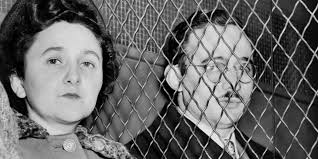
June 19, 1953, 72 years ago. Julius and Ethel Rosenberg, convicted of spying for the Soviet Union, including providing secrets of the atom bomb, were executed.  Strapped in the electric chair at Sing Sing prison in New York.  Killed by our government, in our names, on our behalf.

Some say they didn't do it.  There's pretty overwhelming evidence that Ethel really didn't. And that the government knew it.

But, you know, dead is dead. Evidence and innocence be damned.


 Oh, maybe it's better to remember them this way.


Thursday, May 17, 2018

What is truth, said jesting Pilate

Back in 2010, Times columnist Nicholas Kristoff had an op-ed about Kevin Cooper, a black man on death row in California for stabbing four people to death and leaving for dead a fifth who somehow survived and said the killing was done by 3 white guys. Kristoff's op-ed grew out of a dissenting opinion by 9th Circuit Judge William Fletcher in Cooper v. Brown, arguing that Cooper was likely factually innocent, had been framed by the cops, and that the courts and prosecutors and government authorities were at least passively complicit.

As Fletcher's dissent was a jumping off point for Kristoff, so his op-ed was a jumping off point for a blog post I wrote.

Today, in the Times on-line and I think set for a print version in the Sunday paper, Kristoff has a lengthy follow-up, detailing his own investigation. It's powerful. Well worth reading for justice gone awry and for the active unwillingness​ of those sometime Democratic heroes Jerry Brown and Kamala Harris to just take the smallest of steps - allowing the DNA testing to go forward. The testing that might well show it wasn't Cooper - which seems pretty likely, but who knows.

As I've regularly said here,

JUST TEST THE FUCKING DNA

But Jerry Brown (yeah, that Jerry Brown, the former Governor Moonbeam, the present Governor Old-Liberal-Icon) won't allow it. And Kamala Harris, once California Attorney General, now Senator Harris - she (like Jerry when he was California's AG) just wants the conviction affirmed and Cooper to stay in prison forever unless he's killed and damned with any DNA testing.

It's worth noting how Kristoff explains his continuing passion for the case:
It’s obvious to you by now that this is not a usual column — I’m not sure The Times has ever published a column of this length — so why am I exploring the case with such passion? I became interested primarily because Fletcher and other respected federal appeals judges had said he was framed. That just doesn’t happen.
I’m also haunted by something else. In 2000, I proposed reporting a lengthy piece about doubts about the conviction of Cameron Willingham, who was then on death row in Texas for the arson murder of his three children. An editor talked me out of it, and I never did write about Willingham, who was executed in 2004. Since then, growing evidence has emerged that he was innocent, and perhaps it’s partly to atone for my earlier failure that I’ve taken up Cooper’s case.​Which does sort of make the point that Cooper's not the only one. That death row, and really all our prisons (and our jails, too, but that's a different story), have significant numbers of folks in them who are likely to be innocent.
Wholly, factually, innocent. Wrong guy.*  Or, even, crime didn't happen.**

All of that ​​is quite an extraordinary explanation from a Times columnist, I think.

And he follows it up with the plaint of everyone who recognizes that we're supposed to have a system of something like justice - whatever exactly that might be.
Maybe in the grand scheme of things, the fate of one man on death row doesn’t seem so important; innumerable people die tragically every day. Yet we aspire to be a nation where we are all equal before the law, and if we execute a man in so flawed a case without even bothering to test the evidence rigorously, then a piece of our justice system dies along with Kevin Cooper.
Governor Brown, if you’re reading this, I understand that you may believe that Cooper is guilty. But other smart people, including federal judges and law school deans, believe him innocent. So how can you possibly execute him without even allowing advanced DNA testing, at the defense’s expense, to resolve the doubt? What’s your argument for refusing to allow testing? ​
Though Kristoff doesn't say it this way, testing will lead to one of three conclusions:
  1. Cooper's guilty, in which everyone can go home and rest assured.
  2. Cooper's an innocent guy we wanted to kill, in which case we can try and find the real killer and, by the way, do what we can to make sure we don't keep doing shit like this and also try to make some small amends to Cooper for his wrongful decades on death row.
  3. Can't really tell shit. In which case, we'll at least have tried.
So what's the harm? What, exactly, are they scared of?  Don't we want the truth?

Oh, yeah, I forgot.


------------------
*In which case, of course, the right guy is presumably still out there on the streets.
**The likelihood in Willingham's case.  The fire was probably not arson but an electrical fire from bad wiring.

Sunday, November 12, 2017

What? You Thought the System Got It Right?

Danny Brown did not kill Bobbie Russell.  

That's settled in the minds of just about everyone except her son, whose memory of his mother's murder is false, and the Lucas County Prosecutor who agreed to cut Danny loose after he spent 19 years in prison and dismiss the case against him but who still believes him guilty and would love to charge him and convict him again.

Despite the DNA that pretty conclusively indicates that Bobbie Russell was killed (and, not incidentally, raped) by Sherman Preston.  Alone.

Cameron Todd Willingham didn't set the fire that killed his kids.  Which Rick Perry basically knew when he signed off of Willingham's execution.  

Joe D'Ambrosio did not kill Anthony Klann, though he did spend 22 years on death row before he was exonerated.  And the state?  Well, you know the story.

And Ricky Jackson.  We'll get  back to him.

There are, of course, others.  The list of the wrongfully convicted isn't just a list of folks who didn't kill.  There are the ones who didn't rape, who didn't rob, who didn't burglarize, who didn't bear false witness or pray to graven images or . . . .  (OK, maybe the graven images thing.)

If you've been paying attention, you know that's true.  (As you do if you've been reading this blog, I should add in a self-glorifying moment.)  The question, of course, is how it happens.  And the corollary is what can be done about it.

Enter Mark Godsey, Daniel P. and Judith L. Carmichael Professor of Law and Director, Lois and Richard Rosenthal Institute for Justice/Ohio Innocence Project at the University of Cincinnati College of Law.  And now author of Blind Injustice: A Former Prosecutor Exposes the Psychology and Politics of Wrongful Convictions.

Mark was at one time, as the subtitle says, a prosecutor.  Not just any old kind.  He was one of that special breed, an Assistant United States Attorney in New York.  That's big stuff, and he was, as he tells us, quite full of himself and the honor and glory and nobility of his job.  Rooting out bad guys and locking 'em up.

He tells us about how he'd brainstorm with his fellow-AUSA's to as they'd cook up cockamamie theories to explain away evidence (say, coerced confessions) that was wholly inconsistent with the guilt of those they so righteously prosecuted.

He tells us that he, well, he didn't exactly cheat.  But he didn't go out of his way to challenge the potential bullshit that was presented to him.  And he didn't notice - didn't let himself notice, really, that a whole lot of what they did in building cases and selling juries on them was grounded in a set of convictions about infallibility that bore no relationship to demonstrable fact.

This isn't exactly news, though it was to Mark until he found himself coerced into running the Kentucky Innocence Project for a year.  And oops.  

The first chapter of his book is called "Eye Opener," and it's where he describes that epiphany.

As for the rest, he takes on the usual suspects.

  • Confirmation bias
  • Faulty memory
  • Coerced confessions
  • Inaccurate eyewitness identification
  • Bullshit forensics
  • Tunnel Vision

All this, he explains, leads to factually innocent folk getting convicted of crime despite the best efforts of everyone to do the right thing.

The academics have shown this, of course.  They've done the studies that demonstrate how false memories can be created, that eyewitness identification isn't particularly reliable, that nobody - not cops, not prosecutors, and certainly not judges or jurors - is particularly good at figuring out when someone is telling the truth or when someone is lying. 

And then there's the explanation.  That's the confirmation bias and the tunnel vision.  It's the group-think of police and prosecutors.  It's built into the human condition.  There's science for that, too.

And the studies, the science, all of it, is backed (often fronted) with stories of exonerations fought, exonerations won, and exonerations still pending resolution.  Here's a case, he says.  Look how the ID was bad!  Look at how the cops coerced the confession!  Look at how they implanted a memory or just got the witness to correct the memory to comport with the evidence! 

It's storytelling not because a story proves the point but because it illustrates the point.  And amid the tens of stories he tells, there's particular focus on a few.  

Most frequently, it's the case of Steve Avery from Making a Murderer.  It makes sense.  Many readers will know the story already.  And it serves to illustrate many of his points.  Clarence Elkins and Dean Gillespie get special treatment too because, well, Mark and the Ohio Innocence Project freed them.  

None of this is particularly new.  Along with untold numbers of books and articles addressing individual horror stories of the innocent convicted and sometimes (but not always) exonerated, academics and others have been churning out books on this with regularity.  In the last few years alone there've been Daniel Medwed's Prosecution Complex: America's Race to Convict and Its Impact on the Innocent, Jim and Nancy Petro's False Justice: Eight Myths That Convict the Innocent, David Harris's Failed Evidence: Why Law Enforcement Resists Science.  And those are just a few I've reviewed here.

The perspectives vary.  They don't all tell the same stories.  But they all make the same points.  The system is flawed.  And while it can't be perfected, there are things that can be done to improve it.  Not surprisingly, they all recommend essentially the same things.

  • Videotape confessions
  • Abandon the Reid technique of interrogation
  • Sequential, double-blind administered lineups with immediate declaration of degree of certainty
  • Remove crime labs from the control of police and prosecutors

All much easier said than done.  Because - and here's the point of Mark's anecdotes - the participants in the system simply don't recognize that there's a problem. 

See, and here's the weakness - of Mark's book and, frankly, the others.  They are, all of them, too trusting.  Oh, sure, there are a few of those so-called "bad apples."  But really, police and prosecutors and judges all really do want to the right thing.  If you could just make them see . . . .

Which is much of why Blind Injustice begins and ends with Ricky Jackson, another of Mark's clients at the Ohio Innocence Project.

Jackson's story is powerful.  In 1975, he, Wiley Bridgeman, and Kwame Ajamu were convicted of murder in Cleveland.  Sent to death row.  Convicted based on a lie.  A 12-year-old kid coerced by the cops into fingering the three of them.  Freed after 39 years when the kid recanted.  
39 FUCKING YEARS.
Because the cops got the kid to lie.

What's striking, though, is not the lie.  Not the wrongful conviction.  Not even the eventual exoneration.  See, they had the hearing.  The kid, now in his 40s, testified about how he was coerced.  How he lied.  How the lie ruined his life.  And how, finally, he came to tell the truth.  When all the testimony was over, they all broke for lunch.  Closing arguments, the judge said, after we eat.
     When we returned to the courtroom at the predetermined time, the prosecutors and the judge were nowhere to be seen.  After thrty more minutes passed, there was still no sign of the prosecutors or the judge.  We sad in the courtroom and waited, confused and exceedingly nervous.
     After about forty-five minutes of waiting, the courtroom doors swung open and Mary and her team of prosecutors entered the courtroom.  With them was the elected prosecutor -- the head of the office.  They entered the courtroom at the same time that the judge entered through his private door behind the bench, as if their entrances had been orchestrated.  The prosecutors walked straight up to the bench and said something to the effect of "We agree that Ricky Jackson is innocent and that a terrible injustice has occurred in this case.  We are dismissing all the charges and agreeing that he may be set free."
     In all my years of doing postconviction innocence work, I have never been so shocked.
OK, as Mark says, that doesn't happen.  Prosecutors typically fight exonerations tooth and nail.  But, the very oddity of what happened in Ricky Jackson's case - put up against all the stories of prosecutors who never concede - gives the lie to the assurance that prosecutors and cops and judges are all acting with good faith something like 99% of the time.

Oh, I'm not saying that they set out to frame people, to convict those they know are factually innocent.  It happens, but the frequency of that is I imagine vanishingly small.  Rather, they blind themselves and then they cheat - and they know damn well that they're blinding themselves and cheating - because that's how they make squishy cases better and good cases great. 

There's a reason we have the word testilying for what cops routinely do on the witness stand.  And the larger truth (one Mark mentions almost in passing) is that we let them get away with it.  Police aren't punished even on the rare occasions they're caught cheating.  Partly that's because they have qualified immunity.  Partly it's because they have powerful unions.  Prosecutors don't suffer for their misconduct.  Partly that's because they have absolute immunity.*  And because the legal disciplinary folks give them a pass.  Why?  Mostly it's because we - the rest of us- just don't care.  They're catching bad guys, after all.

Remember, the theory of our system is innocent unless proved guilty.  If we mean it, we have to take seriously the idea that the proof should be reliable.

Blind Injustice is worth the read.  Give a copy to your favorite prosecutor.  And maybe to your neighbor.


--------------
*Mark says that they, like cops, have qualified immunity.  He knows better.

-------------
My thanks to Mark and the University of California Press for providing me with a copy for this review.

Saturday, September 30, 2017

Did Kellyanne Conway murder Melissa Trotter?

It's been a while, years in fact, since I've written about Larry Swearingen who did not kill Melissa Trotter.  That's the same Larry Swearingen the good people of the State of Texas intend to kill on November 16 for the murder of Melissa Trotter.  The same Melissa Trotter Larry Swearingen did not kill.

Sigh.

Let's do this in three parts.

Part I:  Larry Swearingen was in police custody when Melissa Trotter was elsewhere getting killed.   That seems incontestable.  

The Texas courts don't care.  The prosecutors don't care.  After all, there's all that circumstantial evidence and junk science that points to him.  Therefore he's guilty.  Proof that he's innocent would be, I don't know . . . . 

Wait, I got it.
Alternative Facts.
Cool.  Let's blame the killing on Kellanne Conway.  I don't know where she was at the time.

Anyhow, whoever killed Melissa Trotter, it wasn't Larry Swearingen.

But, again, the courts don't care.  The prosecutors don't care.  And Texas plans to kill him on November 16.

Part II:  As I've said from time to time in the context of more than one allegedly bad guy
TEST THE FUCKING DNA!
But of course they won't.  Well, that's not quite right.  They've tested some.  To the surprise of pretty much nobody who paid attention to Part I, 
IT AIN'T HIS.
Which is, of course, not of any particular interest to the courts or the prosecutors.  Who don't care.

There's more stuff that can be tested, really, stuff that should be tested.  The trial court (the Texas trial court!) has a couple of times now ordered the testing under the Texas post-trial DNA testing statute. Of course, the prosecutor appealed, because -- we'll get to that.  And the Texas Court of Criminal Appeals said "No."
YOU MAY NOT TEST THE DNA!
YOU MAY NOT TEST IT IN A CAB!
YOU MAY NOT TEST IT IN A LAB!
YOU MAY NOT TEST THE DNA!
YOU MAY NOT TEST IT, THAT WE SAY!
Oh, and in particular, if testing were to be allowed, the DNA could not be run against the existing DNA databases to see if it matched a person who might have killed Melissa Trotter.  Say, someone who understands and hides behind alternative facts.  Say, Kellyanne Conway.

Nah!
No testing, no checking.
But the court is cool with killingLarry Swearingen November 16 for the murder of Melissa Trotter whom he did not kill.

Part III:  Which brings me to the prosecutor and the reason he doesn't want the testing done - though he'd love to have it done.  Just as long as he can be assured that the testing will be irrelevant.  Jordan Smith, at The Intercept: 
The problem is with the way the statute is written, says Bill Delmore, chief of the Montgomery County DA’s Legal Services Bureau, which handles the office’s appeals. In deciding whether a defendant is eligible for DNA testing, a judge is required to find that exculpatory results would likely change the outcome of the defendant’s trial. That’s exactly what Case found each time he granted Swearingen’s request. But Delmore says his office is unwilling to accept that possibility. “I would never, ever agree — never, ever agree — that the presence of a third party’s DNA on some random piece of evidence in this case establishes that Larry Swearingen is innocent. That is ridiculous,” he said.
What the DA’s office wants is to be able to conduct testing without ever having to acknowledge that the results might change the original conviction. “If you told me that all the other evidence had somebody else’s DNA on it, then I’d say, well, [that person] must’ve done this with Larry Swearingen,” Delmore said. “It’s really hard for me to imagine DNA evidence in this case that would actually, in my mind, exonerate Swearingen.”
See, the problem is that the evidence might matter.  Oh, sure, it would just get a hearing.  But damn, then someone would have to consider . . . .
Still, Delmore is adamant that he and his boss Ligon are not opposed to DNA testing, per se. “We’ve always been willing to do the testing, but we’re not willing to do it under the constraints that this stupid statute puts on us.”
Besides, they probably like Kellyanne Conway.

Or maybe it was Sean Spicer.

OK, I'll come clean.  I don't think it was Kellyanne Conway.  She probably wasn't there, either.

Saturday, September 23, 2017

The Innocence Commission and the Innocent Man

October 1987.  Nine at night.  Hickory, North Carolina, an hour or so west of Charlotte, they called it Little Berlin.   Carrie Eliot, widowed just under a year, 69 years old, five foot nothing on a good day, widowed, living alone.  

A man forced his way in.  "I want you. . . . I like older women. . . . They don't mess around."

He raped her.  First in the living room.  then the bedroom.

A neighbor, paid $1,000 for the tip, told police it was Willie Grimes.  Carrie Elliot, whose description didn't match Willie, picked him from a photo spread.  Then she identified him in court.  

Willie testified. He'd gone to the police station voluntarily.  Had no idea what they wanted.  They hadn't let him go. And now here he was. And damn, he never raped that woman.  Or anyone else, for that matter.

You know what happened next.  Nice white lady.  Black guy.  She says it's him. He says nope. There's no DNA.  No forensics.  Just she said.  And he denied.

Willie J. Grimes was sentenced to spend the rest of his life in prison.

* * * * *

It's not giving anything away to say that Willie Grimes didn't do it.  The title of Benjamin Rachlin's book, Ghost of the Innocent Man: A True Story of Trial and Redemption, makes that clear.

And if you read the flap on the dust jacket, you'll realize that the title tells only half the story. Rachlin's book is as much about Willie's "relentless champion, Christine Mumma, a cofounder of North Carolina's Innocence Inquiry Commission," as it is about Willie.  That's its strength - and its weakness.


Here's Willie.  He knows he's innocent.  His family and friends know he's innocent.  His lawyer fully believes he's innocent.  But the jury didn't buy it and the judge didn't buy it and the appellate courts don't buy it and . . . .  Damn.

The guy is shuffled from prison to prison.  He has menial jobs (there are no other sorts in prison) but makes the best of them.  He tries to stay out of trouble.  He wishes his lawyer would get back to him with what's happening - or even what isn't happening.

He'd probably have been paroled, but that required rehabilitation, which required accepting responsibility for raping Carrie Elliott.  And he couldn't do that, of course, because he hadn't raped her.

Christine Mumma was a juror in the capital case of one James McDowell.  She voted for death, but really . . . .  A few years later she went to law school. First thing she did when she got there was look up the guy she'd condemned. He hadn't been killed. In fact, he was off the row.  New lawyers got his sentence reduced to life.
She felt strangely relieved he'd never been executed.  Even a criminal like McDowell deserved a better attorney than he'd had.
After law school, after one thing and another, she ended up clerking for I. Beverly Lake, chief justice of the state supreme court.  She noticed that some of the criminal cases were incompetently tried.  Maybe the guys were guilty, maybe not.  But if they were innocent . . . . No, that never happened.  But shit.

She talked to Lake who told her what she probably knew anyway.  "Guilt wasn't a question his court considered.  That had been addressed already, at trial. . . . A judge didn't overrule jurors based on his own subjective opinion."  But you know, and they knew, that some folks behind bars were being proved innocent.  So it seemed it did happen.

Meanwhile, Willie, who was innocent but without proof, sat in prison.  In time he converted.  He became a Jehovah's Witness.  

And Christine got to working with a small clinic at UNC's law school.  And then she got Lake involved and others.  And they put together a committee to try to figure out how to make convicting innocent people harder.  

Willie's case eventually made it to Christine's file cabinet.  Where it sat because while it seemed pretty clear that his was a good innocence case, there wasn't the evidence to help him.  There just wasn't anything she could do.

And then she dragged that commission kicking and screaming into actually trying to figure out how to get North Carolina to make a serious effort to undo past wrongful convictions.  

Which eventually led (as you learned from the dust jacket) to North Carolina's Innocence Inquiry Commission.  Which is something extraordinary.*

And as you might imagine, after, years and years and false starts and dead ends.  YIPPEE!  The NCII gets its second exoneration.  And it's Willie.

And it's all very cool.

Rachlin tells the stories in alternating chapters until the end when they merge.  It's an effective narrative technique, and he tells the stories well.  That's especially true as he reports on the rape and what passes for an investigation and the trial.  And it's true as he follow's Christine's efforts to create something new in North Carolina.  And it's true when the strands come together at the end.

But the day to day of Willie's life in prison.  All 24 years of it.  Too often not so much.  It's not surprising.  It's hard to make the quotidian - even the prison quotidian - fascinating.  There are moments, but they don't tend to get developed.  An then there's another visit from his Jehovah's Witness teachers.

I'm carping, and probably shouldn't.  It's not how I'd have told the story.  But that's not the test.

So let's go with this.  You know, if you're among the people who read this blawg, that the legal system fucks up more than its fair share of the time.  Too damn many factually innocent folks are in prison - often leaving the actual criminals to prey on others.  Willie Grimes's story of innocence eventually recognized is, in that sense, nothing much new.  

By itself, it's one of those long New Yorker articles.  But it's not by itself.  it's connected to Christine Mumma's effort to do something not just for him but for a conception of justice.  That's something to write home about.  

It's something, too, to read a book about.  Ghost of the Innocent Man is that book.


----------------
* And unique.  There are, scattered around the country in various prosecutors' offices, conviction integrity units.  Some of which actually seem to function - though others pretty clearly don't.  But no other state has an actual, statutory Commission and a procedure for locating and exonerating.


Sunday, June 18, 2017

Government Work

Hey, maybe he didn't do it.  But close enough for government work.

It's the story of too many folks on death row.  Too many folks in prison.  Too many charged and convicted where . . . .

OK, let me be both careful and honest about this.  I don't know how many factually innocent folks - ones who just flat out didn't do it (whatever the it may be) are charged with and convicted of crimes.  I don't know how many pay the traffic tickets they shouldn't have gotten or how many are doing a few years in stir or how many are awaiting a trip to the gurney.  Or how many have been executed.

I don't know.  Neither do you.  Neither does anyone else despite studies and analysis and careful estimates and wishful thinking and blind guesswork.  Nobody knows.  

What we know is that whatever the number, it's too many.  Every one is a failure of one or more parts of the system.  Every one is a mistake.  Some of those mistakes are more tragic than others.  Some have deadly serious consequences:

  • Innocent people locked up forever.
  • Innocent people killed.
  • Lives ruined.
  • Families destroyed.
  • Guilty people left free.
  • Some to pillage, rape, murder again.

But every one a mistake.  Every one a failure of our system of so-called justice.

Nicholas Kristof in today's Times tells the story of one likely candidate.  (Kristof's written about him before; so have I.)  This guy.
Kevin Cooper's on death row in California for four brutal murders in 1983.  There's a better than even chance he was framed for the killings that put him there.   Despite a lot of concern - and some outright vituperation - expressed by a number of judges, by some media, and by plenty of do-gooders, nobody with the power actually to do something has seemed to show much interest.

I mean, hell.  The guy was convicted by jury of 12.  And we haven't gotten around to killing him yet, despite his having spent more than three decades on death row.  What more can you ask for?

Oh, yeah.  You can ask for new and more definitive DNA testing.  

You know, the stuff that can maybe answer the question of whether he's the wrong guy.  Or, of course, maybe not.  If they'd do the testing, there are three possibilities.

  • It'll pretty conclusively show he didn't do it - and just maybe who did.
  • It'll pretty conclusively show that he did just what he was convicted of, showing that this is a case where things actually worked right.
  • It'll be inconclusive and leave things about where they are now, but with another stone turned.

Is any of those a bad thing?  Is there something to fear?  Is there any good reason why they won't just

TEST THE FUCKING DNA?

Yeah.  I couldn't think of a reason, either.

Close enough for government work?

Looks like it is.

Saturday, June 17, 2017

Conflating Guilt

You know Cosby's guilty.  You just know it.  But the jury hung!?

What is it that the jury did't get?  How could they have been so confused? 

And that cop in Minnesota, Jeronimo Yanez.  The one who killed Philando Castile who's girlfriend caught it all on video.  Acquitted?  

Gimme a break.

I mean, we know.  We just fuckin' know. 

Which is, kinda, the problem.  Sorta.  In part.

Greenfield explains today why Cosby may not actually be guilty.*  But, well, Scott only touches on a part of it.  Because guilt is complicated.  As is innocence.

I've talked about these things at length before (here for instance).  I'm going to try doing it simply, now.

So -- 


GUILT

By which you mean exactly, what, Grasshopper?

Legal?  Cosby will be legally guilty only if and when a jury says they are convinced that the prosecutor proved beyond a reasonable doubt each of the elements of the offense as set forth in the Pennsylvania criminal code.  Legal guilt is, essentially, a question of what the jury says it believes based on the evidence presented.

Factual?  Cosby will be factually guilty of violating that law, whatever the prosecutor does or does not prove to the satisfaction of the jury, if he in fact did each of the elements of the offense as set forth in the Pennsylvania criminal code.  The jury may or may not reach a verdict (OK, this jury didn't actually reach a verdict at all, but that's a quibble) that conforms to factual guilt.  That's why factual and legal guilt aren't the same thing.

Moral?  The fucking SOB is a pig who ought to be strung up by his fingernails.  Sometimes moral guilt equates with factual or legal guilt.  Sometimes not.  Nobody said life is fair.  And nobody says that we're all going to make the same moral judgements.  You know, life sucks.

Biblical?  We're all children of original sin, if you believe that shit.  Ain't none of who isn't guilty. Sigh.

Which brings us to


INNOCENCE

Ditto.

Legal?  Unless and until a jury says he's guilty, he's legally innocent.  Wholly and completely. Without exception.  Which has, of course, nothing beyond vain hope and some degree of luck and coincidence, to do with 

Factual?  As in, he did not in fact do each and every one of the things the statutes set out as elements of the offense.  Which may or may not match up with 

Moral?  Is what he did subject to moral opprobrium?  Kinda depends on whose morals you look at, I imagine.  

Biblical?  Is he saved?  God'll sort it out.  If she's so inclined.  And exists.

CLASS DISMISSED 

-------------
*And with the hung jury he is, at least for now, wholly and completely innocent - in a way.  (Keep reading the damn post to learn the way.

Sunday, November 6, 2016

The Lawyer's Story of Himself and the Innocent Guy He Helped Get Off Death Row

I nearly tossed the book aside at the first sentence.

Wait, I'll get back to that.

Instead, start with this.  Alfred Dewayne Brown did not shoot and kill (actually he neither shot nor killed) Charles Clark, a police officer during a robbery of the ACE Cash Express on South Loop in Houston in April 2003.  He wasn't even there.  Which didn't stop them from trying him for the killing and putting him on death row.

It was the usual stuff.  Eyewitness IDs that weren't worth much.  A witness coerced by the cops and the prosecutors into telling them what they wanted to hear rather than what she knew to be true. Crucial evidence corroborating Brown's story (and giving the lie to the lie the cops and prosecutors coerced) discovered and then hidden by the cops and prosecutors.  And then discovered largely by chance by diligent post-trial investigation.

And it was the unusual stuff.  A reporter who sunk her teeth into the case.  A later prosecutor who acknowledged the significance of the evidence. A trial court judge who accepted evidence of innocence and figured it mattered.  The Court of Criminal Appeals that finally, finally, after sitting on the case for nearly a year and a half, granted a new trial.  

And a prosecutor who then dismissed the charges.  

Cool.  Great stuff.  Good for Brown.  Good for Texas not killing another innocent guy.

It's a feel-good story.  Good for Brian W. Stolarz who worked on Brown's case for several years, cared deeply for Brown, and now has a book about it.  The one I nearly tossed aside at the first sentence.  

I knew Alfred Dewayne Brown was stone-cold innocent the moment I met him.
As it happens, of course, Stolarz was right.  But despite his "more than functional 'bullshit meter'" that makes his gut more reliable than a polygraph (so he says), he knew no such thing.  He may have believed it with all his heart.  But that ain't the same as knowledge.  And if he's either lying or delusional on the first page. . . .

Of course, he also claims to have essentially proved Brown innocent, though in fact it was other lawyers, after he was off the case, who turned up the crucial evidence and then used it to free Brown.
As I said, the story of how Brown got railroad onto death row for a crime he had nothing to do with and then, with diligent lawyering and more than a soupçon of luck, got off the row and then freed is pretty good.  

Told well, it'd make a terrific long-form magazine article in, say, Texas Monthly.  As one of perhaps several examples showing the numerous ways wrongful convictions happen, it could be part of a terrific book.

As part of Stolarz's solipsistic . . . .

OK, maybe I'm not being altogether fair.  Not altogether.  

The book isn't just about Brown's case.  It's also about Stolarz and how he's just so devoted to Brown's case that . . . .  

Look, there's good stuff in the book.  But, well, I kept wanting to toss it aside.  Really, I kept wanting to throw it at the wall.

Stolarz is opposed to the death penalty.  He's a Catholic, and that informs his opposition.  He says that if we're going to have it, we should do all sorts of things (yes, he details some) to reduce the likelihood that we'll kill innocent folks.  

He's particularly appalled that Antonin Scalia did not think the Constitution prohibited the execution of an innocent person who had all the process due.  And Scalia claimed to be a Catholic!  As if he should have shared Stolarz's understanding of Catholic doctrine and that understanding should have controlled his understanding of the Constitution.  (Not that I think Scalia was right, you understand. But there is no such thing as a proper Catholic interpretation of the Constitution.  It ain't a religious document.) 

Hell, even the subtitle's dishonest.  That "Race against Time" suggesting that execution was imminent.  It wasn't.  The years Stolarz worked on the case, and on through the granting of a new trial, they were all in the Texas courts.  This wasn't the heroic, last-minute work you hear about.

Last Thursday, the U.S. Supreme Court asked Alabama to hold off the execution of Tommy Arthur for two hours so the Justices could decide whether to issue a stay.  (They did.)  Now that's last minute work.  Getting that stay was a race against time (or something, the metaphor doesn't really make much sense).  

Brown? His case hadn't entered the federal system.  He had at least a couple more years of litigation before he had a serious execution date.  

There's just too much wrong.  Stolarz gets facts wrong.* He gets the law wrong.**  He wrongly says that if he hadn't agreed to take the case up Brown would have been executed.*** 

I imagine Brian Stolarz is a nice guy.  I'd like to think that he'd have worked as hard for Brown and cared as deeply about what happened to him if his spidey sense had told him that Brown was guilty as sin.  I'd like to think that.  I really would like to.

I really wanted to like Grace and Justice on Death Row.   I really did want to.


--------------------
*Dr. Quijano, who testified that Duane Buck was likely to commit future acts of criminal violence because he was black, was not a prosecution witness in that case.  He was a defense witness.

**When they meet with the prosecutor to set out evidence Brown was innocent, he wondered if she would "take the step of letting Dewayne go" or if they'd have to go to court. No need to wonder.  The prosecutor has no magic wand that can undo convictions.  Only courts can do that.

***He doesn't claim to have single-handedly saved the day.  It's just that without him . . . .

* * * *

Thanks to Skyhorse Publishing for providing me a copy of the book to review.
Thursday, July 2, 2015

Inverting Blackstone

It's called the "Blackstone Ratio" after William Blackstone who said it was
better that ten guilty persons escape, than that one innocent suffer.
It is a lovely idea.  One we pay homage to while patting ourselves on the back about the wonders of our Beyond a Reasonable Doubt standard of proof for a criminal conviction.  And one we don't mention as we issue a celebratory oopsie when we release a wrongfully convicted, innocent person and claim it shows how well the system works.

It's also a fantasy.  For all the noble assertions - reaching back into history centuries before Blackstone and up to the present in academic discourse and jurisprudential ideal* - we don't really believe it.  Ask your neighbors.  Ask your co-workers.  Unless they happen to be criminal defense lawyers, and maybe even then, they'll look at you as if you're a lunatic.

Still, we aspire.  At least, we did.
* * * * *
Enter the American Law Institute.** Institutionally respected (and influential, which is more important), the ALI consists of some 4,000 academics, lawyers, and judges (invitation only, please) who among other things drafts "Model" laws that tend to be adopted, with only slight variation, around the country.  In particular, ALI is responsible for the Model Penal Code.  Taught in law schools, what the Model Penal Code suggests as, er, model, states commonly adopt as law.  

Of course, ALI has to keep tweaking the MPC.  That's good, since it allows them to amend stuff that turns out to have deplorable consequences.  And it gives them a chance to add new crimes since, for instance, we didn't have cyberhacking in the old days.  (I don't actually know whether the MPC includes cyberhacking as a crime.  Nor, frankly, do I care enough to see if the answer is available somewhere that isn't behind their paywall.)  Of course, the tweaking also keeps them in business, and like every institution, ALI is deeply concerned with maintaining its relevance - and income.

But then . . . 

So for the past few years, ALI has been working on a new version (they call it an "updated" version of 
Article 213 of the Model Penal Code, which was ahead of its time when approved by ALI in 1962, but is now outdated and no longer a reliable guide for legislatures and courts.
But what is it, exactly, that made the old version unreliable? Probably bunches of stuff. It turns out that in the old version unless there was force or some form of coercion it was not a crime for sex "between professionals (mental health providers, lawyers, executives, etc.) and those under their supervision or in their care." You know for a doctor to have sex with a patient or a lawyer with a client or the CEO with the company's VP for handcuff design or whatever. Ooooh. Damn. Actually, in the regulated professions, that's pretty much a no no anyway. You could lose your license. Not enough punishment, though, since you couldn't also lose your freedom.

And of course the tweaking cranks up the sentences.  Because in 1962 we didn't think all sex offenses deserved LWOP followed by lifetime registration and matches on the front lawn to make it easier to burn down the registrant's home.

But I'm quibbling and ignoring the real news which is the criminal law adoption of Mattress Girl as a mascot for the new crime.  Elizabeth Nolan Brown at Hit and Run:
To this aim, ALI proposes establishing the new crime of sexual intercourse without consent, a misdemeanor, which takes place when a person "knowingly or recklessly has, or enables another person to have, sexual intercourse with a person who at the time of the act of sexual intercourse has not given consent to that act." (This is, of course, absent any sort of force, coercion, or indication the victim protested/resisted, which would remain felonies.) It would also expand the definition of criminal sexual contact to include any unconsented to contact with any body part if the perpetrator intended the touch amorously or lustfully.
How does that work, exactly?  Here's the explanation in a way-too-long excerpt from a memorandum opposing the draft recommendations by some 70 members of ALI (edited slightly for comprehensibility).  It begins with a hypothetical.
A and B are on a date and walking down the street. A, feeling romantically and sexually attracted, timidly reaches out to hold B’s hand and feels a thrill as their hands touch. B does nothing, but six months later files a criminal complaint. A is guilty of “Criminal Sexual Contact” under proposed Section 213.6(3)(a).
How can this be? The draft explains:
Section 213.0(5) defines “sexual contact” expansively, to include any touching of any body part of another person, whether done by the actor or by the person touched. Any kind of contact may qualify; there are no limits on either the body part touched or the manner in which it is touched…. 
The offense arises because A failed to obtain the draft’s requisite prior “positive agreement” to the “sexual contact.” Section 213.0(3). The draft repeatedly “makes clear that when a complainant’s behavior has been passive—neither expressly inviting nor rebuking the defendant’s sexual advances, that behavior cannot be considered sufficient to show affirmative permission.” A’s guilt is absolute because, “feeling romantically and sexually attracted” and feeling “a thrill as their hands touch,” A has no defense against the accusation that the touch included the “purpose of sexual gratification… or sexual arousal.” Section 213.0(5).
The draft purports to preserve mens rea as an element of the offense, but that is no comfort because it is proven with barely an effort from the prosecutor: “A, When walking down the street side by side with your date, you knew, or knew of the risk, that B had not expressed prior positive agreement that you could reach out and hold B’s hand, didn’t you? In fact, that’s exactly why you were “timid” about it, right?”
Of course, A does not have to testify but A will have great need to testify because of the shifting of the evidentiary burden that is caused by the “positive agreement” standard. Note that A is still guilty even if they were both wearing gloves. Section 213.0(5) (“clothed or unclothed”)
Consider the same couple, but now B responds to the criminal hand-holding by pausing to kiss A on the cheek. A remains guilty since there is no mechanism for retroactive consent, but now B is also guilty because A has not expressed prior positive agreement for this particular escalation. Under this scenario, the actions of both A and B would satisfy the elements of the offenses. Thus, they would be adjudicated as sex offenders, would be required in many states to register as such and would suffer the other collateral consequences of conviction for a sex offense.
Section 213.0(5) defines “sexual contact” expansively, to include any touching of any body part of another person, whether done by the actor or by the person touched. Any kind of contact may qualify; there are no limits on either the body part touched or the manner in which it is touched…. 
Ain't life grand.

OK, that's ridiculous. And fortunately there's no prosecutor who would proffer charges like that. Except that they would.  Plead to hand holding and we'll drop the more serious groping charges. Hey, it's just a little thing.  A kiss is just a kiss.

But here's the nub.  None of it is an accident.  The drafters understood, announced up front that they didn't care about snaring the innocent as long as they upped the odds of catching the guilty.
[T]he appropriate default position clearly is to err in the direction of protecting individuals against unwanted sexual imposition. (Discussion Draft No. 2, Substantive Material, at 53).
Of course, a legal standard requiring the affirmative expression of consent to sex will—inevitably—entail many false negatives, in the form of findings of unwillingness when in fact passionate desire was present. But the contrary standard now prevalent in American law will—just as inevitably—entail many false positives, assumptions of willingness and subsequent sexual intrusion when such intimacy was entirely unwanted. Section 213.2(2) reflects the judgment that the harms that arise under the latter standard present far greater reason for concern. (Id.).
Ah, yes.  Better that ten innocent persons suffer, than that one innocent escape.

Hear that creaking sound?  It's Blackstone turning over in his grave.


-------------------
*See Alexander Volokh's "n Guilty Men."
** The ALI's self definition:
The American Law Institute is the leading independent organization in the United States producing scholarly work to clarify, modernize, and otherwise improve the law.