Showing posts with label Supreme Court. Show all posts

Tuesday, July 14, 2020

On the Murder of Daniel Lee

Daniel Lewis Lee was killed early this morning at the federal prison in Terra Haute, Indiana, by agents of the federal government. It was the first federal execution in 17 years.  

The Supreme Court, by a 5-4 vote declaring that Lee had almost no chance of showing that the method of execution would violate the Eighth Amendment, cheered it on.  It was, the court majority  said, its "responsibility" to ensure that Lee got killed.  And so he did.
The following is a statement from Ruth Friedman, attorney for Daniel Lee who was executed this morning:
It is important for everyone to understand exactly what happened last night to our client, Daniel Lewis Lee. At 2 AM on July 14, while the country was sleeping, the Supreme Court issued a 5-4 decision vacating the injunction that had been in place against the first federal execution in 17 years.  Within minutes, the Department of Justice moved to re-set Danny Lee's execution--for 4 AM, summoning media and witnesses back to the prison in the very middle of the night.  When it was brought to the government's attention that a court stay still remained in place, the DOJ first maintained that that stay presented no legal impediment to executing Danny Lee, but then filed an "emergency" motion to lift the stay.  
Over the four hours it took for this reckless and relentless government to pursue these ends, Daniel Lewis Lee remained strapped to a gurney:  a mere 31 minutes after a court of appeals lifted the last impediment to his execution at the federal government's urging, while multiple motions remained pending, and without notice to counsel, he was executed. 
It is shameful that the government saw fit to carry out this execution during a pandemic.  It is shameful that the government saw fit to carry out this execution when counsel for Danny Lee could not be present with him, and when the judges in his case and even the family of his victims urged against it.  And it is beyond shameful that the government, in the end, carried out this execution in haste, in the middle of the night, while the country was sleeping.  We hope that upon awakening, the country will be as outraged as we are.
 -- Ruth Friedman, attorney for Daniel Lee and Director, Federal Capital Habeas Project--July 14, 2020
Amen.

Saturday, December 26, 2015

Wherein I Resist the Temptation To Discuss the Chlamydia Incident

He had me at nitwits.

Jay Wexler is a lawprof at BU, author of The Odd Clauses: Understanding the Constitution Through Ten of Its Most Curious Provisions (a terrific book I reviewed here) and Holy Hullabaloos: A Road Trip to the Battlegrounds of the Church/State Wars, and also of a collection of short fiction and other stuff (like law review articles and humor pieces).  He was once a law clerk to Ruth Bader Ginsburg (though not at the time she declined to provide the fifth vote for summary reversal in Overton v. Ohio thereby leaving me with what I am forced to describe as "the case I almost won in the Supreme Court").  He's probably best known for his studies of which of the folks on the Supreme Court generate the most laughs with their comments and questions during oral argument.  (Spoiler alert:  Clarence Thomas, who never speaks, comes in dead last.)

And now he's published his first novel, Tuttle in the Balance.  It's a keeper.

Ed Tuttle is an associate justice and the swing vote on a deeply divided Supreme Court.  And the sexagenarian (a double entendre from which Wexler wisely refrains) has just returned to DC in time for the Court's new term.  That's after spending 
two months of bliss in the Wyoming mountains, a glorious spell of crisp mornings and dry brilliant afternoons, of soaring eagles and scurrying marmots, of white water rafting and fly-fishing on the Snake River, not to mention a good deal of eye-popping sexual intercourse with a series of younger women who, to Ed's great surprise, were just delighted to bed down with an associate justice of the Supreme Court.
Now he's back for a term filled with important issues.  There's the first amendment case Texas v. Sexy Slut Magazine (the mag's cover featuring 42 erect penises).  There's the Pledge of Allegiance case from the Third Circuit (does "under God," a 1950's addition to the pledge to remind school children that we in the US aren't like those godless commies, violate the Establishment Clause).  And there's the question of whether cameras should be allowed in the courtroom.

Of course, Tuttle in the Balance is not all about the law.  Mostly it's about Ed Tuttle, who (as Wexler writes on his blog) is
having a mid-life crisis in the middle of one of the biggest terms in recent years. Among other things, it involves Taoism and a frisky cat.
I really don't want to give away much.  I don't want to tell you about the running meta gag about justices competing to see who can generate the most laughs during oral argument and so make points in the study that some law professor publishes.  Nor do I want to write about the laugh-out-loud fracas at the Court's conference when . . . .  And I particularly don't want to mention that drunken night when Ed and the . . . .  No, I won't go there. I won't. 

But you should.

You'll actually learn something about the law along the way.  You'll learn something about how the Supreme Court operates.  (There's some inside baseball, though not too much, and it never messes with the story.) And you'll have a good time if your sense of humor veers readily between the Marx Brothers and Animal House.

Or, well, as I said, he had me at nitwits.  

Oral arguments for the term begin Monday.  Ed has to prepare.  But "After four or five attempts to pore over the brief's Summary of Argument," he's ready to quit.  There's still time to prepare.  And he already taken a look at the bench memo Dawn, his brilliant law clerk, has written.
[A]nd if he has to, he figures he can probably read the thing the night before argument and still understand what's going on better than most of his colleagues, which is a testament not only to the fact that Dawn graduated first in her class at Harvard Law School but also to the sad truth that some of his fellow justices are, frankly, nitwits. 
Page 6.  I was hooked.

 ----------
Special thanks to Jay who arranged for me to get a copy to review.

Thursday, September 17, 2015

Like and Unlike - Sandy and the Notorious RBG

I like to call it "The Case I Almost Won in the Supreme Court."

"Almost won" is, of course, an awful lot like lost, except maybe it sounds better.  Sigh.

Here's what happened.  No votes to grant cert, which made sense.  The issue had been resolved by the Supremes decades earlier except that Ohio didn't get the memo.  And really, it wasn't (anymore) the least bit controversial.  Not even in Ohio where there was no controversy since it was as if it had never happened.

It wasn't a death penalty case.  Millions weren't at stake.  The republic wasn't in any particular peril from a rogue Ohio court.   My client had been convicted of a low level drug offense and sentenced to some 6 months in the hoosegow.  Why would anyone down in D.C. call for full briefing and oral argument?  Hell, I wouldn't have.

But Justice Breyer figured that since this was the 2001 and the issue had been resolved in 1958, well, maybe it was time to pass the word to the folks in the Buckeye State.  So he wrote what they call on First Street a "Statement . . . respecting the denial of the petition for writ of certiorari."  Three others signed on, the usual suspects for such a thing: Justices Souter, Stevens, and Ginsburg O'Connor.

Wait, did I say O'Connor?  Did I strike out RBG?  That's not the usual suspects at all.  And it's not what should have been a losing hand.  After all, I got the Justice who was never in the minority.  But I lost the presumed liberal.

And while the plural of anecdote is not data, the story says something about the Justices Linda Hirshman calls "sisters in law."  In fact, she makes that the title of her new book, a joint biography of the two: Sisters in Law: How Sandra Day O'Connor and Ruth Bader Ginsburg Went to the Supreme Court and Changed the World.  

O'Connor and Ginsburg are, of course, an oddly matched duo. But matched they are.  O'Connor, the child of an Arizona rancher, born in El Paso in 1930, raised on the ranch and sent off to boarding school.  Ginsburg, born and raised in Brooklyn in 1933, educated at the local public schools.  Both academic stars at college and at the top of their classes in law school.  Both denied opportunities they'd have gotten after law school had they been men.*

O'Connor ended up practicing law and volunteering like crazy back in Arizona.  Then she got elected to the legislature and then appointed to the Arizona Supreme Court.  Ginsburg taught law and developed and ran the ACLU's Woman's Rights Project and argued landmark cases advancing gender equality before the U.S. Supreme Court.

In 1981, Reagan appointed O'Connor to the Supreme Court.  The first woman ever in that men's club. Ginsburg, who had been appointed to the D.C. Circuit Court of Appeals in 1980 by Jimmy Carter, joined O'Connor on the Court in 1993.  As they both acknowledged repeatedly over the years, life on the Court for each was better when the other was also a Justice than during the years (fewer for Ginsburg) when she was the only woman there.

Those are the facts.  Hirshman sets them out clearly, balancing them, adding stories as she goes.  And Hirshman's a good storyteller.  (She demonstrated that in her previous book, Victory: The Triumphant Gay Revolution.)

The meat of the book, though, isn't in the biography or the personal tidbits (O'Connor cooked up meals for meetings with her clerks; Ginsburg didn't cook at all but her husband was a terrific chef). It's in the discussion of the cases and the law, that part of the subtitle about how they "Changed the World." 

Ginsburg, Hirshman says repeatedly though rarely as explicitly as I;m going to make it sound, has an agenda.  Her goal as a litigator and as a justice has been to eradicate gender inequality in the law.  Completely. She advocated for the goal (brilliantly and with remarkable success) in the work she did at and for the ACLU.  She had a strategic plan, modeled on how Thurgood Marshall went after racial discrimination leading to Brown v. Board of Education.  It's an incremental approach, winning the easy cases that establish precedents that make the harder cases inevitable.  (It's using the uppercase L Law that I've regularly say I don't much believe in.)

She maintains that agenda on the Court, but she's frequently been blocked at advancing it because she can rarely garner 5 votes for the sweeping language she wants to put into opinions.  As a result, she either has to tone down her opinions or to write stirring dissents.

O'Connor has no agenda.  Like Ginsburg, she's a feminist, but unlike Ginsburg she's a secret one  She agrees with all Ginsburg's goals (except on abortion where she voted to keep it legal but make it extraordinarily difficult for women who aren't rich to obtain) but doesn't actually favor advancing them very far.  Rather, she simply votes not to make things worse.  Because she has neither agenda nor philosophy she chooses to decide cases in ways that provide no precedent for anything and no guidance for the lower courts.** 

She was almost always in the majority but routinely limited the reach of that majority.

But ultimately, the two working together advanced women's equality in absolute terms.  And it couldn't have happened without both of them working together.

Hirshman plays that out with discussion of case after case.  She gets into the behind the scenes maneuvering on how opinions get written and the internal dynamics of the Court and the Justices. (Lewis Powell comes off particularly poorly.)

The problem with the thesis is that it's too bold, doesn't quite follow from the evidence she presents, and frankly ignores too much.

For most of her time on the Court, Ginsburg has been the closest one there to being what we think of as a liberal.  Yes, she's voted strongly in favor of gender equality - which has had, by the way, some serious success at the Court.  But she's pushed other traditional liberal causes, too.  She has been, and remains consistently among the Justices favoring due process in criminal cases, government regulation of business, and the welfare state.

In each of those areas, O'Connor has been, shall we say less enthusiastic.  Not the most avid voice of traditionally conservative values and positions, her case-by-case jurisprudence, her disinclination to set rules and precedential guidance made her the Court's swing vote when opinions otherwise divided along traditional lines with four votes on each side of an issue.  Win O'Connor, and you carried the day even if it didn't do much for the next case up.  (My case, of course, was an exception, dammit.) Win Ginsburg and, well, you won Ginsburg.

So did they "change the world"?  Hardly.  They changed the complexion of the Court itself, of course.  And that has had consequences.  It's given the lie to the claim that women can't.  It's allowed them to serve as role models for a couple of generations now.  And it's affected some votes and, therefore, some rules of our society.  They moved a set of issues - important ones, but just one set.   And in very large part, Ginsburg moved it before either of them got on the Court and O'Connor resisted undoing what she'd achieved. 

Hirshman's occasionally just wrong about something.  She defines "borking," a term growing out of the confirmation hearings of Robert Bork (who of course did not get on the Court) as "killing a nominee by letting him expand upon his weirdly marginal beliefs." Not so.  Borking is the systematic, unfair, and dishonest vilification of someone - especially a candidate for public office. (Whether Bork was actually borked is a arguable; the question depends on whether the attacks on him were fair, a matter of some dispute.)  

Hirshman's prose is sometimes too glib and at times jarringly colloquial.  Some of her characterizations veer toward caricature (especially of Lewis Powell, who's almost borked himself here).  There are things one would like more of - including the less than cordial relationship William Brennan had with O'Connor after he, in dissent, derided an early opinion of hers as an "exercise in judicial activism."  Hirshman references the story, then lets it go.

These are quibbles.  Sisters in Law is on the whole engaging and informative.  Hirshman has an eye for the telling anecdote.  An if O'Connor and Ginsburg haven't changed the world, they've certainly made their mark.

----------------
*The stories are well known.  
O'Connor, getting no traction on the job market after law school because firm after firm explained that they didn't hire women, finally used connections to speak with one of the big shots at Gibson, Dunn & Crutcher.  She was told that the firm never hired a woman lawyer and never would.  "Our clients wouldn't stand for it."  But he did offer her a shot at a job as a legal secretary.
Ginsburg, too, was not offered a job at a firm after law school.  But some of her professors thought she could do better.  They recommended her to their close connection, Justice Felix Frankfurter, urging him to hire her as a law clerk.  Nope.  "I'm not hiring a woman."

**O'Connor's vote in the case I almost won is a perfect example.  This is settled law, she joined Breyer in saying, just, do what we told you 43 years ago.  Ginsburg's vote remains to me a mystery.
-------------------
My thanks to Harper Collins for sending me an advance copy of the book to review.

Tuesday, July 28, 2015

Against My Better Hopes

I was talking with another lawyer about an appeal someone might be filing.  He thought it surprising that instead of rooting for a defense win, the criminal defense bar might actually be hoping that the prosecutor prevailed.  On the particular facts of the case, it would make better law.

No big deal, I said.  It's the sort of thing that happens more than you'd imagine.  I want to win the case for this client, but on the peculiar facts, the government's argument would do more good for the defense bar.

A variation involves getting a case into the Supreme Court - Ohio's, the U.S., or maybe the high court of your state.  Any court that gets to decide whether it will hear the case.  Consider:  

The supreme court hasn't ruled on an issue, but we've lost in an intermediate appellate court.  It's in the client's interest to get heard by the high court.  After all, whatever the odds, we might win and he'd get some relief (a new trial, a lesser sentence, sent home with an apology, whatever).  On the other hand, the court could take in the case and turn bad local law into bad statewide/nationwide law. 

Not a happy prospect.  But we do it anyway.  Because whatever we might wish to see happen, we don't represent the cause.  We represent the client.

And so, Richard Glossip, John Grant, and Benjamin Cole.  And the problem of counting to five.

Bring us a case, said Stephen Breyer joined by Ruth Bader Ginsburg.  Call the question.  It's time, once again, to ask whether the death penalty is unconstitutional for all these reasons.  

And he laid them out, those reasons he and RBG had, for 40 pages in a dissent from the decision to allow Oklahoma to kill Messers Glossip, Grant, and Cole using a mix of drugs including midazolam. If it were so inclined. 

It's clear that the two of them would vote, if they had a clear opportunity, to say that the death penalty is unconstitutional.  It's a fair assumption that the Generalissimo and the empathetic Latina would join them.  And then?

I spent a few days earlier this month with a couple of hundred death penalty lawyers.  Many of the top capital defense lawyers in the country were there.  And there was much talk about that fifth vote. 

It's Anthony Kennedy, of course, if it's anyone.  Lots of folks are ready to trust him.  As one smart, thoughtful, knowledgeable guy explained, neither Breyer nor especially Ginsburg is so naive as to call for a frontal assault on the death penalty without being damn sure that they'd win.

To which many of the others present, said
Maybe.  But maybe not.
And it's a hell of a risk to take.  

But the world is complicated.  And while the capital defense bar scrambles and tries to decide and works at putting together a strategy, the court in Oklahoma set dates for Richard Glossip, John Grant, and Benjamin Cole. On Friday, they filed a petition for rehearing.  They made this pitch.
The Court Should Grant Rehearing To Consider Whether The Death Penalty Is Unconstitutional Per Se. 
Which is what the lawyers had to do for their clients.  And what I imagine the State of Oklahoma will either oppose or ignore in the hope it goes away so they can get on with the killin'.  But what in their heart of hearts at least some in the prosecutorial, kill-'em-all community will wish the Court would take in.  To drive another nail into the abolitionist position.  Here's Bill Otis immediately after Glossip was decided.
  1. Justice Kennedy joined Justice Alito's strong opinion for the Court and did not pen any kind of concurrence. For those who thought (or hoped) Justice Kennedy was on the verge of disbanding capital punishment, this is hugely important.
  2. If either of President Obama's appointees were inclined to outlaw capital punishment per se, now was the time to go on record by signing on to at least some part of Justice Breyer's dissent (with Justice Ginsburg). Neither did. It would thus appear that there are seven solid votes against the abolitionist position, including the five youngest Justices.
I'm not sure Bill's right about the conclusions he draws from any of that.  In fact, I think he's wrong on 2. But on 1?  I don't want to find out.

And so, I - along with many other folks who oppose the death penalty and believe that it really is unconstitutional - find myself rooting against Glossip, Grant, and Cole.  Do I want them to be killed? 

No.  

Do I want the folks in Washington to take up their request - which may be their only hope?

No.

Damn.  This is fucked up.


Tuesday, June 30, 2015

1 +1 +1 +1 +1 = 5

I have spent a lot of time in the last week speaking with people who had the good sense not to go to law school.  Bright people.  Educated people, many of them.  Folks who know more, far more, than the general public about our legal system.

They've been paying attention to the Supreme Court's opinions lately because, well, who hasn't been? (Don't argue; it's a rhetorical question.) And because I'm a lawyer, they're inclined to ask questions. Which I try to answer.  And I've found myself explaining the mathematics of the law.

Now, I'm not talking about any high falutin, fancy ass, full dress stuff.  It aint rocket science.  It's not calculus, not non-Euclidian geometry.  I'm talking basic numbers.  1 through 9.  And, well, not even arithmetic.  Just basic counting.
1, 2, 3, 4, 5
That's it.  OK, you made it to five.

Justice Brennan used to hold up a hand, fingers splayed, before his new law clerks.  "You know what this is," he'd ask.  "It's five.  With five votes, you can do anything around here."

Which is true.  Except insofar as it's not.

In the beginning, (1972) there were two:
  • William Brennan
  • Thurgood Marshall

And then, 22 years later (1994), a third.
Harry Blackmun
The fourth came after another 14 years (2008).
John Paul Stevens
Now, a mere 7 years later (2015), two more.
Stephen Breyer
Ruth Bader Ginsburg
Which is 6.  And yet not 5.

Because we're talking votes, not heads.  And accomplishing something takes not 5 heads but 5 votes. At one time.

In 1972, in separate opinions in Furman v. Georgia, Justices Brennan and Marshall explained why they believed the death penalty unconstitutional - not merely as applied by the states under then-current law, but across the board.  And while there were five votes to strike every death penalty law on the books, five votes to empty death row, there were only two who were ready to end it for good.

Brennan retired in 1990.  Marshall in 1991.  When Harry Blackmun announced his opposition in Callins v. Collins,  he was alone on the Court.  Not a third vote, but a first.  When he retired some six weeks later, it was back to none.

And so it stood.  Until Baze v. Rees in 2008 when John Paul Stevens said that they hadn't shown Kentucky's lethal injection protocol was constitutional, but the death penalty itself, which was not then before the Court, was not.  Again there was one vote.  Even though he was number four.

Monday it was Breyer, joined by the Notorious RBG in Glossip v. Gross.  Which would be three, except that Stevens retired in 2007.  So, now it was two.

And while it may well be that Kagan and Sotomayor would, if the question were called, add two more votes, it's not enough.

So 6 votes.  Call it a supermajority, if you like.  But it's a case where 6 is less than 5.  And it's less than 5 even if 6 is really 4.

And so, we turn to Anthony Kennedy.  Who is the only one of the remaining Justices who just might jump ship.  And who's key to the major question:
Can you count to 5?
Breyer asks that someone raise the question.  Which is great if there are five votes but sucks if there are only 2 (or 4).  Since that would simply entrench. 

So? Josh Lee think we can get him.  Some days I agree.  Other days, not so much.

What to do?  Do the math.


Tuesday, May 5, 2015

Got Plans for the Next 3 Years? How about Burning Someone at the Stake?

In May, 1984, John David Stumpf shot and killed Mary Jane Stout.  (He shot her husband, Norman, too, but Norman didn't die.)  He's been sitting on death row in Ohio for the last 29 years.

In January 1997, Doug Coley shot and killed Samar El-Okdi. He's been on death row in Ohio since 1998.

In June 2001, Stanley Fitzpatrick killed Shenay Hayes, Doreatha Hayes, and Elton Rose.  He's been on death row in Ohio since 2002.

This morning the Ohio Supremes, Justice O'Neill dissenting because he believes the death penalty unconstitutional, set dates for their executions.  January 3, March 14, and May 30.

Of 2018. 

Yep.  Around three years from now.

They say that justice delayed is justice denied.  I say, regularly in these posts, that I don't know what justice is.  I do, however, sometimes know what it's not.

If it made sense to kill Stumpf and Coley and Fitzpatrick, if it was wise and moral and proper, if it was just frgodssake, maybe years ago.

Stumpf, if they kill him as now scheduled, will have been on death row for somewhere close to 34 years.  There are reasons, of course.  He was one of the early cases.  The Ohio Supremes were still working at getting a handle on how our death penalty law works.  (It keeps changing, and the Supremes keep fiddling with how it works, but in the early days of the law there was a whole lot more uncertainty.)

And every case has issues that need to be resolved.  And good god, Ohio just released three guys who'd each spent 39 years in prison for a killing they didn't commit.  I mean, it's worth taking the time to be sure.

But 34 fucking years?

Well, yeah.  'Cause that's what it takes.  And even then there are issues, and frankly, I'm far from convinced any of these three will get killed as scheduled.

So we have a system that's expensive and disfunctional.  It denies justice.  It's imperfect.  And oh, yeah, it's immoral.

But by god, we've got plans for 2018.

* * * * *
I was just looking in my calendar.  I don't have anything scheduled after a doctor's appointment in September of this year.  

2016?  2017?  Hell, I've got more than two years of nothing before they plan to kill Stumpf.  

Of course, he doesn't have anything scheduled either.  Except for when they do the count every day to make sure none of the guys have escaped.

* * * * *
Meanwhile, at the Supreme Court of the United States, they're working on the really important issue:
When is it constitutional to burn someone at the stake?
The case is Glossip v. Gross and the formal subject is Midazolam and the dangers and incompetence of lethal injection as a method of government sanctioned murder (why don't we just take these guys out with drones?) as demonstrated in Ohio and Oklahoma and Arizona.  But when you're a SUPREME COURT JUSTICE you can ask pretty much anything you want during oral argument.  

Which Elena Kagan did, posing the question to Patrick Wyrick, Solicitor General of Oklahoma who responded:
                   JUSTICE KAGAN:  So suppose that we said, we're going to burn you at the stake, but before we do, we're going to use an anesthetic of completely unknown properties and unknown effects.  Maybe you won't feel it, it, maybe you will.  We just can't tell.  And ­­-- and you think that that would be okay.
                 MR. WYRICK:  I think that that ­­ a Petitioner in that case would have no trouble meeting -- satisfying the burden this Court imposed in Baze, which is showing that that puts me at a substantial risk, objectively intolerable risk of severe pain.  That -- that threshold showing would be incredibly easy to make in that case.
                 JUSTICE KAGAN:   No, I'm -- I'm saying, because you just don't know about the anesthesia.  Maybe the anesthesia will cover all that -- the pain of being burned at the stake or maybe it won't.
When Robin Konrad who represented the guys on the row in Oklahoma stood up for rebuttal, Sam Alito (who's concerned about guerrilla warfare on the death penalty) returned to that all-important constitutional question. 
                          JUSTICE ALITO: But you're not sure that being burned alive ­­ that you think there are circumstances in which burning somebody at the stake 17 would be consistent with the Eighth Amendment?
                         MS. KONRAD: It is ­
                         JUSTICE ALITO: It's an irrelevant point, but you're ­­ you're not certain about that?
                         MS. KONRAD: Well, what I'm saying is that this Court has --­­ the founders say burning at the stake is unconstitutional. It creates an Eighth Amendment violation. It's cruel and unusual. But in your hypothetical, if there was a way to ensure that that was done in a humane way, there could perhaps be. That --­­ I don't think that any ­­ any State would go to try to do that, because we move forward evolving ­­--
                         JUSTICE ALITO: That's an incredible answer. You think that there are circumstances in which burning alive would not be a violation of the Eighth Amendment? Burning somebody alive would not be a violation of the Eighth Amendment?
So there it is.  The Oklahoma Solicitor General, who favors lethal injection, tells Kagan that burning at the stake is always unconstitutional.  The lawyer for the guys on death row tells Alito that, hey, maybe it would be OK.

Really, you can't make this shit up.

Wednesday, April 1, 2015

On Not Reading the Fucking Record

When one of the justices of the Ohio Supreme Court (as they say, there is no justice in the lower courts and there are no judges on the Supreme Court)* recuses herself, they bring in a visiting judge from one of the courts of appeals so that there will be still be seven folks to hear the case.  

One of those VJs, one who sat on a death penalty appeal, said afterwards that he was appalled by the fact that none of the others, not one of the six, read the transcript of the trial.  How, he wondered, could they fairly determine exactly how the case went down, what the evidence did and did not show.  In particular, how could they decide whether the aggravating circumstances outweighed the mitigating factors - the question that's the basis of the life/death decision in Ohio, if they didn't read the record for themselves?

I was in court with a guy, back for resentencing after the Supreme Court had thrown out his death sentence.  The judge, a successor to the trial judge who was no longer on the bench, started to pronounce sentence.
Wait, your Honor.  You can't decide on the sentence without having read the record.
Oh, yeah, I suppose. 
Not just capital cases.  commonly, all that appellate judges know about the record in the case before them is what the parties said in their briefs.  Maybe they'll read a few pages if something catches their attention or raises a question.  Not often, though.  And not the whole damn thing.

Trial judges, too, ruling on motions in civil cases where there may be hundreds, even thousands of pages of depositions and exhibits.  Rely on the briefs.  Oh, and the law clerks (often called "staff attorneys" these days to distinguish them from law students who may do the same work) will sometimes slog through the record.  But sometimes not.

Sure, there are exceptions.  Too few.

Our vision of the dispassionate judge, sitting on the bench, dispensing Solomonic justice after full and careful reading of the whole and independent legal research.  I'm not saying it doesn't happen. 

But

It's not that long ago that the U.S. Supreme Court (OK, The Supreme Court of the United States) heard argument and issued opinions in 150 or 175 cases a year.  And then the 9 folks in their robes took July, August, and September off.  They're down to about  80 cases a year now.  They still take those months off.  And they're up to 4 law clerks/staff attorneys each.

From the oral argument before the court Monday morning in Brumfield v. Cain, about how Louisiana deals with (and in Brumfield's case dealt with) questions of mental retardation which relate directly to whether folks (like Brumfield) who face capital charges or actual death sentences can be executed. The 8th Amendment, according to the Court, says they can't.  But how to implement that?

The lawyer for the state, Premila Burns, is at the podium trying to answer questions.
JUSTICE BREYER:  No, no.  I think we're all on the same page here, and I think we've made some progress in this, because I agree with you, and I agree with Justice Scalia that what we have to do is to look at the whole record and see, keeping in mind the fact that it was a pre-Atkins record, and they didn't know about Atkins, but looking at the whole record, is the Louisiana court clearly wrong?  Is it unreasonable in saying there wasn't enough evidence, even though there has to be some, which is up to them pretty much how they say the some, but they're unreasonable in saying that there wasn't some evidence justifying a hearing.  And the only way to do that is for us to read it.  Is -- is that right?
MS. BURNS:  The record has to be read.
JUSTICE BREYER:  Would you agree with that?
MS. BURNS:  I would agree that the ­­--
JUSTICE BREYER:  I agree with that.
MS. BURNS:  ­­ -- entirety of the record has got to be read. It cannot be taken in a vacuum as counsel would have you believe that this judge was myopic.
JUSTICE SCALIA:  I haven't read the whole record, you know, and I doubt that I'm going to.  And ­­ and I doubt that this Court is going to read the whole record in all of these Atkins cases in the future.  I mean, what ­­-- what you're saying is ­­-- is­ -- you don't think it's -- it's fantastical?
Sure, the record in Brumfield is somewhere around 20 volumes long.  And it's mostly tedious.  And will mostly prove irrelevant to the question if anyone actually bothers to read it all.  

Mostly.  Not entirely, though.  Except who'll find out? 

Shit, we're only dealing with life or death.  And constitutional rights.  And a bunch of folks doing half the work they used to but with a larger staff and still managing to take three months off a year.

Dahlia Lithwick, and probably not she alone, was struck by Scalia's brazen admission that he won't do it.  
To be sure, 20 volumes is a big, big record. And probably lots and lots of reviewing judges don’t bother to read the record every single day across this great land. But it takes a certain kind of something-something to say it out loud, right there at the highest court in the land.
Well, yeah.  It's one thing for us to know.  One thing for the child who knows no better than to speak the truth to point out that the emperor has no clothes.  

It's something else for the emperor to admit it.

They want our respect.  They work so damn hard.  The ones you like and the ones you don't.

And they just can't be bothered.  Which means they really do just pull it out of their collective asses.

But hey, they're supreme.

Law of Rule.


------------------
*Which is properly, if pompously, called the "Supreme Court of Ohio," a term slightly less pompous than the high court in Massachusetts which is the Supreme Judicial Court to distinguish it, perhaps, from those supreme courts which are not judicial - like perhaps the courts of New York where the Supreme Courts are the trial and intermediate appellate courts while the high court is the Court of Appeals, which is at least properly descriptive if not terribly grand sounding.  Of course, the court that just declared Amanda Knox and Raffaelle Solecito innocent is the wonderfully (and in this case aptly) named Court of Cassation.  (Look it up yourself if you want to know what it means.)  

Tuesday, December 9, 2014

The Rule of Nine in a Supreme Year

No doubt it seemed a clever idea.  Focus on a single term of the Supreme Court to illuminate how it operates, what its individual and collective constitutional understanding currently indicates about some of the more controversial issues of the day, and how each of the nine justices interprets and applies the Constitution.

Or perhaps the seemingly clever idea was to focus on each of the nine justices interprets and applies the Constitution in order to illuminate what their individual an collective views indicate about some of the more important issues of the day and how the Court operates.

Or perhaps the seemingly clever idea was to focus on one opinion by each of the nine justices, some majority opinions, some dissents to illuminate . . . .

You begin, perhaps, to understand both the virtues and the problems of American Justice 2014: Nine Clashing Visions on the Supreme Court, the new book by Garrett Epps.

Epps is a lawprof with a focus on constitutional law.  He's also a credentialed reporter at the Court who writes regularly for The Atlantic.  It's not a bad combination for a book like this that "tries to give [his] sense one year in the life of the Supreme Court."  That year is the October Term 2013, the term that technically ended at the end of September this year but as a practical matter ended in June with the decision holding that Hobby Lobby would not have to provide birth control in the insurance packages it offered its employees no matter what the Affordable Care Act says.  (And if you come to this blog for my take on Hobby Lobby, you're going to be seriously disappointed.)

As a project, the one Epps set himself isn't bad.  Even though it's no more than a fragment, a moment in time necessarily limited in scope, you can learn a lot from a snapshot taken by a good photographer.  The snapshot provides focus, an opportunity to see and study one thing with care. When it's also well curated, you get context.  

There are, of course, many ways to take that picture of the 2013 Term.  You could look at the data.  How many cases?  What were the votes and who voted with whom most (or least) often?.  Who wrote concurrences and dissents and who just signed on to what someone else did?  You could ask what kinds of cases the Court chose to decide.  Business?  Criminal?  Were the successful petitioners individuals or businesses or government agencies or non-profits?  You could look into which courts got affirmed and which got reversed?  (Hint:  If the case comes from the 6th or 9th Circuit, it's almost certainly going to get reversed.)

Or you could pick, seemingly at random, a single opinion written by each justice and use it to try and reveal something about the justice and the Court as a whole.  Which is what Epps does.  And therein . . . .

Well, like I said, you can sort of see where this is going to go.

Consider the Clarence Thomas chapter.  Thomas is an interesting character.  A conservative African-American, he's deeply hostile to the affirmative action that worked to his advantage and, frankly, secured him a seat on the Court.  His confirmation hearings at the Senate Judiciary Committee were riveting television as he was accused by Anita Hill of graphic sexual harassment.  Epps summarizes.
Hill told the panel that her boss had harassed her in the rawest possible terms, pressured her to view pornography, discussed his own genitalia and sexual prowess, and asked her repeatedly for sex. Supporters of Thomas fought back with a furious attack on Hill's truthfulness and sanity, while Thomas branded the committee's hearing "a high-tech lynching for uppity blacks."
Yowzah.

There's much of interest in Thomas, including his backstory.  And there's the curious fact that he simply doesn't speak at the Court.  It's been, quite literally, years since he's asked a question at oral argument.  Some say that indicates that he's just blowing it off.  Epps says he's deeply engaged, which you can tell because he sometimes whispers comments to Stephen Breyer while "grinning broadly."  Hmmm.

Mainly, though, there's his jurisprudence.  He views the law in rigid, cramped terms.  And he's "notoriously unwilling to compromise his own views in order to win over his colleagues."  So he frequently concurs or dissents by himself.  Moreover, he's often not particularly "interested in the narrow issue actually presented by facts of cases," looking instead to find a broader rule he can write or a precedent he can overrule.  Which is interesting.  And raises the question of why Epps chose to have the Thomas chapter nominally be about his narrow opinion for a unanimous Court in Susan B. Anthony List v. Driehaus.

Or take Chief Justice Roberts.  Epps explains that it's obvious to anyone who pays attention that "he was quite sincere in his wish for greater unanimity, greater judicial modesty, and a widely repected Supreme Court quietly calling 'balls and strikes.'"  That quote is from page 19.  On page 22, just three pages later, Epps notes that Roberts' encomia "to Rehnquist and Reagan cut against the promise of humility."  

The case Epps chooses for Roberts?  It's McCutcheon v. Federal Election Commission, in which he "brushes aside" precedent and offers, at "the heart of the opinion," a "view of democracy" that is, at least as far as its logic goes, "demonstrably false."

Here's the thing.  Epps likes the so-called liberals on the Court, none more than Ruth Bader Ginsburg, and he has no particular affection for the conservatives.  While disavowing any prediction for the future, he brands this (not quite with disdain) the "Alito Court" and identifies it as one that adores and supports the rich and powerful while eagerly repressing the poor and powerless.  That's fine (and not altogether wrong). And really, there's much to be said for a book with a point of view.

American Justice 2014 is published by the University of Pennsylvania Press, but don't let that fool you.  It's not an academic book, nor is it for specialists.  But the generalist, the gal who's got an interest in how the Court operates, the guy who wants to know the players? This is for them.
  

--------------
My thanks to the Penn Press for sending me a review copy of the book.

Tuesday, October 7, 2014

Stopping the Innocent: SCOTUS Edition

Well, there -- wholly innocent people are stopped quite often because of mistakes of fact, for instance.  That's part of the whole Terry ­­ how Terry works and those types of brief stops.  There turns out times that citizens have not committed any kind of offense, and yet they are stopped.
Robert C. Montgomery, Senior Deputy North Carolina Attorney General, oral argument, Heien v. North Carolina.
* * * * *
It was at the U.S. Supreme Court Monday morning, the first Monday in October.  Montgomery was trying to answer a question from Justice Sotomayor who wondered just how many folks in the Old North State (Tarheels they) get illegally stopped for having only one brake light* and then asked if they're ok with having the cops search their car.  And, she wondered, 
[I]s that something that we as a society should be encouraging?
Montgomery told the truth, of course.  

Cops stop lots of innocent people.  They do it all the time.  Enthusiastically.  On the flimsiest of excuses that they say (and the courts are willing to believe) amount to what the Supremes said in Terry v. Ohio is enough for a stop: "reasonable, articulable suspicion."  It's a standard just about any cop who's not brain dead can make up shit to satisfy, which is one reason the Fourth Amendment has become more a cover for the police than a shield against police misconduct. 

But you know, there are truths and there are truths.  And this is one that nobody in authority is supposed to admit.  That much of what the cops do is just stopping folks for no acceptable reason.  

Except that they wanna.  And they can get away with it.  Because we let them.

Which takes us back to Sotomayor's question about what we should be "encouraging."  And back to Stop and Frisk and Driving While Black and being Hispanic in Maricopa and

The actual question in Heien, the one the Court agreed to answer, looks straightforward enough.
Whether a police officer’s mistake of law can provide the individualized suspicion that the Fourth Amendment requires to justify a traffic stop.
As often happens during oral argument that's not mostly what they talked about.  Mostly what they talked about was whether the question mattered or they should have been answering another question. (If it happen that hte stop was illegal, what should happen to the ensuing search of the car?)

But there was that single line, really, just part of a sentence.
wholly innocent people are stopped quite often
And the rest, never quite said because it's impolitic.
And we're good with that.
Besides, it doesn't happen to us.

Just to them.

It's one of those times when we don't disguise that the Rule of Law is, in fact, the Law of Rule.

Which Deputy Attorney General Robert Montgomery came right out and admitted.  


-------------------
*Do not try this at home unless home is North Carolina.  The law pretty much everywhere else in these United States is that you have to have two working brake lights.

Friday, August 29, 2014

Ferguson and Spokeo

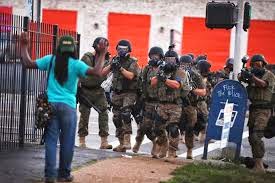
Rejecting the notion, floated by some so-called "progressives" and members of the Congressional Black Caucus that we need a Police Czar to prevent what happened to Michael Brown.  Or maybe what happened afterwards.  You know, to make the police friendly (just as the [war on] Drug Czar did such a fine job making the drug war genial and the Homeland Security Czar made TSA screenings warm and fuzzy and the Russian Czar made A FUCKING REVOLUTION), Scott Greenfield suggests that we already have the tools in place to reign in the police war on the citizenry.
But there is nothing sought for which there isn’t someone already responsible. The DoJ has an office of civil rights. The DoD doles out surplus military equipment under its 1033 program. You’ve got people paid to lead the police, oversee the police, fix the police, stop the police, then you can shake a stick at. And it’s amounted to a group of overarmed, undercaring, people with the power to subjugate upon command. So the answer is let’s add another layer with a cool Russian title?
Is there something progressive about the men and women we elected to national office, sometimes referred to as members of Congress, getting a free pass on their responsibilities? Or perhaps a Chief Executive who might use the fiat of his office to satisfy the needs of the citizenry. If only he had an Attorney General (which, If it makes people feel better, could be renamed to Attorney Czar) who was charged with seeing that the Constitution was honored by all who hoped to receive a government pension some day?
There is nothing here, nothing called for, that can’t be accomplished by the people already in place. They have the power and authority to control law enforcement. 
Don't hold your breath.

It is, after all, those elected officials (and the ones appointed by them and confirmed by them) who enthusiastically created this mess.  it is they who enthusiastically promoted the movement from 
 to

Oops.  Sorry.  Meant this

Of course, there are also the courts.  They, as Scott added, are the backup.
And to the extent some slimy bastards sneak through, we then have judges to fix their wagon.
Well, not so much.  As Erwin Chemerinsky pointed out in a Times Op Ed the other day, various sorts of Court-created immunity protect government and cops from being sued.  You have to make them pay, but the courts insist that we can't allow that.  Oh, sure we have the right not to have our rights violated. But nobody gives a rat's ass about that.

What some people do care about is a broader effort to shut the courthouse doors to people who've been wronged.  What makes it easy, and what purportedly justifies it, is how the Supremes have dealt with the provision of Article III of the Constitution (specifically, the first paragraph of Section 2 of Article III) that sets out the jurisdiction of the federal courts.
The judicial Power shall extend to all Cases, in Law and Equity, arising under this Constitution, the Laws of the United States, and Treaties made, or which shall be made, under their Authority;—to all Cases affecting Ambassadors, other public Ministers and Consuls;—to all Cases of admiralty and maritime Jurisdiction;—to Controversies to which the United States shall be a Party;—to Controversies between two or more States;— between a State and Citizens of another State,—between Citizens of different States,—between Citizens of the same State claiming Lands under Grants of different States, and between a State, or the Citizens thereof, and foreign States, Citizens or Subjects.
Which brings me to Spokeo.  That's Spokeo v. Robins, a case that the Supremes have been asked to hear this year.  

Spokeo asks the question of whether Congress has the authority to give people the right to go into federal courts and sue because their rights have been violated.  Technically the issue is much narrower than that, but the broad brush is suitable here.

This is the problem.  The Court has long held that those "Cases, in Law and Equity" coming from the Constitution, laws, and treaties, are only ones where somebody has suffered a specific and personal concrete injury.  Out some money, you can sue.  Be physically harmed, you can sue.  Just be pissed because your constitutional rights are being violated but not in any personal, concrete way - you haven't lost anything except a bit of your guaranteed freedom?  Nope.  Sorry.  The courts won't fix that.

As the Supremes said, back in 1979 (citation omitted, Rehnquist and Stewart dissented from the Court's decision, but pretty clearly not from what I'm quoting), explaining what that limitation to cases meant
In no event, however, may Congress abrogate the Art. III minima: A plaintiff must always have suffered "a distinct and palpable injury to himself" that is likely to be redressed if the requested relief is granted.
Why, if we actually said the courts were there to protect rights generally, to hold the government accountable for violating the Constitution?  It would surely be the end of the Republic.

Or not.

So Congress passed the Fair Credit Reporting Act and said that credit reporting agencies could be sued for willfully getting the information they reported wrong even if the person whose info was misreported hadn't suffered any actual harm from it.  (I'm oversimplifying like crazy.  Live with it.)  Spokeo said that Robins was better educated than he was, had more experience than he does, is married though he is not, and was better off financially than he is.  Robins sued for what he called a willful violation of the Act's requirements.  (Spokeo denies that it violated the Act, but that's irrelevant here.)  Ultimately, the 9th District said Robins could sue because he had an "injury in law" even if not an "injury in fact," and Congress said in the Fair Credit Reporting Act that an injury in law was enough.

Sorry for the arcana, but there was no other way.

So the question the Court can now answer if it's so inclined (the Court is set to consider whether actually to hear Spokeo at it's "long conference" on September 29) is whether there are circumstances when you can sue even if you haven't been hurt except that some right has been violated.  If the Court says yes (and I'm not putting good money on that), it's not only a victory for Robins and many other litigants, it's also a crack in the machinery that keeps the courthouse doors locked.

And once the doors are open even a little bit, then we can try to drive the trucks through.

The rules for closing the courthouse to people like Robins are supposedly based on the actual language of the Constitution.  The rules that say that cops are mostly immune to suit, that prosecutors are absolutely immune, that government is mostly immune, those rules have no grounding in the Constitution at all.  They were made up because the Divine Right of Kings and besides, if prosecutors and cops can be sued for riding roughshod over the innocent and guilty alike, they might exercise restraint - and then where would we be.

None of that would do much to hold Ferguson or Officer Wilson liable for what happened to Michael Brown.  And it doesn't directly address
But it'd be a start.