Showing posts with label Juries. Show all posts

Monday, October 5, 2015

The Spoken Postulation of His Unheard Presence

In a post at Fault Lines this morning (probably yesterday morning by the time anyone reads this), I wrote about some of the arbitrariness and and hypocrisy of the death penalty as practiced in the US of A.  

To know how the death penalty works in practice is to know that, whatever hopes one might have for it, the death penalty doesn't actually work.  It does, however, have effects.  Let's call them penumbras.  (Lawyers will know that there's some irony to the choice of term; nonlawyers should consider themselves lucky.)

I began that post with a story about Tim Hoffner's jury.  You can go over to Fault Lines and read the tl;dr or stay here for the  shorter version.   

The jury sat through days of testimony of a horrific crime, an Edgar Allen Poe sort of crime.  They found Hoffner guilty.  Then they said that he should die.  The judge, the late Bill Skow, thanked the jurors for their service.  
What you did, he told them, was difficult but necessary.  And we, the citizens of Lucas County, and the officials of the county, are enormously grateful.  For what you did, he added, if any of you need therapy as a result, the county will pay.
I don't know if anyone took the judge up on the offer.  And, frankly, the county wasn't about to pay much.  But it's worth taking a minute to think about the offer - and the need for it.

Sitting on a capital jury, sentencing someone to die, it's traumatic.  Like being (and yes, I know the analogy isn't fair) in a combat zone.  A vital job for which there's a fair chance you'll suffer a lifetime of psychological problems.  And, of course, juries are drafted, not filled with volunteers or professionals.

What I told you about the Hoffner jury was from the outside.  It's what the judge offered and the messages implicit in it.  Sometimes we get a peek inside.
She still cries when she thinks about the 12 people she never met. At night she imagines the horrors she only heard about.
The life she led before this summer still feels out of reach, and she fears that others will find out who she is and what she did for 16 weeks.
She was one of the jurors who listened, deliberated, voted guilty, and then said no, not death.  Not for James Holmes who shot up that movie theater in Aurora, Colorado.  She'd kept silent, but last week she spoke with Jordan Steffen of the Denver Post.

The headline is that the press has been misled and misleading in saying that there was only one juror for life.  In fact, she said, there were three.  But the headline isn't the point.  Here's the point.
In the interview at an empty diner in eastern Arapahoe County, the juror eyed the wait staff. She politely asked to move to a table in the corner of the room, out of earshot of others.
It was the first of two relocations she would make in the restaurant.
The toll of the trial is evident. At times she fights back tears. Afraid someone will recognize what she's talking about, she stops in the middle of words when a server checks on her meal.
She does not doubt her verdict.
The juror still believes in the death penalty, but she is adamant that death was not an appropriate sentence for Holmes. She said she decided to end her silence because she could no longer bear to watch the weight of public scrutiny — what she described as a "witch hunt" — fall solely on the shoulders of her fellow juror.
"I don't think any one of us three would ever tell you that he deserved life or that we felt life was appropriate. It's just that the other option wasn't an option," she said. "It was one or the other. You didn't get anything in the middle."
Oh, but how important that we put her through it.

Kelly Gissendaner faced death for the murder of her husband.  A murder she did not commit.  The murder was committed by Gregory Owen.  He was, at the time, her lover.  And she got him to do the deed.  He's serving life and will be eligible for parole in 2022.  She was executed last week by the good people of Georgia.

Rhonda Cook, a reporter with the Atlanta Journal-Constitution was one of the media witnesses. 
The singing is what I will always remember about the execution of Kelly Renee Gissendaner.
Her voice was joyful and light as she sang the first verse of “Amazing Grace.” By the second verse, though, the 47-year-old dying woman struggled to sing as the lethal injection drug took hold.
It's a prison, so the witnesses are regimented.
We are led though an underground tunnel and up a flight of stairs where we are given notepads and two pencils. We then wait in a nearby employee break room.
We wait for hours and the mood shifts from boredom to high-alert and then back to boredom. The long stretches of silence are broken by talk of sports, people we cover and, of course, Gissendaner.
An obviously bored prison guard assigned to baby sit us pops her chewing gum as she studies the screen on her cell phone.
The hum from the condenser keeping soft drinks in a vending machine cold is almost deafening.
When I was waiting, in an office across from the death house at the Southern Ohio Correctional Facility in Lucasville, waiting for them to finish killing my client, there was a clock in the room. Stuck.  The time, permanently it seemed, 11:24.  The second hand would advance toward the twelve, toward it becoming 11:25.  Click, click, tick, tock, one second at a time.  And then it would fall back. 

It's what you fixate on.  Chewing gum. The condenser.  Pencils.  Two of them.
Gissendaner is strapped to the gurney when we enter the chamber. She lifts her head to watch the witnesses taking their seats on the three church pews. Hers arms are strapped to boards that extend out and down from each side. The IVs have been inserted. A sheet covers most of her body.
With everyone seated, Gissendaner directs her final statement to one of her lawyers, Susan Casey.
“I love you, Susan,” Gissendaner said.“You let my kids know I went out singing “Amazing Grace.”
Casey nods and then sobs. A chaplain prays. And then she sings.
“Amazing grace,
how sweet the sound,
that saved a wretch like me.”
A few more lines and then Gissendaner closed her eyes for the last time.
Jeff Hullinger of 11 Alive watched the killing, too.
We were the last in to a small building that looks like a concession stand at a high school football game. We entered seeing three church style pews with lots of men. Then right in front of us is Kelley Gissendanner- -on the gurney, arms outstretched with needles and tubes. She makes eye contact as we enter the room. She begins to sob, I avert my eyes trying to compose myself. She is somewhat agitated or nervous.
The chamber door closes behind with a clang. No one is to exit. We are told, “There is medical attention (a doctor) if you need it.”
Wait.  Why would you need a doctor?  Has a witness ever hard a heart attack from the stress?  And they really won't let him out?  So they get a twofer?  Gissendaner and a member of the press?  Cool. Or horrifying.  Hullinger doesn't pursue the thought, doesn't question.  Anyhow, the door closed with that "clang" so it's really too late to find out.
The warden appears as a sort of host. A prayer is said; Gissendanner is crying, sobbing, wailing. Gissendaner singing a panicked “Amazing Grace” is a searing thought tonight. The hymn will not sound the same to me again.
“I’m sorry” she says to her husband, an “amazing man who didn’t deserve it”. . . She wants to take it back, She wanted her Children to know she went out signing Amazing grace.
The faces of those viewing were empty, forlorn, mostly male, and mostly turned away. A woman sobs & sings. Compassion is only present in thought.
Forget what they did to Kelly Gissendaner.  Look what they did to Jeff Hullinger.
Listening to prayer in the middle of this execution – in this awful place – felt necessary but unheard by a deity.
. . .
And when it was over, I wanted to sprint to the prison van amidst the razor wire. I wanted someone to take me somewhere to collect myself and pray.
Feel better now?
* * *
1968, I'm pretty sure it was.  Central Park in New York.  Concerts in the Park, sponsored by, if memory serves and it may not, Schaefer Beer.  Judy Collins.  Time for her encore during a raging Thunderstorm.  She alone on the stage.  A capella.  Her voice soaring above the thunderclaps. If you were there, you remember it.  This is as close as I can find.

---------------
"The Creation of the Inaudible," by Pattiann Rogers

Maybe no one can distinguish which voice  
Is god’s voice sounding in a summer dusk  
Because he calls with the same rising frequency,  
The same rasp and rattling rustle the cicadas use  
As they cling to the high leaves in the glowing  
Dust of the oaks.

His exclamations might blend so precisely with the final  
Crises of the swallows settling before dark
That no one will ever be able to say with certainty,  
”That last long cry winging over the rooftop
Came from god.“

Breathy and low, the vibrations of his nightly
Incantations could easily be masked by the scarcely  
Audible hush of the lakeline dealing with the rocky shore,  
And when a thousand dry sheaths of rushes and thistles  
Stiffen and shiver in an autumn wind, anyone can imagine  
How quickly and irretrievably his whisper might be lost.

Someone faraway must be saying right now:  
The only unique sound of his being
Is the spoken postulation of his unheard presence.

For even if he found the perfect chant this morning 
And even if he played the perfect strings  to accompany it,   
Still, no one could  be expected  to know, 
Because the blind click beetle flipping in midair, 
And the slider turtle easing through the black iris bog,   
And two savannah pines shedding dawn in staccato pieces   
Of falling sun are already engaged in performing   
The very same arrangement themselves.

Thanks to Paula Wallace and The Rev. Dr. Thomas C.H. Scott for the poem.

Thursday, August 6, 2015

Sure They Considered Race. What's Your Point? - UPDATED

Linda Greenhouse offers what she inaccurately calls a "thought experiment."*
What if we abolished peremptory challenges?
The subject is discrimination in jury selection.  The occasion is Foster v. Chatman, a case of pretty blatant racial discrimination where a Georgia prosecutor used peremptory challenges to kick blacks off a jury and help secure a death sentence.  

The Supremes thought, in their naiveté, that they'd abolished that sort of discrimination in Batson v. Kentucky and a string of cases applying and extending it.  They were wrong.  They were also, as it happens, misguided.

Oh, the goal, end discrimination in jury selection, is high-minded enough.  Nobody much, today, is going to be a public advocate for racial discrimination.  (Batson's been extended beyond race, but the same point applies.)  That's not really the issue, though.  Because once you start down the road you've got a problem.

When Batson simply applied to the prosecution in criminal cases, it was a sham.  (Only the hopelessly - like the berobed ones in Washington - really thought it would achieve what they claimed.)  Built into the ruling was an easy out for prosecutors:  Offer a race-neutral lie for why they were kicking this or that juror off a case.  (Juror frowned; juror smiled; juror wore green pants; juror wore no pants (!); juror once knew someone who once knew someone who heard about someone who got a traffic ticket - or didn't; the possibilities are endless.)

But when the Court went further and made clear that the goal of Batson was not to ensure that defendants got fair trials but that discrimination ended, the largely empty but plausible logic went out the window.  Batson, it turns out, isn't about the rights of the accused - not about the rights of the litigants at all.  It's about the rights of the juror who is excused based on a discriminatory peremptory. The lawyer who challenges the peremptory, acts not (the court says) in the interests of her client but in the interests of the excluded juror.

That's bullshit, of course.  As a lawyer, your only responsibility beyond upholding the basic integrity of the system by obeying the rules, is the interests of your client.  If that peremptory - racially motivated or otherwise and regardless of reason - is one you're happy the other side exercised, you're not going to complain.  It's only when your client would get screwed that you're gonna bitch.

And that's as it should be.  The theory is that when I get rid of the jurors I hate and the prosecutor gets rid of the jurors he hates, the remaining 12 are going to be pretty fair.  That theory may be nonsense in practice (jury selection is largely a matter of gut feeling rather than hard science), but it's the underlying idea.  And it works.  There are jurors who pretty obviously will be biased one way or the other but don't fall into any of the categories where exclusion for cause is allowed (brother of the defendant, witness in the case, plaintiff's lawyer in another case, whatever).  So we have peremptories to get rid of them.

Doing away with peremptories means assuming that any 12 random folks will be fair to both sides. In the real world, that ain't so.  And nobody who litigates really wants that.  We want jurors who will vote our way. Same as the other side does.  So we all get rid of the ones who surely won't.  That's the idea.  And hundreds of years of Anglo-American jurisprudence suggests that it works pretty well.

Does it allow for discrimination?  Yeah.  Can the discrimination be invidious and unfair and racist and lead to appalling decisions?  Yep.  (Think of those all-white juries in the south that routinely sentenced blacks to die for looking crooked at whites and routinely acquitted whites who murdered blacks.)  

Of course, if instead we figured out how to give teeth to what seemed like the idea of Batson when it first came out.  Prevent the government from using race to secure convictions and death sentences. Now that was an idea. 

UPDATE

Scott Greenfield also takes on Greenhouse and Batson over at Fault Lines.


---------------
*If it were actually a thought experiment, the follow-up would be an examination of how that would (or would not) change things.  Her follow-up is to announce that there aren't enough votes on the Supreme Court to do it but that she longs for a day when there are.  Not an experiment at all.

Tuesday, May 12, 2015

On Juries

I’m not absolutely sure that it’s not Pedro Hernandez. But that’s my how our legal system works.
Adam Sirois, the lone juror who voted not guilty in the Pedro Hernandez trial. Consistently. Over some 100 hours of deliberations.

Adam Sirois, who doesn't know whether Pedro Hernandez abducted and killed 6-year-old Etan Patz in 1979.

He sat and listened to all the testimony. As did the other 11. He paid attention to it all. As, we must assume, did they.
At times he was certain Hernandez did it. At the end, the other 11 were. But after all was said and done, he wasn't sure enough. Reasonable doubt. 11-1. Which means that Pedro Hernandez is innocent.

Even if he did it.

If you can't understand that, if you can't accept that, then ours isn't the system for you.

Pedro Hernandez is innocent. Wholly, completely, totally innocent. So are you.

It's not that as a matter of historic fact he did not abduct and murder Etan Patz. Maybe he did. Maybe he didn't. I don't know. You don't know. Adam Sirois doesn't know. Neither do the other 11 jurors. 

I've said this before, but it bears repeating.  Trials are not about truth.  They're not about what happened.  They're about proving things - elements of crimes we call them - to the satisfaction of 12 jurors.  Beyond a reasonable doubt.  Whatever that might be.

The prosecutors proved what they had to, proved to 11 jurors, those elements.  From which they, the 11, said Pedro Hernandez was guilty.  Adam Sirois wasn't convinced.  He didn't believe it beyond a reasonable doubt.  Whatever that might be.

And so Pedro Hernandez is innocent.  Wholly, completely, totally innocent.

Even if he did it.

Which maybe he did.  And maybe he didn't.

That, my friends, is the American Way.
.
* * * * *
It is, of course, also The American Way™ that even though the Constitution guarantees that nobody can be tried twice for the same crime, prosecutors plan to try Pedro Hernandez again for the same crime. And the Supreme Court says that's just fine.  Being tried twice for the same crime, you see, is just fine as long as it isn't being tried twice for the same crime. 

Because criminals. 

Tuesday, November 4, 2014

Buyer's Remorse: Another Body in a Body Bag

On Halloweeen, the jury returned its verdicts.  Shawn Ford, Jr., should be killed for beating Margaret Schobert to death with a sledgehammer, they said.  He should spend every day of the rest of his natural life in prison for killing Margaret's husband, Jeffrey, the same way.  They're both death sentences, of course. The difference is that for Margaret, the jury said not only that Ford die in prison, but that he should be killed there.*

One of these days, Judge Tom Parker will sentence Ford.  He has no choice of sentence involving Jeffrey.  He's required to do what the jury said: LWOP, death in prison.  He does have a choice in the other case:  Death, LWOP, 30 years of actual time in prison and then a theoretical chance of parole, or 25 years of actual time before a theoretical chance of parole.

Of the hundreds of jury death recommendations in Ohio, only 8 times have judges rejected the recommendation and imposed a version of a life sentence.  I wouldn't put any money on this being number 9.

All that is, ultimately, a digression from what I want to talk about.

Ohio law says that those verdicts must be unanimous.  And they were.  The 12 jurors who earlier found Ford guilty deliberated again and then unanimously agreed that he should be killed for Margaret's death and spend the rest of his natural life in prison for Jeffrey's.  All 12 signed both verdict forms.  The judge polled them.  All 12 agreed that they intended what they signed.**

Except.

One of the things we know about capital juries, even capital juries that eventually decide to kill, is that at first, there are almost always votes for life, even if only one or two.  When the jury returns a death verdict, it's because those one or two lifers eventually gave way.  Because it's tough.  And part of what we need to do as trial lawyers is empower those jurors, give them the tools and the strength to stand up to the rest.  Because all it takes is one, finally, who won't cave.

There isn't supposed to be any caving, of course.  Jury deliberations are supposed to be, well, deliberate.  Reasoned and rational.  Tote boards adding and subtracting.  Balance beams for weighing.  This much on one side, that much on the other.  Jurors are told not to vote for the majority "just to be congenial." 

But it's not congeniality that screws with the verdicts.  it's hostility.  The jury room is contentious, argumentative.  It can get ugly.  Nigger.  Honky.  Fucking cunt.  Shithead.  There have been assaults. 

I didn't want to find him guilty, a juror told us in a case I handled on appeal.  And then I didn't want to vote for death.  But she did.  She found him guilty.  She voted for death.  The law says, basically, so be it.  Jurors can't recant their verdicts once they've been accepted.   Finality, after all.

So it was in Shawn Ford's case.  Phil Trexler in the Akron Beacon-Journal.
A juror who agreed that Shawn Ford Jr. should be executed for the killing of a New Franklin woman now says others on the panel intimidated her over two days of contentious deliberations and she never believed a death sentence was warranted.
Never believed.  Never wanted it.  Voted for it anyway.
“I didn’t want the death penalty at all,” she said. “I fought for hours. I had one juror get in my face saying, ‘I can’t believe you wouldn’t give this kid the death penalty. What’s wrong with you, something’s wrong with you.’
“Yes, [I was intimidated]. It was rough. It was hard. And I’m still not at peace that a death sentence was handed down … I don’t feel a death sentence is right for Shawn. He needs help, not a needle in the arm.”
No, I don't imagine she is at peace.  She said she held the verdict form for 20 minutes, unable to sign it even after she agreed to.  But she did.  Sign.  Death.

And when the jury was polled? 
“I hesitated to say yes,” she said. “I wanted to say no, but I couldn’t. I was looking down. I was shaking. I couldn’t even control myself. But I said yes.”
She caved
[b]ecause of how awful they were. . . . They were screaming at me.
The law, our law, says the jury must be unanimous.  They said they were.  That's enough for the law.

Enough, even if it's a lie. Truth, that elusive thing?  It doesn't matter.  It's all about magic words. Signatures in ink on a verdict form.  Saying "yes" to a question nobody really understands.
After the verdicts were read and the courtroom cleared, the juror said she found herself back with the others in their deliberation room. She said some hugged and others laughed while she wept looking out a window.
“I was furious with them at the end. I couldn’t even look at them in the eyes. I wanted to get the hell out of there,” she said. “I didn’t say a word to anyone. I flung my juror [badge] on the table. One lady who works for the judge said, ‘It’s OK.’
“And I said, ‘No, it’s not OK.’ I said, ‘We’re putting another body in a body bag.’ ”

-----------------
*Yes, I know, and I assume the jurors knew, that For cannot serve both those sentences.  One keeps him in prison until he dies of natural causes.  The other arranges his murder.  If he is killed for Margaret's murder, he won't have served the sentence for Jeffrey's.  If he serves the sentence for Jeffrey's, he won't have served what the jury urged for Margaret's.  Nobody said the criminal law makes sense.

**Actually, each of the 12 was asked, "Are these your verdicts?"  And each said "Yes."  I've often wondered if jurors asked that question really know that what it means is "Do you agree that this is the verdict you think is correct?"  I"m pretty sure the answer is that they don't.

Wednesday, May 14, 2014

Because We Want Him To Be Executed. That's Why.

Here's how the Ohio law works.

If and only if the jury convicts the defendant of both aggravated murder and at least one death specification, there will be a second phase of the trial.  If and only if the jury in that phase decides that the death specification outweighs whatever mitigation there was, it is supposed to recommend a death sentence. If and only if the jury recommends death, the judge gets to decide whether to impose a death sentence.*  If and only if the judge decides to impose a death sentence, the case goes directly to the Ohio Supreme Court to review and the Ohio Supremes decide, independently, whether that death specification outweighs mitigation.  If and only if they decide that, the defendant can be executed. (Not right away, of course.  There are likely to be years of further appeals and litigation.)

Tuesday, the Ohio Supremes issued their ruling in the case of Anthony Kirkland.   Kirkland's case had gone through all those preliminary steps.
  • Jury said he was guilty of specifications
  • Jury said they outweighed mitigation so he should be killed
  • Judge said he should be killed
So the Supreme Court reviewed the case and said, as it often does (and with particular but not exclusive regularity in Hamilton County where Kirkland was tried) that the prosecutor overreached cheated during the second step where the jury had to decide whether Kirkland should be killed. Generally, the court follows that conclusion by saying it didn't matter.  Prosecutor just said one improper thing in 25 minutes of explanation to the jury of why they should recommend killing.  The mistake was harmless. Just a blip.  Trivia.  No biggie.  

Not this time.  This time the court said the prosecutor's misconduct was pervasive.  It mattered. 

We also find that the prosecutor’s closing argument prejudicially affected Kirkland’s substantial rights.prejudicially affected Kirkland’s substantial rights. 
Which is extraordinary.  It means that the misconduct was so bad that it might have swayed the jury, might have changed the outcome.  It means that the court was saying that the jury's recommendation of death, which is what the whole thing rests on, can't be trusted.  Had the prosecutor played by the rules, the outcome might reasonably have been different.

Which means, of course, that Kirkland gets a new sentencing hearing.
WOW!
But wait, as Ron Popeil used to say, there's more.  Or maybe less.

The court's vote was 4-3.  The court's opinion was by Justice French.  O'Connor, O'Donnell, and Kennedy joined it.  Not so the other three who dissented in part.

OK, so it was less than unanimous.  But a new sentencing is . . . .  

NO. NO. NO.  Pay attention.

The dissenters (Pfeifer, Lanzinger, and O'Neill) said he should get a new sentencing because the jury verdict was unreliable because of the misconduct.  After all, if the jury hadn't voted for killing, then the court wouldn't be deciding whether killing was right.  And the prosecutor's cheating made it impossible to trust the jury.  That's what the court said, what Judy French wrote and what O'Connor, O'Donnell, and Kennedy signed on to. 

So what's the dissent?

Oh, the majority said that the jury doesn't matter.  Sure the error wasn't harmless and the jury might not have found that Kirkland should be killed.  But we think he should, so that solves the problem.  Oh, we wouldn't be able to say
Kill him!
if the jury hadn't said it first.  But they did, even though at a fair trial they might not have. And we care deeply about juries.  And proper procedures.  And fair trials.  And fair sentencings.  

Except when they get in the way.

Really, and sad to say, you can't make this shit up.


-----------------------
*If the jury doesn't find that the death specification it convicted of in the first phase outweighs mitigation, it imposes a life sentence.  That is, a jury's vote for death is only a recommendation to the trial judge.  A jury's vote for life is binding.

Sunday, July 14, 2013

Because There Really Is No Better Alternative

Eric Mayer, the Unwashed Advocate, clearly lays out "all you need to know."  Scott Greenfield explains why the crowd can't be trusted and hasn't a clue. And Brian Tannebaum gets to the nub of both points with well deserved slams at the media for making it worse.

So. One more time. Whatever you believe.  You need to start with this.
  • You don't know just what happened that night.
  • I don't know just what happened that night.
  • None of the reporters or analysts or commentators know just what happened that night.
  • The judge and the prosecutors and the defense lawyers don't know just what happened that night.
And, oh, yeah.  Which is how it happens that we're here.
  • The jury didn't know just what happened that night.
Oh, we all know that Trayvon Martin is dead and George Zimmerman killed him.*  That was never the issue.  The issue was whether George Zimmerman committed a crime.  And the answer to that, as I've told my clients repeatedly over the years, as I've written here from time to time, is that none of us (maybe not even George Zimmerman at this point, if he ever did) knows just what happened that night.

The other day, Scott Greenfield noted that despite what TV and the newspapers (and perhaps twitter and facebook but I'm not on those so can't say) may lead you to believe, there's a class of folks you might think spend their every waking moment - and perhaps a significant portion of their dream lives - contemplating the Zimmerman case but in fact don't.
Many criminal defense lawyers studiously ignore cases that catch the public's attention. They just aren't that legally interesting, even if the facts or issues give rise to popular passion. And so it's been for the trial of George Zimmerman for murder 2º in the killing of Trayvon Martin.
I confess to being part of that cadre.

After the knock, knock joke, I was done.  I mean, here's a lawyer who's carefully planned, worked out, scripted, practiced, beginning the trial by . . . . My head hurts just remembering it.**

So I quit. Enough of it.  The case had some sociological interest but legally it was just another show trial and they're just not interesting.  I have my own cases to worry about.  But then the jury came back.  

OK, I get it.  The people who think Zimmerman a hero for killing that drug-addled, dope-fiend street punk looking for a little white girl to rape are pleased that justice prevailed.  The people who think Zimmerman went trawling for the opportunity to kill someone and who better than an innocent black kid minding his own business while heading off to buy a candy bar are outraged.

But see, and here's back to what I tell my clients, this was a trial.  And trials aren't about what happened.  They aren't about truth (whatever that might be and regardless of whether it's knowable).

They're about proof. Which is something altogether different.  Proof isn't what happened.  Proof isn't whether it actually was Colonel Mustard in the den with the candlestick.  And god knows proof isn't what's in the human heart (or what was in George Zimmerman's head).  Proof is about what the jury believes based on the testimony and other evidence as it came in at the trial.  What it believes not more likely, but what it believes beyond a reasonable doubt (whatever that might be).  

Each crime has what lawyers call elements.  Those are the things that the duly enacted statute says the jury must believe the prosecution showed to be so beyond a reasonable doubt.  If the jury finds that the evidence (and only the evidence) as it came in at trial proves every one of those things beyond a reasonable doubt, then it's supposed to convict.  If not, if the prosecution didn't prove all of those things that thoroughly, then it's supposed to acquit.  To say
NOT GUILTY
Even if they believe in their heart of hearts that he did it.  And even if, maybe especially if, you believe it.

And even if it's factually wrong.

John Henry Wigmore who (quite literally) wrote the book on cross-examination said
Cross-examination is the greatest legal engine ever invented for the discovery of truth.
Which is just silly, even it's so.  The idea is the idea of trial.
Sparkling, brilliant, equally matched and resourced advocates lay out their evidence and point out the holes and gaps in the other side's evidence.  It's an adversary system, and like a Hegelian dialectic, the truth emerges from the clash and the 12 good men and true (it was pretty much always men when Wigmore was writing) will get it and reveal it in their verdict.  
It is to laugh.  It's not that cross-examination isn't valuable.  It can help lead to the discovery of truth (whatever that is) or more often it can show up lies and mistakes.  But if it's the best we can do, we're woefully incompetent.  And the lawyers?  Those masters of trustworthiness and integrity?  Please.

Look, I'm not saying that juries are usually wrong or that proof only occasionally overlaps perfectly with quotidian reality.  If the system were that fucked up it would have imploded decades, maybe centuries ago.  It probably comes pretty close to right a pretty large majority of the time.  And I surely don't have a better one to propose.

Nancy Grace? MSNBC? Your friendly neighborhood politician?  God help us Thane Rosenbaum?  

I think not.

But then?

The reality is that it isn't just me.  You really don't know what happened, not in absolute terms.  And really (epistemological moment here), it cannot be known.  And so we have - and in practice, by the way, in that Florida courtroom - The Rule of Law.

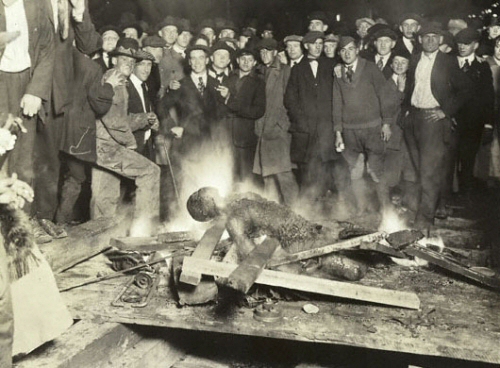
Because the alternative is the Law of Rule.  Which comes from vox populi as readily as from the government.  And which ultimately looks like this from Omaha, Nebraska in 1919.


Or like this


And it sucks.

---------------------
*Note to those of you who want to say, "Told you so" because I'm admitting to actually knowing something when they've accused me of lying when I say that we can never really know anything.  That's an epistemological claim and a quantum uncertainty claim, and I stand by it.  This is a quotidian world claim.  Context matters.  Keep reading.  (Or not.)

**Mark Bennett's commentary is all you need.

Sunday, June 30, 2013

Ethics, Juries & Lies - Lessons We Don't Actually Derive From a Second Century Roman

Aulus Gellius (c. 125-after 180), in his Attic Nights, recounts the "difficult decision which the Lacedaemonian Chilo made to save a friend." Gellius describes Chilo as "a man of surpassing wisdom," and reproduces the story as, he says, Chilo told it to friends about his bedside when he was near death.
That very little of what I have said and done in the course of a long life calls for repentance, you yourselves may perhaps know. I, at any rate, at such a time as this do not deceive myself in believing that I have done nothing that it troubles me to remember, except for just one thing; and as to that it is not even now perfectly clear to me whether I did right or wrong.
I was judge with two others, and a friend's life was at stake. The law was such that the man must be found guilty. Therefore, either my friend must suffer capital punishment or violence must be done to the law. I considered for a long time how to remedy so difficult a situation. The course which I adopted seemed, in comparison with the alternative, the less objectionable; I myself secretly voted for conviction, but I persuaded my fellow judges to vote for acquittal. Thus I myself in a matter of such moment did my duty both as a judge and as a friend. But my action torments me with the fear that there may be something of treachery and guilt in having recommended to others, in the same case, at the same time, and in a common duty, a course for them contrary to what I thought best for myself.
Chilo's problem is a variation on a theme I've explored here before, most recently here and in comments here:  How does one deal with conflicting moral imperatives?  In this particular context can one obey the law while flouting it?  And ought one do that?

His solution has a certain elegance.  It's also, as he recognizes (it "torments" him, after all, and he managed to keep it secret until on his death bed) seriously problematic.  Gellius begins his commentary on the story with that recognition.
This Chilo, then, though a man of surpassing wisdom, was in doubt how far he ought to have gone counter to law and counter to equity for the sake of a friend, and that question distressed him even at the very end of his life. So too many subsequent students of philosophy, as appears in their works, have inquired very carefully and very anxiously, to use their own language, εἰ δεῖ βοηθεῖν τῷ φίλῳ παρὰ τὸ δίκαιον καὶ μέχρι πόσου καὶ ποῖα. 1 That is to say, they inquired “whether one may sometimes act contrary to law or contrary to precedent in a friend's behalf, and under what circumstances and to what extent.”
John Rolfe, Gellius's translator, provides the relevant footnote.
The sentence which follows translates the Greek literally, except that for τὸ δίκαιον “what is right,” we have in the Latin ius moremve, “law or precedent.” The Romans laid great stress on the mos maiorum, the precedent set by their forefathers.
(I've removed all the hyperlinks that were in the on-line edition from which I've copied all these quotes.)

The conflict for Chilo wasn't entirely between moral absolutes.  Obey the law is what is "right," an absolute moral obligation.  Friendship is a good, but saving the life of a criminal friend simply out of friendship is, at least to him, perhaps less than an absolute moral obligation.

Yet it was enough.  And so he sought to find a way to reach his end without violating his duty to the law or his love (for there is no other word) for his friend.  

Our system creates a theoretical out, since we cannot have, the Supreme Court told us in 1976, a mandatory death penalty.  There must be at least one life alternative because the death penalty is to be reserved not merely for the worst offenses but also for the worst offenders.  In practice, that means the jurors and the judges have the wiggle room to do whatever they want as they decide whether this or that person should be killed.

Of course, we first remove from the jury those who insist nobody should be killed (and in theory at least are entitled to remove those who cannot be dissuaded from declaring their insistence that everyone should be).  But there is room.  The jury which is instructed not to consider mercy, may be merciful.

So it is that Chilo could in our system, salve his conscience by voting to convict his friend but also voting to sentence him to death in prison rather than killing by prison guard.  Except that it's not the same.  Chilo's friend walked free after he somehow convinced the other judges that his friend should not be found guilty - which he understood to be wrong.  His powers of persuasion must have been extraordinary.  (You will find him innocent because I'm convincing you that he is, but hey, I'm gonna vote guilty because I believe he is.)

All that ignores that today, in this country, Chilo would not have been serving as a judge on his friend's case.  But that's also trivia.  Here's the real question, and I'll put it in the context of Ohio law.  (Other state laws differ in detail, but the general principles apply.)

In Ohio, if a defendant is convicted of aggravated murder and at least one death specification (details don't matter here), the jury or panel of three judges is to decide whether the death specification or specifications "outweigh" beyond a reasonable doubt whatever is put in front of them as a reason to not kill.  Before a person will be seated on the jury, she'll have to agree that she would, if the specifications outweigh mitigation, vote for death.  And she'll probably have to agree that she could consider, if they don't, voting for life.  

That's skewed of course.  We demand that the juror will vote for death and will be willing to think about voting for life.  But imagine it works fairly.  Still, what the juror says during voir dire is one thing.  How the juror votes is something else.

So now the question and answer:
Q    Can you follow the law, Chilo?
A    Yes.  If the aggravating circumstances outweigh the mitigating factors, I will vote to kill my friend.
If it stops there, all is well.  Chilo can serve and obey his oath and the law because the relative weight of aggravation and mitigation is personal, it's what the individual juror feels.  To Chilo, friendship (or at least this friendship) is such that it can never be outweighed by the aggravating circumstance.  So if selected he can follow the law and still vote for life.  

Which is the answer for all who would . . . . .  But of course it's maybe a not-altogether forthcoming answer.  If Chilo knows that there are no circumstances in which, to him, the aggravating things will outweigh the mitigating ones, then can he still follow the law?

That's why they ask the next question of people like him.
Is it possible for the aggravating circumstances to outweigh the mitigating factors?
And of course he can say, 
Sure.
While perhaps mumbling under his breath - just not in this case (because he's a friend).  And for others, just not in the real world (because he's a human being - however defective).

Which leads to the narrower and narrower question.  Until Chilo lies.  Or tells the truth.

The same calculus works at the other end, of course.  I'll always vote to kill - unless the aggravating circumstances don't outweigh mitigation (which, and now mumbling they always do because the guy is dead and the defendant's a killer who, Q.E.D., should be killed.)

It's a dance and a farce.  And we end up with juries who really will kill - and who, by the way, are more inclined to vote for guilt than juries that haven't been death qualified.

Yet Chilo should tell the truth.  Even if the lie - consistently and forcefully told - might perhaps, although probably it won't matter in the scheme of things, end up saving his friend.  

Because although the system is corrupt and venal, the marginal benefit of trying to scam it is far outweighed by the harm of treating it as a game.

Which it's not.

h/t Alan C.

Sunday, June 23, 2013

Ethicist, Shmethicist

Somehow, I must have missed the Ethicist Q & A (Q by "Name Withheld," A by this year's official Ethicist, Chuck Klosterman) in last week's Times. Scott Greenfield didn't, though it did take him a week to get around to writing about it.  (A week, Scott? Really?)

Here's NW's poser.
About 15 years ago, while living in St. Louis, I was summoned for jury duty. The defendant was charged with two counts of murder. During jury selection, I was asked if I supported the death penalty. I don’t. I’m unalterably opposed to capital punishment. But I feared that potential jurors who did not support the death penalty could be automatically disqualified by the prosecution. So I said I agreed with capital punishment. That way, if it came down to it, I might help spare the defendant from execution. But this violated the oath I had taken to tell the truth. Was it ethical for me to lie in order to possibly spare the life of this defendant?
It's generally understood by capital defense lawyers that a significant number of enthusiastic killers lie in order to get on capital juries while the number of folks who lie as NW did is vanishingly small.  Capital prosecutors, I suspect, believe it's the other way around.  Regardless, NW is hardly the first person to confront that issue or a variation of it.

There was, for instance, A.J. Wagner, judge of the Court of Common Pleas of Montgomery County, Ohio, about whom I wrote three years ago.  What distinguished Wagner from NW (well, lots of things did, but the one I want to mention here) is that he was actually aware of the relevant law.  NW was guessing.*

So, it turns out, was Klosterman who figured that the way it worked was that both the prosecutor and the defense could kick off a few jurors they didn't like and that you'd end up with some jurors who wouldn't impose a death sentence no matter what and some who'd enthusiastically give it to anyone who changed lanes on the interstate without first signalling while the bulk of the jury would be made up of folks like himself who favored the death penalty only for people they thought guilty of something.

NW's guess was wrong, but closer to the truth than Klosterman's.  Klosterman's, however, was presented as fact, not speculation, and carried the implicit imprimatur of the Newspaper of Record (which it no longer is, since that had a specific meaning and reference to information the Times long ago stopped carrying, but I digress).

Anyway, Scott does a fine job eviscerating Klosterman's ignorance and the danger his misinformation poses.  No need to rehash that here nor to bemoan the further ignorance advanced by the Ethicist's commentariat.  (Besides, Scott and I did the latter in comments to his post.)

No, what got me to write this is Klosterman's last paragraph, the part where he actually offered what he thought a good answer to NW's question.
What you should have said was this: “I personally disagree with the state of Missouri’s position on capital punishment, but — if selected — I will perform my duty to the best of my abilities, within the framework of my own conscience.” This, as you note, may have automatically disqualified you from service (and if you said those words exactly as I just wrote them, you might also get marginalized for speaking like a weird robot). But it’s equally possible you’d have been perceived as someone who is both serious and reasonable, which is what lawyers on both sides would claim to want from any juror (assuming both sides think they can make a serious, reasonable argument). And if this was ultimately not the case — if the prosecution flatly refused to allow anyone on the jury who didn’t inflexibly agree with a maximum penalty that is inherently controversial — it’s probably better not to be involved at all. Being disqualified from service for voicing your political opposition is a form a personal protest, which is really all you can do in this situation (without misleading the court and mangling the procedure). 
Put aside the flatulating ignorance of assuming that it's the unusual prosecutor who would "flatly refuse[] to allow anyone on the jury who didn’t inflexibly agree with a maximum penalty that is inherently controversial."  That's the law, Klosterman.  Those people are deemed by the courts to be unfit for service on a capital jury.  (Like lepers, really.  "Unclean! Unclean!" shout Scalia and his compadres.)  The capital jury is supposed to be a fair cross-section of the community excluding those who don't think it's OK for the government to kill people to demonstrate the evil of killing people.

Step away from that and consider what he's saying.
If our criminal justice system were to work as it actually does, in a way I consider wholly corrupt and possibly evil, rather than as I wish it did and believe it does, then the proper, the ethical response is to allow it to function that way.  The alternative would be "mangling the [deeply fucked up] procedure.
Oh, he does say quite specifically that allowing the system to function in it's corruptly evil way would be a personal protest.  (You know, like blacks in the south didn't even try to drink from the "White's Only" water fountains as a silent protest against the prohibition - because to actually interfere would mangle the procedure of racism. )

I don't think Klosterman meant that.  I hope he didn't.  But he's being paid to opine in the pages of the New York Times Magazine, and really that's beyond the pale.

It's also what follows from inviting this level of ignorance.

When the Times started the Ethicist column a few years ago (and a few Ethicist's ago), it was mostly an amusing lark.  The questions were quirky, the answers witty.   The whole thing was obviously a bit silly.  Each new Ethicist has been more sober and serious than the last, each more committed to delving into the philosophical foundations of ethical rules.  And each less willing to bother with actual knowledge before offering mindless answers.

The lawyers who answer questions on AVVO in order to build up their profile notice and get more calls from prospective pro bono clients dispense faulty information by the bushel basketful.  But they're not vetted.  One might wish for more from the Grey Lady, which has an actual editorial board after all, even as she strives for Technicolor.

One would, it seems, be disappointed.


---------------------
* There was also the judge with a pending capital trial who stopped me in a courthouse hallway one day.  "Can't you do something about this death penalty thing?" the judge asked, almost grabbing my lapels to shake me out of my presumed inability.
         "I do what I can," I said.  "But you can actually stop it in your cases."  The judge walked away in disgust at my failure to end capital punishment in Ohio.
         The defendant in that pending case, by the way, is on death row.  Sentenced by that judge.


Saturday, June 22, 2013

The Truth, The Whole Truth, and Whatever Those Women Think Is True

So the jurors are all of what has occasionally been referred to as the "female persuasion." This has, somehow,  become a newsworthy piece of information.  Can six women be fair?  Are they tough enough to convict?  Do they have the cojones?*  Are they too weak-kneed, too faint-heartedly feminine to acquit even though a man's gotta do what a man's gotta do?

And who are these six on whom the fate of the western world depends?  These six women about whom we (or at least I) know essentially nothing but odd factoids.
  • 2 rescue animals, though not professionally (is there such a profession?)
  • 2 have been victims of "non-violent" crimes
  • 2 are married to lawyers.
  • 1 has been arrested and had her case "disposed of" (whatever that might mean).
  • 1 looks Hispanic maybe.
  • 0 appear to be African-American.
Their job will be to sift through the evidence they'll hear over the course of the next month or two, decide who's telling the truth about which things so they can agree about what actually happened that night (the law doesn't require that they be right, just that they agree) and how those agreed "facts" fit within the framework of the likely impenetrable instructions on the law the judge will give them.

Will they be fair?  Can they be?  Can 6 non-blacks fairly sort the evidence (whatever it might be) of an incident which has become racially charged whether or not it was racially motivated?  Can soft-hearted animal rescuers fairly evaluate the circumstances and motivation of human killing?  Do those husband/lawyers screw everything up?

When they're done, and assuming that they eventually do agree about what they must, George Zimmerman will have been found guilty of something or not guilty of anything.  And neither you nor I nor anyone else (including those 6 women) will know whether those factoids had anything to do with whether they were or were not fair in how they listened and discussed and evaluated and decided.

Nor will we know whether they got it right (whatever exactly that means).

I still won't know what happened that night.  Nor will you.  Nor, and this is central, will they.

That's not exactly true, of course.  I know, and unless you've been living under a rock so do you, and surely they do or will, that Zimmerman shot Trayvon Martin and that Martin died from the gunshot.  Almost everything else is, and will ultimately remain, a subject of conjecture and guesswork.

Many years ago, my sister was called for jury duty and made it into the box to be questioned.  It was, as I understand it, a civil case involving something falling off a building or a scaffolding or some such and perhaps injuring a passerby.  Several years had passed since then.  Finally the trial.  Justice.  Truth will out.  All that good stuff.

My sister raised her hand.  
I don't see how it's possible to know what happened after all this time just because these people will come in here and tell their stories.  It's just not possible to know who's telling the truth and who's not and who's just mistaken and how memory might have ebbed over the years.
She was hauled into chambers.  She was sent home.  She was also, of course, right.

See, it matters who those 12 6 jurors are because they have to decide.  But it's impossible for them to know.  Which is why the lawyers work so hard to get jurors they think might be inclined to accept their version of what the evidence shows or doesn't show.

And why I've spent so much time over the years explaining to my client that
  • No DNA doesn't mean the jury has to acquit.
  • No eyewitness doesn't mean the jury has to acquit.
  • Haven't found the gun doesn't mean the jury has to acquit.
  • Your brother or mama or baby mama or the fucking Pope coming into the courtroom and testifying that you couldn't have done it because you were with him/her at the time doesn't mean the jury has to acquit.  (The Pope would be great, though, if he'd come to court and testify to the right things.  Baby mama not so much.)
  • You getting on the stand and saying you didn't do it sure as hell doesn't mean the jury has to acquit.
  • And the fact that you're absofuckinglutely innocent absofuckinglutely doesn't mean that the jury has to acquit.
Because no matter how much they talk about trials as a search for truth, they're not.  And Beyond A Reasonable Doubt means, in the real world, whatever the jury believes enough to satisfy itself.  Because trials, as I've said before, are about proof not truth.  And proof, as I've said before, is whatever convinces those folks in the jury box.  Or what doesn't.

It's not random.  Most jurors try hard to get it right, and most juries probably come pretty close most of the time.  But innocent people are convicted.  Guilty people go free (or are convicted of something more or less than what they actually did).  

And sometimes . . . .  Well, they're planning to take another stab at trying to get 12 jurors out in Phoenix to agree about whether Jody Arias should be killed in prison or just rot away there until she dies.

But six women in Florida?

What will Nancy Grace say?

--------------------
*I actually have the transcript snippet of a female criminal defense lawyer explaining to a judge that she "wouldn't have the balls" to make the argument the prosecutor was making.

Friday, March 15, 2013

Jury Schmury Who Needs a Jury

I spent some time on the phone this afternoon with another lawyer offering him some thoughts and experience about making arguments and convincing courts and how it is that being right isn't enough. The details and background don't matter and would, anyway, invade a conversation which while not exactly privileged was certainly private.  But part of what we discussed was the Harmless Error Rule.

I've written about it before.  18 months or so ago, I wrote this.
The nice way to put the rule is to say that because perfection isn't possible, nobody's entitled to a perfect trial. The Constitution guarantees only a fair trial. If a trial was imperfect in some minor, technical, meaninglessly mechanical way, who cares? Let it go.
And there is a certain logic to that. I mean, if it's clear that the imperfections (a nice word for "errors") didn't matter, what's the point in reversing and doing it over? Why bother? No harm, no foul.
You don't have to have a Mickens case, one where nobody can really tell if it mattered, to know why.
Because, see, here's the thing, and you can forget who has to prove harm or harmlessness or how strongly, because those are quibbles. Those details matter or they don't.
The courts are supposed to get it right. The cops are supposed to do it right. The prosecutors are supposed to do it right. The defense lawyers are supposed to do it right.
And if they can get away with not doing it right, if they can get away with it even some of the time, then three important and really bad things happen.
They have no incentive to do it right. I mean, why bother? Close enough for government work proves, really, to be close enough.
The poor guy at the end of the line is victimized. Maybe he doesn't suffer a result that wouldn't have happened anyway. Maybe he does. But he suffered because his rights were violated. Maybe they were clear constitutional rights. Maybe they were rights he had because some local law or rule wasn't followed (which actually is a constitutional claim, but a derivative one). But he was denied that to which he was entitled.
The system, this whole edifice we've built up, the one we claim to be the bestest and goodest in the world. It suffers. Because we've shown it's bullshit. The rules only matter some of the time. Which means, of course, that they don't matter. And that means it's all a sham.
Which is all true, but that's a different point than today's. That's the policy argument. You know:
The Harmless Error Rule is bad because its consequence undermines any claim to the integrity of the system.
Which, as I say, is true, but a different point.
The lawyer I was speaking with said
It's speculation.
By which he meant, and he was right, that the judges applying the rule are speculating about whether this or that error or impropriety or lie or whatever might actually have been harmful.  And that allows them to decide pretty much whatever they want because, he said, except in extraordinary cases, how can they know.  Which is certainly true and gets at the essential randomness of the Rule.
They're just making it up as they go along.
Which, as I say, is true.
But it also hints at another problem, at another way of thinking about it.  And, sadly, it's another way that won't make any difference, either.
The Sixth Amendment says that the accused has a right to, among other things,
a speedy and public trial, by an impartial jury.
Since 2000, the berobed ones who work in the grand edifice on First Street where the lowly public and the supplicant lawyers must use the servant's entrance because the front door is barred to them and hidden behind a curtain anyway have taken the curious position that three of those words matter.
  1. Trial
  2. By
  3. Jury
And so, they said in Apprendi v. New Jersey, any fact (except a prior conviction) that enhances a sentence beyond the statutory maximum, must be either admitted by the defendant or proved, beyond a reasonable doubt, to the satisfaction of a jury. And they said, in a series of later cases (look 'em up yourself if you care), that they meant it.  It's a jury system the framers gave us, and that means the jury has to decide stuff.  It's just not good enough for the judge to decide.

Which is, of course, exactly what happens with the Harmless Error Rule.
Something went wrong?  OK, now what?  Now we, the ones wearing the robes, get to decide what facts the jury would have found to be true if only they'd known what we know (or not known what they shouldn't have been told).

The Sixth Amendment says the accused has a right to have a jury decide the facts.  The Harmless Error Rule says that the accused has the right to have a judge decide what the jury would have decided.  Which makes the Rule not just bad policy but flat out unconstitutional.

Which is what I told that lawyer on the phone.