Friday, October 30, 2026

Statement from Christa Pike

 Reposted from Tennesseans for Alternatives to the Death Penalty:

Statement from Christa Pike as dictated to her legal team.

One month ago on September 30, I walked into the execution chamber at Riverbend men’s prison prepared to die. I had made my peace. I had told the people who loved me, supported me and stood by me through the years I was grateful for them. I had also told the people in the room and who were there to witness my execution that I was leaving them in loving kindness. Several days later I woke up alone in a hospital confused and in pain.

There hasn't been a moment since that night when I haven't been in pain. My body hurts. My arms hurt. My hands hurt. My throat hurts. I still struggle to speak. And the pain isn't just physical. There is pain in my mind and in my soul. I had not contemplated life beyond that night, and I’m deeply hurt by the incompetence that has put so many people in this terrible position. I continue to think about my victim’s family and the terrible pain and loss they have endured.

I am recovering, and I know that I am getting stronger. But healing is not the same as being okay. Since that night, I have been largely isolated in the prison’s medical ward, away from other people and the human connections that mean so much to me. That isolation brings its own kind of pain. I spent 28 years in solitary confinement and much of what I am experiencing today is a repeat of that condition.

I am searching for meaning in what happened to me. One thing that has given me strength is the extraordinary love and support I have received from people around the world. I am overwhelmed by the kindness and prayers of people I have known for years and complete strangers who have never met me. To know that so many people care about me, that they see me as a human being whose life matters, is something I cannot fully put into words. It is humbling, and it has touched me more deeply than I can explain.

I also want to thank the first responders, doctors, nurses and everyone at the hospital who cared for me. They treated me with compassion, dignity and respect. I will never forget their kindness. I also want to thank my attorneys and everyone who has fought for me, stood beside me and refused to give up on me.

I don't know why I survived that night. I don't know what comes next. Some days, finding hope is harder than others. For now, I am trying to heal, one day at a time. And I am holding on to the love and kindness of so many people who have reminded me that I am not alone.

Wednesday, October 7, 2026

A Bit of Self-Promotion

 I haven't written much here for a number of years now.  I'd like to think I'll get back to it on something like a regular basis, but I'd been liking that thought for some time and . . . . Crickets.

Well, I'm retired now, still involved with criminal law and the death penalty but that takes a back seat. As you may know, my first career was English prof.  Reading and talking about books has always been my main leisure activity.  And so in retirement, I've started a Substack about books and words and language and who knows what all else.  But not law.  

I invite you to take a look, and if you're so inclined, subscribe.  It's free.  

https://jeffreygamso.substack.com/

Thursday, July 23, 2026

The Deserving

It's been decades since I underlined or wrote in the margins of books, really dating back to some point when I was in college and began instead writing notes on bits of paper and stuffing them into the binding.  These days I use sticky arrows reaching out beyond the edges of the page pointing to what I'd once have underlined and post-it notes to take the place of marginalia.  That's all personal preference for keeping books in pristine condition.  

And, of course, it's a moral obligation when I'm dealing with borrowed books whether from friends or, more often, libraries.  

Either way, when I've finished the book, I'll review the notes and marked passages to decide whether to keep them in place if I'm going to hang onto the book, or, if the book is borrowed or going to be passed on to a friend or colleague, whether to copy and save them.  Mostly they get tossed.  Helpful for focus when reading and sometimes reviewing, but not demanding to be kept in perpetuity.  Except sometimes.  Like now.

Which brings me to Elizabeth Vartkessian.  She's a mitigation specialist.  She works with lawyers in (mostly) death penalty cases digging out everything there is to discover about the history and background of the accused or, often, the already condemned and his (mostly his) family and circumstances.  Going back generations.  She'll spend hours and hours - over the course of years or even decades, getting to know and connect with the guy (again, it's mostly guys) and his parents and siblings and classmates and teachers and counselors and prison guards and . . .  basically with anyone and everyone who might have something, anythinbg she can learn about not just what he (there's that mostly correct pronoun again) did but about who and what and why and how and from where and . . . .

The idea is to be able to show the jury or a court or a parole board or governor (or President) why despite having done something awful, there's value in the person - enough value to prevent - or reverse - a death sentence.  

To advance that work, Vartkessian founded Advancing Real Change, Inc. which is described this way on its website (advancechange.org):

We unearth the true histories of people accused of crimes and share their stories with decision-makers to foster empathy and understanding. We aim to take what we learn through this work—mitigation investigation—and uplift those experiences to reshape and rebuild social systems so that communities and individuals may truly flourish. Our vision is the transformation of the criminal legal system and all social systems into systems that deliver true justice.

.  . . . . . .

Vartkessian is, as I suppose is obvious from what she does, opposed to the death penalty.  If you somehow didn't know it before, you certainly would after reading her quite amazing and wonderful new book, The Deserving: What the Lives of the Condemned Reveal About American Justice.

Start with me.  I'm known in some circles, as the atheist who believes deeply in mercy and grace.  Mercy is not something earned, I say, it's something given.  And grace, like mercy, is about the giver, not the given.* (Or maybe sometimes both, but don't quibble.)

And there's Sister Helen Prejean who says (and who, as it happens, wrote the Foreword to Vartkessian's book where she in fact repeats it though phrased a bit differently),  "We're all better than the worst thing we've ever done."**

And so Vartkessian tells us (with an assist from my post-its):

[W]e cannot incarcerate our way out of violent crime. (p. 18)

William's words hung in my mind.  Have a good life.  His lawyer would, and so would I.  We would have those lives simply because we were lucky enough to be born to parents whom society valued more.  It wasn't fair.  (p. 109)

American culture[***] considers inhumane treatment part of the punishment.  We take freedom, but we also take a person's humanity.  And by allowing ourselves to treat others as something less than human, we take the humanity of everyone involved in the enterprise of housing the incarcerated. (p. 191)

It's about us, not them. (post-it)

So many moments in a life when, had the focus been genuine care and concern, the scales might have balanced differently.  That wasn't something I knew until I started working with people who had killed; how grace and love did more to transform a person than anything.  Genuine human conncection- authentic, messy, hard - is the most powerful and restorative force in human existence. (pp. 205-206)

Wes caused a great deal of suffering.  He also gave a tremendous amount of love.  When we take a life, we take the whole life, including the good, which exists in every single human being and just needs the right conditions to emerge. (p. 214)

[T][he criminal legal system cannot deliver an end to suffering.  But we cvould have build a society that prevent it in the first place. (p. 221)

I could go on.  Hell, I could quote the whole book (though I suppose I could also get sued for copyright infringement).  Instead, I urge you to read it.

Those of us who toil in the trenches of criminal defense - and especially death penalty defense - know all of this.  But the reminders, the stories Vartkessian tells, the reminders that we must care, that it takes a village and we're all in it together, and yeah, the tears she jerks, they make it worth our reading.

And, really, others should read it too.  To learn.  To understand.  To grow they're own compassion.

You know.  Mercy and grace, about the giver, not the given.

The Deserving?  It's all of us.

----------

*That's from one of the post-its I put in the book.

**She doesn't add my corollary,  "We're all worse than the best thing we've ever done."  But it's her quote and the point she regularly, and rightly, wants to make.  (Another post-it I stuck in the book, by the way.)

***As opposed, she points out, to Scandanavien culture.

Wednesday, July 8, 2026

Well, He Kinda Pardoned Her

FIRST ANECDOTE

Several decades ago, I was invited to a meeting to help figure out how to prioritize and then advance the goals of an anti-death penalty organization.  

Should we, the group's conveners asked, be focusing on the risk and evil of executing the factually innocent? It seemed a simple question.  On the one hand, the answer was obvious. Of course factually innocent people shouldn't be executed; nobody disagrees with that.  But might that focus lead folks to adopt a simple carve out:  

Sure, save those folks.  But of course that acknowledges that we can feel good about killing the guilty ones.

SECOND ANECDOTE

Another time, a prosecutor and I were guest debaters in a law school class on the death penalty.  Who, the question arose, ought the death penalty be for?  

Well, we both agreed, the idea is that it should be reserved for the worst of the worst who did the worst things.  But, I said, how can you tell?  Where's the margin?  Oh, c'mon said the prosecutor.  It's easy.  Hitler,  Stalin.  Pol Pot.  Yeah, I said.  But you wanted the death penalty against my client who killed the clerk while robbing a carryout.  He wasn't Hitler.  Didn't kill millions.  What's the stopping point?  And that's if you think it's OK to be in the execution business in the first place.

THIRD ANECDOTE

Guy on death row, not my client, days before he's due to be executed, tries to commit suicide.  Guards find him in his cell.  He's rushed off to emergency medical care and then the prison hospital.  Why for godssake?  Hell, they want him dead don't they.  He's just helping them along.  But no the sentence isn't death, it's execution.  The government's job isn't to let him die.  It's to kill him.  And if we have to save his life so that we can kill him, well, that's just how it goes.

FOURTH ANECDOTE

Another client: 22 years old.  Got his conviction and death penalty vacated, he's sent back for a new trial.  The problem is that he is, and is incontestably, factually guilty.  And at the new trial they'll bring in evidence of another person he killed.  Goes to trial it's a sure thing he'll get another death sentence.  But he's offered a deal:  Plead guilty and accept a sentence of life without the possibility of parole.  You'll die in prison, but we won't kill you.  No, he says.  No. No. No.  

We argue with him for weeks.  Take the deal.  You'll be in general population which is less restrictive, less harsh, than being on death row.  And it's not like the one end will be fast and peaceful.  In the end, he takes the deal.

In this business, that sentence, Death in Prison but not killed there by agents of the government, is a win.

. . . . . . .

This business of deciding who should live and who should die.  This business of killing people in our name.  This business of insisting that the proper way of dealing with the worst of the worst who did the worst things, of pretending we can figure out who they are and never accidentally misidentify someone who's only nearly the worst of the worst, or who, frankly, we just don't like because he (it's almost always a he) is black or brown or yellow or has an ugly tattoo or if it's a woman wore transparent thongs and slept with people for money, and besides all that think about the drugs, and at trial had a  shitty lawyer who couldn't be bothered or . . . . 

Look, the system sucks.  And it's efforts, even the serious ones, to do better are hopeless and doomed to failure.  And that's if you're OK with the morality of the thing.

. . . . . . . 

All of which, 

well, probably I should tell you first about Tommy Lee Walker who was killed in the electric chair by the good people of the State of Texas on the 12th of May, 1956.  Walker, a 21-year-old Black man, was tried and convicted of raping and murdering Venice Parker, a young white woman.  He had a rock solid alibi, but hey, that was Dallas County, Texas, he was Black, she was White, and . . . .  

Or maybe I should tell you about Francis DeSales Grayson, Frank Hairston Jr., Howard Hairston, James Luther Hairston, Joe Henry Hampton, Booker T. Millner, and John Clabon Taylor, young Black men convicted of raping and beating Ruby Stroud Floyd, a young white woman in Martinsville, Virginia in 1949.  Six trials (2 were tried together) and six death sentences.  Four executions February 2, 1951, the other three February 5

Or maybe?  Nah, you don't need another of these stories.  You know how they go.  But here's what you need to know:  On August 31, 2021, Virginia's Governor, Ralph Northam, formally pardoned the Martinsville 7.  This year, on January 21, the Dallas County Commissioner's Court unanimously adopted a resolution exonerating Tommy Lee Walker.  None of these folks were brought back, but their actions made clear that what was done to them - not just the executions but the arrests and trials - were travesties of justice

ALL OF WHICH is a prelude to the news today from across the pond.

Again, I have to take you back.  This time to Easter Sunday, April 10, 1955, that was the day Ruth Ellis shot and killed her lover, David Blakely.  She never denied it.  As she said on the witness stand, "[W]hen I shot him, I intended to kill him."

Ellis was, by all accounts, no saint.  But Blakely was worse.  He physically and mentally abused her.  When she was pregnant, he punched her in the stomach, causing a miscarriage.  But murder was murder, guilty was guilty, and mitigation didn't count.  Ellis was sentenced to death.  On July 13, 1955, she was hanged at Holloway Prison in London, the last woman to be executed in England.

But now, and here's where I've been heading with this, King Charles has granted her a pardon.  Sort of.

Per the BBC:

On Wednesday in the House of Commons, Labour MP Pam Cox asked Lammy for the pardon on behalf of her grandchildren, who were watching proceedings from the public gallery.

She said: "Her case serves as a haunting reminder of a time when our justice system ignored the realities of domestic abuse and coercive control.

"In the decades since, members of Ruth's family and supporters have campaigned unwaveringly for her to receive a posthumous pardon.

"Will the deputy prime minister agree with me that their courageous campaign, and the terrible lessons of Ruth's case, must strengthen the government's resolve to free women from devastating cycles of abuse?"

Lammy responded: "I have the honour to say that His Majesty the King has accepted our advice to grant Ruth Ellis a conditional pardon, the last woman to be hanged in the United Kingdom.

Hold on.  A "conditional pardon"?  What the fuck is that?  Oh, right.  The execution is off.  She's now sentenced to spend the rest of her life - which was ended by the crown some 70 plus ears ago - in prison.  Not execution, but death in prison.  Sort of makes you feel all giddy.


But as I said, it's not death.  So it's a win.


Fuck.


Sunday, June 28, 2026

Bernie Goetz Is Not the Subject of This Post (though when I've finished the book I might review it here)

So this retired criminal defense lawyer is sitting in his recliner one summer evening in Phoenix, Arizona (10 pm temperature a nippy 92 after a high today 106) reading Fear and Fury, which if you're old enough to remember and even if you aren't is a book about Bernie Goetz and the shootings and the aftermath and well, I haven't finished it so I'm not sure just where it will end up, though the subtitle Is "The Reagan Eighties, the Bernie Goetz Shootings, and the Rebirth of White Rage." 

Anyway, I'm reading this book (yes, I'm that retired criminal defense lawyer, which I figure you really didn't need me to tell you) and suddenly there's this guy, a lawyer, name of Scott Greenfield being quoted. And I know Scott.  And I have some vague recollection that he had something to do with one of Goetz's victims.  So I check the footnotes to see if he'd been interviewed by Heather Ann Thompson.  And no, he hadn't been. The quotes came not from an interview but from a blog post, "Remembering Troy," on Simple Justice which I'm sure I read 8 plus years ago when Scott posted it.  

And, even if I hadn't read it then, I [re?]read it now.  Because that's what we did back in the day, read each other's blawgs and commented on them and argued about them and with each other and damn I miss that, though I'm partly to blame my own blawg (this one) being essentially fallow now.

But I'm writing this both to let Scott know in case he doesn't that he's quoted in the book.  And to remind myself that what we write (and wrote) has some life and significance at least occasionally beyond our little stables of readers. And, finally, as a reminder to myself that I'd really like to get back at doing this regularly.  

Except that being retired takes up so damn much time.

Monday, June 23, 2025

Until They Are Dead

 Back in the day, when I was writing this blawg on a regular basis, I wrote often about lethal injection.  (You can click the link on the "Labels" section at the top right if you want to bury yourself in those posts.). I thought I knew quite a lot about it:

  • how the drugs were basically unavailable
  • how the states went out of their way to ensure that nobody could know what they were doing or who in particular was doing whatever it was they were doing
  • how whoever those secret folks were who were doing whatever it was they were doing were often grossly incompetent and unable to do whatever it was
  • how . . . . 

You get the idea.

Hell, I'd talked with experts.  I'd read the books.  I followed all the litigation.  I'd even gotten a court to declare that the Buckeye State's method of killing by injection was unconstitutional and had to be changed.*

And I followed the sad saga of lethal injection as it got screwed up over and over, as it tortured and tortured and failed to live up to the promise that it would, as the Ohio statute mandated, "quickly and painlessly cause death."**  So, as I said, I thought I knew quite a lot about it. And about how screwed up it was.

Boy was I ever wrong.  

Corinna Barrett Lain, a law prof at the University of Richmond, makes it clear in her new and powerful and frankly terrific book, Secrets of the Killing State: The Untold Story of Lethal Injection.  

Lain has scoured the country, pored over the protocols (when she could find them), studied the cases, reviewed the autopsies, spoken to the litigators and the experts [disclosure: not me, though my case is footnoted a couple of times], read the books and articles, listened to the folks who invented lethal injection, those who oversaw and those who performed and those who witnessed it.  

And, not incidentally, she looked closely at the folks on the gurneys.  She heard (OK read about) their choking and their gasping, their twitching and their reaching and their clutching their fists and their desperate but futile efforts to get a breath or get up off the table. Or even to advise the incompetents about how to get a needle into them, or just how to get it done.  She examined their last words.

She's done, that is, a deeply thorough and exhaustive exegesis of how and why it's totally and beyond repair fucked up.  And how the states that kill don't really give a rats ass about any of that because all they want to do is ensure that the guy (it's almost always a guy) ends up dead.  And then they'll declare that all went according to plan and smoothly and kindly, quietly and peacefully - and humanely forgodssake - despite all the evidence to the contrary.

And finally there's this, from her Epilogue:
This project has offered (insisted upon even) a front row seat to who these people are.  Many, too many to count, found redemption on death row, and prayed to their Lord and Savior, Yahweh or Allah, as they died, some after starting prison ministries.  As Saul became Paul, so it is for many on death row.  Others were just deeply broken people, desperate to go back to their younger selves and warn them to stop before it was tragically too late.  Over and over, this was a theme in the last statements I read.  A few went out defiantly, but very few.  For the vast majority of these prisoners, it was evident that the person who committed that terrible crime just wasn't there anymore.

(Endnote citation to the biblical story of Saul becoming Paul omitted)

Yeah.

------------

*The state ignored violated that order, and a couple of months later an appellate court declared that it wasn't a real order anyway and so didn't count.

**That's from Section 2949.22(a) of the Ohio Revised Code.

Thursday, June 19, 2025

Today in History

Today is Juneteenth, the newest, most recently enacted federal holiday.  That's the date in 1865 when federal troops arrived in Galveston, Texas, with the news that slavery was over.  

But dates are tricky things.  And as we rightly celebrate liberty and freedom today, so, if you know me, you know there's also a dark side to the day.

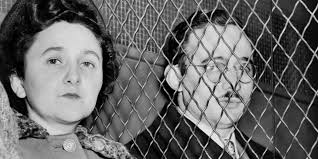
June 19, 1953, 72 years ago. Julius and Ethel Rosenberg, convicted of spying for the Soviet Union, including providing secrets of the atom bomb, were executed.  Strapped in the electric chair at Sing Sing prison in New York.  Killed by our government, in our names, on our behalf.

Some say they didn't do it.  There's pretty overwhelming evidence that Ethel really didn't. And that the government knew it.

But, you know, dead is dead. Evidence and innocence be damned.


 Oh, maybe it's better to remember them this way.


Saturday, June 7, 2025

Uncle Fred and the Texas Bar

Decades ago, back probably when I was a baby lawyer, the Texas Bar Journal (the, er, literary arm of THE STATE BAR OF TEXAS to which every Lone Star State lawyer must belong) announced that it was looking for contributions from members who might take positions that, you know, THE [stodgy] STATE BAR OF TEXAS (did I mention that every Texas lawyer is required to be a member?) might not absolutely favor.*

So I wrote this piece called something like "Uncle Fred in Court."  My thesis, simply, was that since it was allowed (not favored, but allowed) for folks who weren't lawyers to represent themselves in court, to go pro se, they really ought to be able to have, say, their Uncle Fred, who also wasn't a lawyer but they figured was a lot smarter than they were.  Sure, they ought to have a lawyer (preferably a competent one, but THE STATE BAR OF TEXAS didn't really make too much of a fuss about that once someone got licensed)******

I made, as I recall, a pretty substantial argument filled with warnings and risks and legal problems and qualifiers and whatnot.  It's even possible I favored the idea.  It's even possible that, if I could now read what I wrote then I might favor the idea.  Or maybe not.  I don't have a copy of what I wrote and the Texas Bar Journal, that, er, literary arm of THE STATE BAR OF TEXAS, never even acknowledged receiving it, certainly didn't publish it.  And never again solicited potentially controversial articles from its members.

Anyway, as I noted in footnote ****** (yes, numbers or another system would have been easier for you and for me but I'm enjoying the silliness here), it's the ABA that accredits law school.  Has been for decades and decades.  And just as the no-longer-red-haired guy (you've noticed that, too, haven't you?) has declared that the ABA won't be vetting the qualifications of his judicial nominees any longer, so there's discussion of getting it out of the business of accrediting law schools - which makes it, really, an accreditor of the vast majority of lawyers in the Good Old USA.

Which brings me back to the Texas Bar Journal, the, er, literary arm of THE STATE BAR OF TEXAS.  I got my copy of trhe latest issue yesterday, and I saw this 

ORDER INVITING COMMENTS ON THE LAW SCHOOL ACCREDITATION COMPONENT OF TEXAS'S BAR ADMISSION REQUIREMENTS

And yes, that's how it appeared, all in caps and boldfaced.  

I won't bother you with the full "Whereas" and "Order" parts (also in boldface and the latter ion all caps).  But here's the meet:

Until 1983, the Supreme Court of Texas (which actually does the licensing of Texas lawyers) decided for itself which law schools would be accredited (though it didn't use that word).  In 1983, it gave that job to the ABA.  But now, it's rethinking that and asking folks (Texas lawyers only, I imagine) for "feedback" on (1) "whether to reduce or end the Rules' reliance on the ABA" and (2) what the hell to do if it decides to dump the ABA.  (Yeah, it phrases that second issue more delicately, but I know what they mean.) 

Naturally, Texas could do nothing, just keep things the way they are.  

Then again, there's history.  (Note the past rearing its ugly head again.) As I wrote in a comment on Greenfield's post (see footnote ****** for the link),

Historically (if I understand correctly), there were two routes to becoming a lawyer: (1) Attend law school; (2) “Read for the bar” which basically meant intern with a lawyer for a considerable period of time and then take an exam. The people who did one, didn’t trust the competence of the ones who did the other. So the system compromised by requiring both law school and the bar exam.

It’s my understanding that as in one or two states degree from an unaccredited law school may allow someone to take the bar exam and practice in that state, so there may be a state or two that allows reading for the bar (with some sort of oversight I expect) and then an exam with no law school at all.

Texas could do some of that.  Allow for non-accredited law schools.  Dump the law school requirement altogether and just rely on the bar exam.  

Or, of course, it could just say that Uncle Fred can represent his nephew in court.

---------------

*Have you noticed that this is the third of my Lazarus, back-from-the-dead posts and they all take on things from the past, which as I quoted Faulkner about, is never past.**

**And see how I'm trying to put the digressions here into footnotes?***

***At least the footnotes that deal with the past - and that are, themselves self-referential and surely of no interest to anyone but me, if even to me.

****OK, you can return to the regular programming at the top of the page now.*****

*****God, this is why blawging used to be such fun.  Or not.

******Wait, this one's substantive.  Getting licensed meant graduating from an accredited law school and then passing the bar exam.  And law schools are accredited by the American Bar Association which may or may not be as stuffy as it was back in the day but has certainly become more controversial (and probably less stuffy, but I haven't been a member for several decades now so I don't really feel competent to address that and frankly don't much care.  Anyway, see Greenfield's post from Tuesday about ABA accreditation which is kind of what got me thinking about this stuff and then - well read on at the top of the page.


Thursday, June 5, 2025

The Past. It's Always the Past.

"The past," Faulkner famously said, is never dead.  It's not even past."

So when this blawg returned two days ago from what certainly seemed the dead, it was a Faulknerian return hearkening to and including (resurrecting, if you will - and I will even if you won't) it's own past as well as . . . . Feh, you get the point.

But it wasn't just here, not just me.  For my blawg's resurrection reminded Greenfield of what this blawgging world used to be.  It was fun and lively and, frankly (I really do believe this) important.  We wrote because we had things to say, things to get off our collective and individual chests.  We challenged, squabbled, supported, disagreed.  And it was worth it.  Day after day.

And posting, and then Greenfield, made me remember, made me feel the loss.  And so, maybe I'm back.  Just maybe.

As it happens (and that was all kind of a digression, so really you could have skipped over it), in my more-or-less retirement out here in Phoenix where the sun don't seem ever to stop shining, I'm in a couple of book groups.  This month, the discussion for one of them will be about David Enrich's new book: Murder the Truth: Fear, the First Amendment, and a Secret Campaign to Protect the Powerful.  

Enrich details how folks with a lot of money (and some without a whole lot who are often bankrolled by folks who do), want to and try with some success to undermine the First Amendment's protections of free inquiry and reporting.

Look, the basic idea, as the folks at One First Street in DC (that's the Supreme  Court) have made clear over the decades, the First Amendment protects even falsehoods about public figures as long as they're not reported with actual malice.  And actual malice doesn't mean that the speakers/writers doesn't like the person about whom the falsehood is offered but, rather, that they either knew it wasn't so and said it anyway or were recklessly indifferent to the question, that they didn't exercise even minimal care to try and get it right.

That's the standard SCOTUS adopted some 61 years ago in New York Times v. Sullivan.  And despite some grumbling by Clarence Thomas and Neil Gorsuch who think it should be jettisoned, it remains the standard for libel.  

Though he does, like so many, get the claim Holmes asserted wrong,* Enrich generally gets stuff right.  And his book serves as a powerful reminder of just why Sullivan is so damn important, why, therefore, so many folks on the right and on the left would like to junk it, and how essential it is that we the people fight back.

Anyway, as I was reading the book, I realized that I'm almost certainly (and here we go again, because the past is never dead) the only person in the book group who's ever been sued for libel.  Rakofsky v. the Internet (or, as it's technically named, Rakofsky v. the Washington Post, et al. I, of course, am one of the 73 in that "et al" or as we sometimes referred to ourselves collectively, "The Rakofsky 74."


---------------
* Enrich claims the rule Holmes set forth is that "you can't say fire in a crowded theater."  Tim Walz, among countless others, repeated that rule in his VP debate with J.D.  What Holmes actually said in Schenck v. United States was far more nuanced (and is still not the law today - if it ever was):  “The most stringent protection of free speech would not protect a man in falsely shouting fire in a theatre and causing a panic” “The most stringent protection of free speech would not protect a man in falsely shouting fire in a theatre and causing a panic” 


Tuesday, June 3, 2025

In Memoriam

 It's getting on to 14 years since I wrote about Sonny Jacobs and Peter Pringle.  I teared up when I wrote that post and suggested that you, my faithful readers might do that also.  I just read it again, and teared up again.  Of course, I'm easy.  But still.

It's a bit more than a year and a half since I last posted anything here - not because I didn't have things to say but because . . . . Damned if I know.  I just haven't.  (Greenfield, how do you keep doing it day after day and year after year?)

Why now, you may wonder?  Why today? It's about death.

See, I'm old.  What goes with being old is knowing too many people who are ill, too many people who've died.  And given decades of work defending folks who were charged with, convicted of, very bad things, many of whom were sentenced to be killed by the minions of the state - and too many of whom were killed by those minions - death is something that . . .  . Well as Jodi Ernst stupidly (if accurately) said, we're all gonna die one of these days.

And so it is that Peter Pringle died a couple of years ago, though if I knew that it didn't register.  But when I learned that Sunny died in a house fire this morning, it sent me back.  And as I said, it sent me crying.  And made me take up the computer and write this.

Go back then, and read the original post if you will.  (No need to search, here's the link:  https://gamso-forthedefense.blogspot.com/2011/11/in-galway-bay-love-story.html)

And I want to add this picture from the NY Times article I cited and quoted then, a picture which, for some reason, I apparently didn't include back then.


Rest in peace Sunny, and Peter too.

Saturday, November 11, 2023

11/11: 11 a.m.

Eleventh of November.  Eleven in the morning. 1918.  That's when the armistice ending the fighting in the War to End All Wars went into effect. Not the end of the war.  That wouldn't come until the Treaty of Versailles, more than seven months later, on June 28, 1919.  So not the end of the war, but the end of the killing.  No small thing that.

Eleventh of November.  Eleven in the morning. 1919.  Five and a half months after the treaty, but one year to the minute after the armistice took effect. One year to the minute after the end of the killing.  That's when King George V declared Armistice Day and called for two minutes of silence.   We celebrated that day on this side of the pond, too.

A day to remember the dead certainly.  But as the name Armistice Day connotes, it's a day to celebrate peace.

Or, it was.

Because, as Karen Zraick explained in yesterday's Times, "In 1953, Alvin J. King of Emporia, Kan., proposed changing the name of the holiday to Veterans Day, to recognize veterans from all wars and conflicts."

And so it would be.  We no longer celebrate Arfmistice Day on November 11.  We give November 11 to honor the vets: Veterans Day.

As Zraick points out, Memorial Day is to recognize those who died.  Veterans Day is for them too, but equally for the all the rest.

But what of the Armistice? What of the peace - not the peace of desolation, of the desert,* of John McCrae's graves amid the poppies,** but the peace of quiet of calm.  The peace we'd vainly hoped would come after the War to End All Wars.  Or the next one.  Or the one after that.  The peace where we say, collectively, universally,

NO MORE

I really am all for Veterans Day.  They deserve it.  But damn, we sure as hell need to get Armistice Day back.

----------------

*From Tacitus we take the sometime truism, "They make a desolation [sometimes translated as "desert"] and call it peace."  Though it's perhaps worth noting that Tacitus himself was quoting Calgus who was referring to the Romans.  


**


In Flanders Fields
by John McCrae

In Flanders' fields the poppies blow
Between the crosses, row on row,
That mark our place: and in the sky
The larks, still bravely singing, fly
Scarce heard amid the guns below.

We are the dead. Short days ago
We lived, felt dawn, saw sunset glow,
Loved and were loved, and now we lie
In Flanders' fields.

Take up our quarrel with the foe;
To you from failing hands we throw
The torch; be yours to hold it high,
If ye break faith with us who die
We shall not sleep, though poppies grow
In Flanders' Fields.

Sunday, September 17, 2023

Executioners

No person shall purposely, and with prior calculation and design, cause the death of another or the unlawful termination of another's pregnancy

That's Section 2903.01(A) of the Ohio Revised Code setting forth the elements of one form of the crime of aggravated murder.   Anyone who is found guilty of doing that faces a minimum of 20 years in prison.  

If the person is also found guilty of what we call a "death specification" (the death specs are set forth in R.C. 2929.04(A)) the person can receive the death penalty. If that happens, and if the sentence is carried out, the prison guards who perform the execution will, of course, have 

purposely, and with prior calculation and design, cause[d] the death of another.

Which, of course, would seem to allow them to be sentenced to prison for a minimum of 20 years and maybe to be sentenced to be killed.

I've made that point before, just as I've pointed out that there's no exception in the law - at least none in either the Ohio Revised Code or in Ohio's case law - for doing the killing at the direction of a judge or a panel of judges.  

As I've also said, ain't nobody gonna get charged with aggravated murder (with or without death specs) for carrying out a court authorized execution.

I've lso pointed out, from time to time, that a substantial number of executions - both in Ohio and elsewhere - are botched, screwed up.  They take too long.  Things go wrong.  Flames shoot out of the head of the guy in the electric chair.  Prison guards have trouble sticking a needle in a vein to inject the lethal drugs.  The drugs don't actually provide the theoretically authorized painless killing. The hanging goes wrong and instead of a quick neck snap the victim dangles choking or gets decapitated.  Sometimes the execution fails completely and the person doesn't die.

And either the powers that be swear, despite the evidence, that nothing went wrong or they promise to double check their protocols and practice better and make sure it won't happen again.

Ho hum

And then I was reading The Faithful Executioner: Life, Death, Honor and Shame in the Turbulent Sixteenth Century, by Joel F. Harrington, history prof at Vanderbilt University.  It's the story of Meister Frantz Schmidt who for some 45 years, from 1573 to 1618, most as the official executioner (and also torturer, by the way) of Nurenberg.  Meister Schmidt was an interesting guy, a second generation executioner who wanted nothing more than to be relieved of the social and legal ostracism that came with the job.  

Of course, executions were public spectacles in those days.  And while Schmidt was apparently really good at what he did, other executioners were not so competent.  You know, they sometimes botched the job, didn't kill smoothly and easily, screwed up somehow.  Harrington quote a report on the 1641 effort by Valentin Deuser to cut off the head of Margaretha Voglin, "an extremely beautiful person of nineteen years" and, oh, a child murderer.  

She was in sorry shape, "ill and weak."  She had to be carried to the chair for her beheading.  Before getting the job done, Deuser apparently stalked around her, waving his sword.  He accidentally hit a bit of wood, sliced a chunk of skin off her head, and knocked her out of the chair. And

since he hadn't hurt her body and she fell so bravely, [the crowd] asked that she be released.

Nope.  Deuser grabbed her, put her back on the chair, took another swipe at her neck, nicked her that time, again knocking her off the chair.  And while she pleaded, "shouting, "Aiee, God, have mercy!" he

hacked and cut at her head on the ground, for which cruel butchery and shameful execution [he] was surrounded by people who would have stoned him to death had nto archers present come to his aid and protected him from the people.

Deuser was arrested and then fired from his job.  But apparently he was not the only screw up.  As Harrington explains,

Mishaps leading to mob violence and lynch justice jeopardized the core message of religious redemption and state authority.  In some German towns and executioner was permitted three strikes (really) before being being grabbed by the crowd and forced to die in place of the poor sinner.

In his concurring opinion in Furman v. Georgia, Supreme Court Justice Thurgood Marshall floated an idea that's become known as the "Marshall Hypothesis."  He thought that 

people who were fully informed as to the purposes of the penalty and its liabilities would find the penalty shocking, unjust, and unacceptable.

It's been suggested that one way to effect the hypothesis - and then end executions - would be to make them public again.  Looking at the responses to botched executions in renaissance Germany, suggests Marshall may have been on to something.

Friday, September 15, 2023

A Moment of Remembrance

September 15, 1963. 

Sixty years ago today.

Birmingham, Alabama, USA

These girls


This church


You know, this one


Here they are again


Sixty years ago today.

Tuesday, August 15, 2023

Tree of . . . Life (?)

Article after article, op-ed after op-ed tells us that the Jewish community is torn, that the Torah and the Jewish tradition and the rabbis can't all agree.  Which is a problem if you're looking for a authority.  Me, I'm just a capital defense lawyer with a blawg who hasn't written much in recent years.

* * * * *

Folks who know me, as well as those who don't but have read this blawg even occasionally, know I am an abolitionist.  An opponent of the death penalty.

Also I am Jewish by birth and was raised Jewish.  I'm an atheist, but still. 

I lived in Pittsburgh for five years.  I went to college there.  I lived in Squirrel Hill where the Tree of Life synagogue is located.  I have family and good friends there.  I visit fairly often.  I was there recently, drove past Tree of Life.  One night I had dinner at a friend's home.  He's Jewish, lives around the corner from Tree of Life, walks past it every day, has friends who worship there, feels the trauma.  

Those things may be relevant.  

So Robert Bowers.  Killer.  Anti-semite.  Apparently unrepentent.

An article, I think in the Pittsburgh Post Gazette, quoted a Pittsburgher, possibly a survivor of the shootings at Tree of Life, but possibly just someone from the community (I didn't save the article, and it was a few weeks ago), said "I oppose the death penalty absolutely in all circumstances" except for Robert Bowers."  Which I pretty much understand.  Because as Stalin is reputed to have said, 

The death of one person is a tragedy.  The death of millions is a statistic.

And when it's personal. . . .   You know, it's what Michael Dukakis got wrong.

<iframe width="560" height="315" src="https://www.youtube.com/embed/DF9gSyku-fc" title="YouTube video player" frameborder="0" allow="accelerometer; autoplay; clipboard-write; encrypted-media; gyroscope; picture-in-picture; web-share" allowfullscreen></iframe>

when he should have said 

I'd want to tear that person limb from limb, but . . . .

The other day,  family was in town and my brother-in-law, asked what I thought about the the death sentence Bowers got, said that he read someone who said something like, 

You can't forgive someone who doesn't ask for forgiveness and show remorse.

And so I quoted the Stalin line and referenced Dukakis and added that forgiveness was really beside the point.

I said that there were all sorts of good policy reasons to oppose the death penalty.  I talked of slippery slopes and how why not Stalin and Hitler and Pol Pot - and then maybe Robert Bowers and then maybe the next guy, because just how awful and evil is awful or evil enough. But I told the truth, which is that there are probably folks who deserve killing, and we can argue about who they are, but that's the quibble not the answer. *

So what I said, finally, is what I've said before in this blawg, which is that in some circles I'm recognized as an atheist who believes deeply in mercy and grace.  And that they aren't about whether they're deserved.  They're about us, who give it (or don't).  

That it's not whether Robert Bowers deserves killing but about whether we deserve to kill him.

Nobody mentioned that line about him who is without sin.  But the atheist was reminded that he sounded very Christian.

Amen.

----------------

*The story, attributed to most every wag of the 20th Century; I like to think it was George Bernard Shaw:

"Madame," Shaw said to the elegant matron, "would you sleep with me for a million pounds?"
"I suppose so," she replied.
"Then, would you sleep with me for 10 pounds?"
"Certainly not.  What sort of woman do you think I am?"
"We've established that," Shaw answered.  "Now we're haggling over the price."

Sunday, November 27, 2022

Gratuitous Indeed.

 So, it seems I have a certain cachet.  Despite being mostly retired from the active practice of law (mostly though not quite entirely; "retiredish" is the term I've taken to since another lawyer used it to describe my current status"), and despite this blawg having assumed much the same posture for a few years now), Jack Marshall just referred to me as a "distinguished defense attorney blogger." Then, of course, he does his best to show that my opinions are claptrap.  But hey, I'm a DDAB!*

Yee! Haw! as they sometimes say in west Texas.  

Anyhow, Marshall's takedown led some anonymous guy to see what I'd actually written (thanks, Jack) and to ask how I'd respond.**  Ever obliging . . . .

Start with the instant recap:

Kevin Johnson's on death row in Missouri for the murder of Kirkwood, Mo. police officer William McEntee 17 years ago.  He has a very serious execution date of November 29.  Johnson was 19 when he murdered McEntee whom he blamed (justly or otherwise) for the death of his 12-year-old brother some two hours earlier.  Johnson's daugher Khorry Ramey was 2 at the time.  She's now 19, and both she and her dad want her to be a witness to his execution. But Missouri has a statute saying that execution witnesses must be at least 21.  She sued to delay the execution long enough to allow her to litigate the statute's application to her.  The judge just turned her down.  

Unless things change (always possible), Johnson will be executed Tuesday and Khorry won't be there to witness it.

OK, that's the legal background.

Now, my position, expressed as it often is, with snark and outrage and at least one use of the word "fuck" is that Khorry ought to be allowed to watch her father die.  Missouri didn't have to fight her lawsuit, and the judge didn't have to shut it down.  And they didn't need to.  But doing so, effectively shutting her out of the execution, were gratuitous acts of cruelty by the state and the judge.

Missouri could have done it by simply agreeing to delay the execution until she litigates her right to attend.  Regardless of whether they had a legal obligation to do that, they could have simply decided that in the interests of justice and human decency she should have the chance to make her case.  Hell, they could have pushed things on a fast track to get it all done quickly so they could get on with the killing.

And the court could have held that the the irreparable harm she would suffer missing the execution was sufficiently grave, and the 21-year cut off sufficiently arbitrary (at least as applied to her - Johnson's adult daughter), that her as-applied challenge to the law was worthy of a stay to litigate the damn thing.

I didn't parse the legal issues in my post, and I'm not really interested in parsing them here.  Nor, frankly, does Jack.  Here's his entire legal analysis:

With an opinion that is both reasonable and, frankly, obvious, the judge refused to order the emergency TRO, concluding as I did the second I learned about the case that she didn’t have a legal leg to stand on. The claim of “irreparable harm” from not being allowed to watch the father you barely knew be executed is particularly weak.

And, he adds, that

Judges holding to the letter of the law is neither cruel nor gratuitous. 

Which as an abstract observation is both unremarkable and uninteresting.  Of course judges should do that.  But judges asked to consider whether a law is unconstitutional don't get to resolve the question by saying, "but the law says that so it's OK."  To quote Dickens:

"If the law supposes that," said Mr. Bumble, squeezing his hat emphatically in both hands, "the law is a ass - a idiot."

The point isn't that the judge had to grant the stay Khorry Ramey sought.  But he could have without clearly ignoring the law.  And the people of Missouri could have been good with that.  And all could done so have without just saying, "hey, whatever feels good to Gamso" or something.  When there are choices, when there are lives involved, compassion's not an evil.***

Jack believes in the death penalty.  I don't. He sees Johnson as solely responsible for the trauma his daughter will suffer.  After all (and Jack doesn't say this, but it's sort of implicit in the argument), he could have decided, before pulling the trigger and killing Officer McEntee that he could be sentenced to die for it and his daughter might want to view the execution and be denied by the Missouri statutes.  

But putting that analytical silliness aside (anyone who spends much time in the criminal trenches knows that people who commit crimes, especially violent ones, simply don't engage first in long-term cost-benefit analysis or, really, even briefly consider the legal consequences.  It's why you don't deter crime by making sentencing laws harsher), it's not Johnson who's responsible for denying his daughter the viewing.  

And, of course, Khorry could have chosen to litigate the legality of the statute's age limitation years ago on the assumption that her dad's execution would be pretty certain to occur at a time when she'd be an adult but not yet of age.

Sure.  Could have happened.

One more bit.  Jack takes me to task for suggesting that Johnson's race may have had something to do with how he ended up on death row.  Here's what we know.  A mixed race jury hung.  He was tried again by an all white jury and sentenced to die.  Do I know that the jury's racial composition was the reason for the difference?  No, not for sure.  Does it seem like that might be relevant given studies of mixed-race versus single-race juries (or even without those studies)?  Yeah.

Jack can disagree all he likes. 


----------------

*Marshall bestows the same honorific on Scott Greenfield, implicitly referencing his post on the same subject that mine riled him up about.

**This sort of thing was common back in the days of the active blawgosphere when bunches of lawyers would routinely discuss and debate (and sometimes eviscerate) issues and attitudes, and other blawg posts).  I kind of miss those days.

***As I explained elsewhere, the late Antonin Scalia disagreed.  

Friday, November 25, 2022

Gratuitously Cruel and Unusual

 July 5, 2005.  Kirkwood, Missouri.  Police executing a search warrant.  Joseph Long, 12 years old, suffers a seizure and collapses to the floor..  Police stepped over him - repeatedly.  Failed to offer him help.  Refused to let his mother in the house to help him.  Joseph Long died.  Kevin Johnson, Long's older brother, stood by helplessly.

Two hours later,  two hours after Joseph Long died, police, including officer William McEntee, returned to the neighborhood after reports of fireworks.  It was McEntee's second visit that night as he'd been part of the search time.  Johnson, still and understandably distraught, saw him. "You killed my brother."

Then Johnson shot him.  Multiple times.

As you might imagine, Johnson being black and facing an all white jury for killing a cop, Johnson ended up on death row.  The good people of the State of Missouri plan to kill him next Tuesday.  Ho hum.  Shit happens.  Especially (but really not exclusively) to black guys caught up in the Missouri Criminal Justice System.  

OK, nothing new here.  The usual voices (mine is one, but you knew that if knew me or you'd been here before) oppose the execution for all the usual reasons - both the general ones about the death penalty in general and the specific ones about the facts and background of this case.  To date, they've had no effect.  The courts so far have all signed off on the killing, the governor is unmoved.  Unless something breaks, always a possibility with several days to go, they'll strap him down and kill him next week.

But see, there's something else.  Really, someone else: Kevin Johnson's daughter, Khorry Ramey.  She's 19 years old now.  Nineteen.  That's the same age her dad was 17 years ago when he watched his kid brother died and then killed Officer McEntee.  Johnson wants her to be there.  More importantly, she wants to be there.  Needs to be there.  To watch ti happen.  To say good-bye in the most intimate and personal way she can.  

To help her, somehow, this victim of the state's killing machine, deal with the trauma those good people of the State of Missouri are inflicting on her by killing her dad for the trauma he . . . . OK, you, know the drill.

Anyhow, here's the thing.  Missouri has a statute, Revised Code Section 546.740 saying who can watch when it kills someone:

546.740.  Execution, witnesses. — The chief administrative officer of the correctional center, or his duly appointed representative shall be present at the execution and the director of the department of corrections shall invite the presence of the attorney general of the state, and at least eight reputable citizens, to be selected by him; and he shall at the request of the defendant, permit such clergy or religious leaders, not exceeding two, as the defendant may name, and any person, other than another incarcerated offender, relatives or friends, not to exceed five, to be present at the execution, together with such peace officers as he may think expedient, to witness the execution; but no person under twenty-one years of age shall be allowed to witness the execution.

It's that last clause,"no person under twenty-one years of age," which Khorry Ramey being 19 and all, just doesn't qualify.  

And so Missouri said no.  And so Khorry Ramey sued.  And so, Missouri could have said to the court,"OK, in the interests of common decency and since we're already committed to a course that will certainly damage the kid maybe we can just let it slide and agree that, as applied to Johnson's kid this is unconstitutional."  And the court would have said, "Dandy.  Khorry wins.  Case dismissed.  Let's eat some leftover turkey."

It could have done that.  It would have been the decent thing to do.  It would have been fair and just and morally right.

Of course, that's not what happened.  Today, the Honorable Brian C. Wimes of the United States District Court for the Western District of Missouri, Central Division (let's make this as wordy as possible) issued his opinion.  Missouri wins.  Oh, sure, 

Plaintiff alleges she will suffer harm that is “real, palpable, and devastating,” and no remedy is available at law to compensate her for the emotional harm she will incur if she is barred from attending her father’s execution. (Doc. #8). The Court does not discount these allegations of emotional harm and does not dispute they are irreparable, both in a personal sense and a legal sense.

But tough noogies.  And fuck you.

Strictly speaking, it's not cruel and unusual punishment because it's not punishment at all.  But this is a blawg, not a court.  And what the prison system and the good people of the State of Missouri and the Honorable Wimes are doing is sure cruel, and damn well ought to be unusual. And, oh yeah, gratuitous.


Thursday, November 24, 2022

Thanksgiving

 It is Thanksgiving night.  Thanksgiving has long been my favorite holiday.  

I am, as I have been since around 11 yesterday morning when I tested positive, self-isolating in the basement. My younger son and his husband, are self-isolating in the second and third bedrooms. My wife, who appears uninfected and tests negative, remains free to wander but is, nevertheless, effectively isolated from the rest of us. 

My older son and his wife flew in Tuesday for the holiday.  They left for a hotel last night and flew back home today.  My cousin, whom none of us have seen for three years, flew in yesterday morning and flew out again in the evening.  She never made it to the house.  (The first positive test came while she and I were standing by the carousel waiting for her luggage.) My sister-in-law and her husband are not, after all, driving in to spend tomorrow with us.

The turkey remains, as it has been, in the refrigerator, waiting to be cooked.  Perhaps on Saturday I'll have the energy.

This is not, as you probably gathered, the holiday we'd been looking forward to.  We'd imagined hours of good food and wine and talk.  We got zip.

And did I mention that two weeks ago we had the Kevorkian the veterinarian come to our home to send our beloved pooch to her eternal rest.  We have her ashes and a pawprint and a lock of her hair.  It's not the same thing.

And yet.

I expect to recover fully.  I began the Paxlovid regimen this morning; we've all been fully vaccinated and the younger isolatees are both otherwise strong and healthy.  And while the world may be going to hell (wars, earthquakes, mass shootings, climate change, the former guy), our little corners, our daily lives the lives of our friends and loved ones, remain largely unaffected.  It is, perhaps, selfish to be thankful at a time like this.  Yet I am.  We are.

Despite the death penalty and something of an upturn in killings over the last few weeks, Ohio has not executed anyone since July 2018, and while we've got folks with dates through 2026, it seems unlikely that we'll be back in the business anytime soon - if at all.  It appears that in this now pretty-clearly-red state there is bipartisan support for abolition.

In so many ways, it could be so much worse.

So yes, I'm thankful.  I got to spend a day with all the kids and an hour or so with my cousin.  I have friends and community and better health than I deserve even with Covid.

Happy Thanksgiving!!!